




The attorney for a Lincoln man serving a lengthy sentence for shooting into a carload of young people in 2019, hitting and killing a 15-year-old boy, argued last week that a recent U.S. Supreme Court decision should lead to a post-conviction hearing for his client.
Majdal Elias, now 30, is serving 85 to 130 years in prison for the second-degree murder of Ali Al-Burkat and three related gun charges at a state prison in Lincoln.
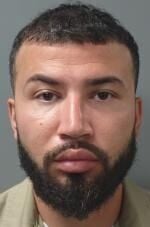
Majdal Elias
Last week, defense attorney Carlos Monzon pointed to June ruling in Chatrie v. United States in which the country's highest court found that people have a reasonable expectation of privacy regarding information about their cellphone’s location.
The case involved a "geofence warrant" that law enforcement in Virginia used to solve a bank robbery in 2019.
In the majority opinion, Justice Elena Kagan said in recent years, officers have employed such warrants to get the information technology companies collect about their users’ cellphone locations.
People are also reading…
"Suppose that investigators know a crime was committed at a particular place and time, but do not have a suspect. They may draw a 'geofence' — a virtual perimeter — around the crime scene and get a warrant compelling a company to hand over data about the cellphones located in that area near the time of the crime," she wrote.
The question was whether police had conducted a Fourth Amendment search to get it.
The U.S. Supreme Court concluded that they had.
"An individual has a reasonable expectation of privacy in records about his cellphone’s location, and police intrude on that constitutionally protected interest when they demand the information — even though for only a limited time, and from a third-party tech company," Kagan said.
Monzon told the Nebraska Supreme Court that the Chatrie case was less egregious than Elias' case because law enforcement in the Virginia case had a warrant.
"In this case they did not have a warrant," he said.
Though, they did have a court order, he acknowledged.

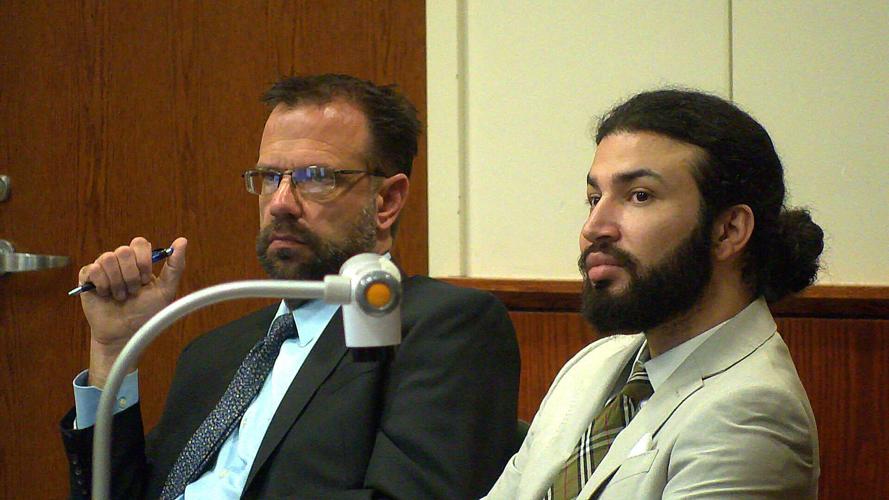
Defense attorney Chad Wythers (left) and defendant Majdal Elias listen to closing arguments in his murder trial in April 2022.
Monzon said Elias' trial counsel prior to trial had sought to keep the information obtained from a so-called "tower dump" from going before the jury but didn't object when the evidence ultimately was introduced at trial.
When the Fourth Amendment issue came up on his direct appeal, the Nebraska Supreme Court affirmed.
"I believe at that point, the court did not believe that there was an expectation of privacy. And the United States Supreme Court now says you do have an expectation of privacy," Monzon said.
Justice John Freudenberg said they also relied on a second ground, the "good faith" exception because the law enforcement officer would not have been aware of this limitation at the time.
"If there was a 'good faith' exception for the officers wouldn't that also apply to the novelty of the argument to the counsel at the time?" Freudenberg asked.
Monzon said it's very clear this wasn't about phone calls. In the request to Google, Lincoln Police asked for phone location data specifically of Alltel customers in a 9-mile radius from the center of Lincoln.
"That means my office. That means your house," he said. "That means almost all of Lincoln."
Monzon said police obtained location information for 20,000 cellphones and streamlined it down. This was a case with no DNA evidence and no gun, he said.
"Pretty much what they're trying to do is put Mr. Elias in the area by obviating the rest of it," Monzon said, like the customers of other phone carriers.
Justice Jonathan Papik asked what trial counsel had done that was ineffective.
"That's what we're here on, right?" he asked.
Monzon said they don't even have to reach that issue. Instead, he asked the court to remand the case to district court to review whether the geo-data evidence that was presented at trial without objection should have been admissible.
"Chatrie makes it very clear. Mr. Elias had an expectation of privacy. And this is perhaps barbarous, egregious. No warrant," Monzon said.
And the 20,000 cellphone users got no notification, he said.
But Papik perhaps cut to heart of the matter when he asked, toward the end of Monzon's time: "Does Chatrie apply retroactively?"
He argued he believes it does. Because what is an expectation of privacy today was an expectation of privacy then, too.
Assistant Nebraska Attorney General Austin Relph spoke briefly, saying the U.S. Supreme Court didn't say Chatrie was to be retroactive and it didn't qualify under the watershed rule.
"The Chatrie case, I don't know how it would apply," he said. "The case here was long final."
He said the court addressed the Fourth Amendment claim on direct appeal and had found no merit in it, concluding that the tower dump had not qualified as a search and that, even if it rose to a constitutional issue, the officers had acted in good faith.
"The Fourth Amendment claim was addressed, dealt with, was final. It would be procedurally barred, assuming that he's making an iteration of that claim now," Relph said.
On Sept. 29, 2019, Ali Al-Burkat was just days from his 16th birthday when he was shot while riding in the back seat of a Chevy Malibu on the northwest edge of town.
At trial, prosecutors described a fateful case of bad timing and a missed turn. They said the four young men in the Malibu had been part of a plot to rob another drug dealer who lived in an apartment on the other side of The Links that night. But the driver, his face partially covered with a T-shirt, missed a turn and ended up circling the complex, which is when an SUV ended up behind them.
The state said the driver was Elias, in his silver Ford Explorer, who must have seen them and thought they were there to rob him. It led to a confrontation where, prosecutors said, Elias pulled up beside them and said: "You're busted," then started firing.
One of the shots into the Malibu's trunk struck Al-Burkat in the back, quickly killing him.
Elias — at trial and sentencing in 2022 — denied he was the shooter and said he felt as if the burden of proof was on him to prove his innocence.
"Yes, I was a drug dealer," he said at sentencing. "Do you want me to say it again? I was a drug dealer. But that does not mean I'm a killer. That's it."
Police initially arrested Elias in connection to a search of his apartment at The Links a month after the killing, where they found a quarter-pound of cocaine, an AK-47-style rifle, a handgun, just less than a pound of marijuana and $25,000 in cash, and in a search of a relative's house across town found more of his drugs and guns.
Elias is serving a 19- to 33-year prison term on those charges.
Deputy Lancaster County Attorneys Jeff Mathers and Morgan Smith and defense attorney Chad Wythers make their closing arguments in the murder trial of Majdal Elias on Tuesday, April 12, 2022.
Tom Casady's list of the 10 most infamous crimes in Lincoln history
Crimes of the times
This is simply one man’s perspective from the early 21st century (first written in 2010). I had to make a decision about crimes that occurred at locations that are inside the city today, but were outside our corporate limits at the time they occurred. I chose the latter.
No. 1: Starkweather
The subject of several thinly disguised movie plots and a Springsteen album, the Starkweather murders are clearly the most infamous crime in Lincoln’s history — so far. One of the first mass murderers of the mass media age, six of Charles Starkweather’s 11 victims were killed inside the city of Lincoln, and the first was just on the outskirts of town. I didn’t live in Lincoln at the time, but my wife was a first-grader at Riley Elementary School and has vivid memories of the city gripped by fear in the days between the discovery of the Bartlett murders and Starkweather’s capture in Wyoming.
No. 2: Lincoln National Bank
On the morning of Sept. 17, 1930, a dark blue Buick carrying six men pulled up in front of the Lincoln National Bank at the northwest corner of 12th and O streets. Five of the men entered the bank, while a sixth stood outside by the Buick, cradling a machine gun. Observing the unusual events, a passerby called the police. The officer who responded, Forrest Shappaugh, was casually instructed by the machine-gun-toting lookout to just keep going, which he wisely did. Returning with reinforcements, he found that the robbers had already made good on their getaway, netting $2.7 million in cash and negotiable securities.
No. 3: The Last Posse
My first inkling about this crime came when I was the chief deputy sheriff. One of my interns, a young man named Ron Boden (who became a veteran deputy sheriff), had been doing some research on Lancaster County’s only known lynching, in 1884. I came across a reference in the biography of the sheriff at the time, Sam Melick, to the murder of the Nebraska Penitentiary warden and subsequent prison break. Melick had been appointed interim warden after the murder and instituted several reforms.
No. 4: Rock Island wreck
The Aug. 10, 1894, wreck of a Rock Island train on the southwest outskirts of Lincoln was almost lost in the mist of time until it was resurrected in the public consciousness by author Joel Williams, who came across the story while conducting research for his historical novel, "Barrelhouse Boys."
No. 5: Commonwealth
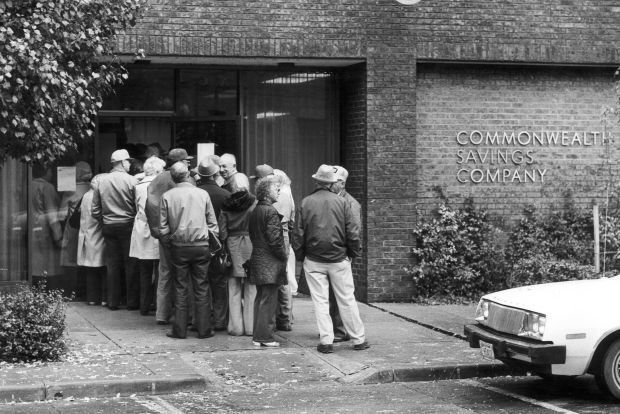
Depositors gather outside of Commonwealth Savings Co. after it was closed by the state Department of Banking in 1983.
On Nov. 1, 1983, the doors to Nebraska’s largest industrial savings and loan company were closed and Commonwealth was declared insolvent. The 6,700 depositors with $65 million at stake would never be fully compensated for their loss, ultimately receiving about 59 cents on the dollar for their deposits, which they all mistakenly believed were insured up to $30,000 through the Nebraska Depository Insurance Guaranty Corporation, which was essentially an insurance pool with assets of only $3 million.
The case dominated Nebraska news for months. The investigation ultimately led to the conviction of three members of the prominent Lincoln family that owned the institution, the resignation of the director of the State Department of Banking and the impeachment of the Nebraska attorney general and the suspension of his license to practice law. State and federal litigation arising from the failure of Commonwealth drug on for years.
No. 6: Candice Harms
Candi Harms never came home from visiting her boyfriend on Sept. 22, 1992. Her parents reported her as a missing person the following morning, and her car was found abandoned in a cornfield north of Lincoln later in the day. Weeks went by before her remains were found southeast of Lincoln.
No. 7: Jon Simpson and Jacob Surber

A parent’s worst nightmare unfolded in September 1975 when these two boys, ages 12 and 13, failed to return from the Nebraska State Fair. The boys were the victims of abduction and murder. The case was similar to a string of other murders of young boys in the Midwest, and many thought that these cases were related -- the work of a serial killer. Although an arrest was made in the case here in Lincoln, the charges were eventually dismissed. William Guatney was released and has since died.
No. 8: John Sheedy
Saloon and gambling house owner John Sheedy was killed outside his home at 1211 P St. in January 1891. The case of Sheedy, prominent in Lincoln’s demiworld, became the talk of the town when his wife, Mary, and her alleged lover and accomplice, Monday McFarland, were arrested. Both were acquitted at trial. The Sheedy murder is chronicled in a great interactive multimedia website, Gilded Age Plains City, an online version that builds upon an article published in 2001 by Timothy Mahoney of the University of Nebraska.

No. 9: Patricia McGarry and Catherine Brooks

The bodies of these two friends were found in a Northeast Lincoln duplex in August 1977. Their murderer, Robert E. Williams, was the subject of a massive Midwest manhunt during the following week. Before his capture, he committed a third murder in Sioux Rapids, Iowa, and raped, shot and left for dead a victim who survived in Minnesota. He is the last man to be executed in Nebraska, sent to the electric chair in 1997.
No. 10: Judge William M. Morning

District Court Judge William Morning was murdered in February 1924. He was shot on the bench by an unhappy litigant in a divorce case. His court reporter, Minor Bacon, was also shot, but a notebook in his breast pocket deflected the bullet and saved his life.
Many other crimes

Wesley Peery, shown in this May 1978 file photo, was identified as an early suspect in the Nancy Parker case. After he was convicted of killing Marianne Mitzner in a Havelock coin shop in 1975, he confessed to his attorney that he had killed about a dozen people, including Nancy Parker.
Choosing Lincoln's 10 most infamous crimes was a challenge. Although the top two were easy, the picture quickly became clouded. We tend, of course, to forget our history rather quickly. Many of the crimes I felt were among the most significant are barely remembered today, if not completely forgotten.
Some readers will take issue with my list. In choosing 10, here are the others I considered, in no particular order. They are all murders:
Reach the writer at 402-473-7237 or lpilger@journalstar.com.
On Twitter @LJSpilger and Bluesky @ljspilger.bsky.social