
When John Kyndt arrived at Bellevue University 13 years ago he was greeted by a less-than-inspiring science lab.
His view? That was almost a brick wall of weeds, he says.
Since then, he and others in the College of Science and Technology have been transforming not just the lab space but the 67-acre campus. It has turned into a living classroom for sustainability with 20 acres of native plants grown on site.

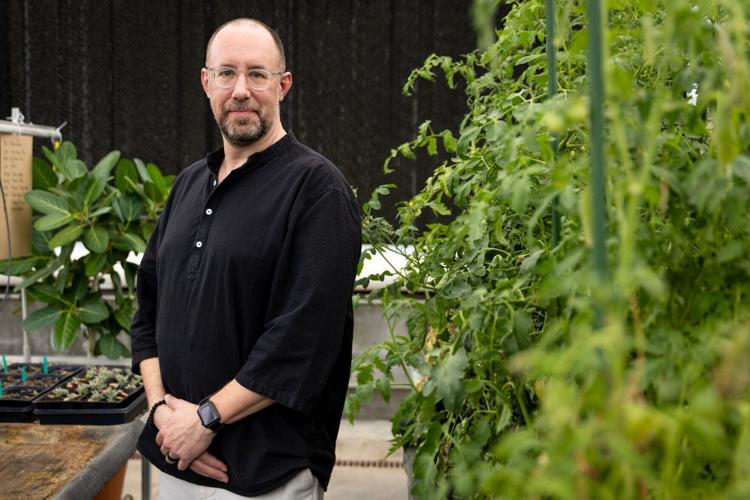
Professor John Kyndt in a greenhouse at Bellevue University. He leads students in hands-on soil research, and guides them as they identify which native plants thrive on campus.
“We wanted to have some biology outside as well,” said Kyndt, a microbiology professor who came to Bellevue from the University of Arizona. “Biology is the science of living things, so we have to go outside sometimes.”
The first lab, with its three rooms and dark hallway, in 2017 was turned into four state-of-the-art areas with large glass windows so people can see the science that students are doing inside.
People are also reading…
Two greenhouses form the sustainability lab, completed in 2019 to grow plants for research and use in the classroom. Soil research is also done here and in indoor labs. Students collect samples, study soil health and identify which native plants will thrive on campus.
Vegetables for the cafeteria are grown in another greenhouse.
Before 2017, because there wasn’t available laboratory space, there was no research capability. The school, with some donor funding, now attracts both local and international students. Majors in biology and sustainability management are offered.
“We have students to do inside and outside research,” Kyndt said. “It has opened up opportunities.”

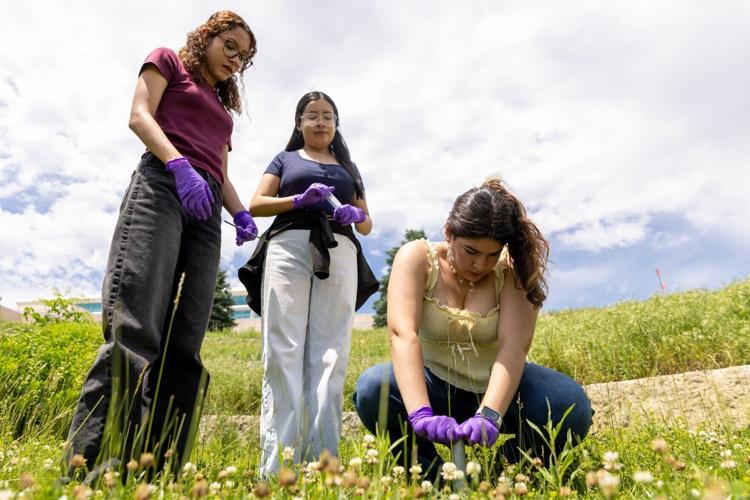
From left, Evelyne Aguirre, Genesis Gallegos and Maria Orta collect soil samples at Bellevue University. Majors in biology and sustainability management are offered.
Grants, like one from the Nebraska Environmental Trust that helped build the sustainability lab, and money from the school have funded the work, which has cost millions.
That brick wall of weeds, which sits behind what is now the sustainability lab, also underwent a renovation.
It’s now a hillside garden filled with native plants, all from the university.
“We grow the plants we use on campus, so we don’t have to purchase new plants every year,” Kyndt said. “We take seeds and grow them in our greenhouse.”
The school consulted with Mulhalls experts about which native plants would thrive on the campus. Benjamin Vogt of Monarch Gardens and Midwest Natives Nursery also helped with the selections.

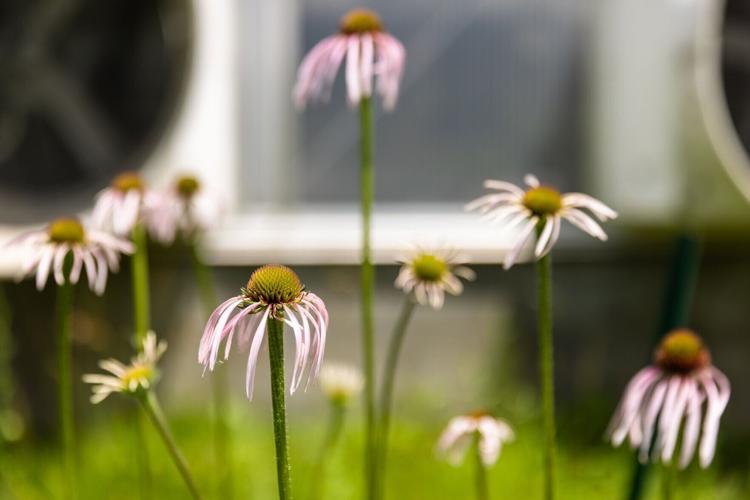
Flowers growing at Bellevue University. Twenty acres of the 67-acre campus are planted in native species and that number is growing.
There are flowers such as aromatic aster (Symphyotrichum oblongifolium), liatris (Liatris aspera), rosin weed (Silphium integrifolium), purple prairie clover (Dalea purpurea), purple poppy mallow (Callirhoe involucrata) and rattlesnake master (Eryngium yuccifolium). Native grasses include sideoats and blue grama and little bluestem.
The campus is in full bloom, but with less water and fertilizer required.
“The difference is the sustainability of it,” Kyndt said. “They are going to be deeply rooted and much better to prevent erosion.”
Secondary education student Mia Arnold, who is from the Scottsbluff area, is doing a fungi project with Kyndt, working with native plants in sequencing their genomes. A science endorsement is part of her degree.
She said she enjoys seeing the native plants on campus because it makes the area more welcoming and inviting.

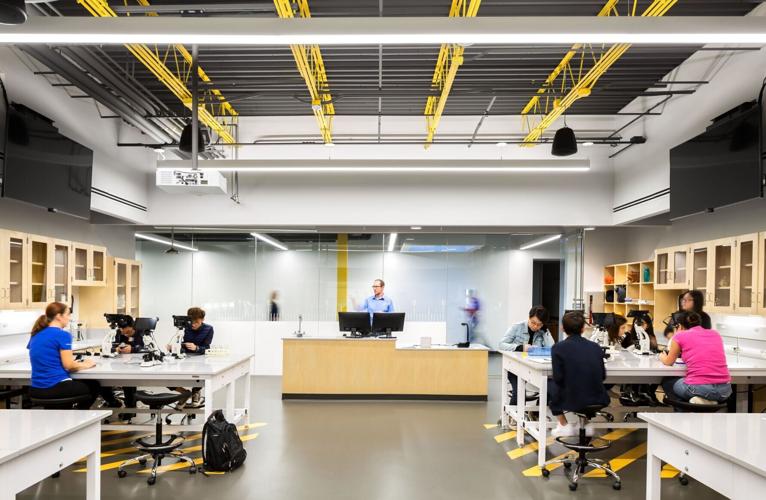
Microbiology teacher John Kyndt lectures in one of the natural science labs on Bellevue University’s campus.
“It’s interesting to see how many native plants there are in Nebraska just from the campus alone,” she said.
She’ll be seeing even more. Although there’s still regular grass turf on the campus, the native areas keep expanding.
Kyndt is thrilled with what has developed.
“Walking through the hallway in the lab and seeing the open lab spaces, that makes me happy and gives me a good feeling science is happening,” he said. “Seeing more pollinators, like birds and bees and stuff, and having the research of the soil, those are the two things that excite me most.”
Photos: Bellevue University is transforming it's 67-acre campus into a living classroom

John Kyndt, a professor at Bellevue University, stands for a portrait in a greenhouse at the university on Friday, June 5, 2026. Kyndt leads students in hands on soil research, and guides them as they identify which native plants thrive on campus.

Maria Orta, one John Kyndt’s students, collects a soil sample at Bellevue University in Bellevue on Friday, June 5, 2026 .

John Kyndt’s students collect soil samples at Bellevue University in Bellevue on Friday, June 5, 2026 .

Genesis Gallegos, left, and Maria Orta, who are John Kyndt’s students, collect soil samples at Bellevue University in Bellevue on Friday, June 5, 2026 .

Native plants are seen growing in a greenhouse at Bellevue University in Bellevue on Friday, June 5, 2026. Bellevue University is transforming its campus into outdoor classrooms, where students study soil health and sustainability, and identify which native plants thrive across campus. These plants will eventually be transplanted outdoors.

From left, Evelyne Aguirre, Genesis Gallegos, and Maria Orta, who are John Kyndt’s students, collect soil samples at Bellevue University in Bellevue on Friday, June 5, 2026 .

Flowers are seen growing at Bellevue University in Bellevue on Friday, June 5, 2026. Bellevue University is transforming its campus into outdoor classrooms, where students study soil health and sustainability, and identify which native plants thrive across campus.

Greenhouses are seen at Bellevue University in Bellevue on Friday, June 5, 2026. Bellevue University is transforming its campus into outdoor classrooms, where students study soil health and sustainability, and identify which native plants thrive across campus.

John Kyndt, a professor at Bellevue University, stands for a portrait in a greenhouse at the university on Friday, June 5, 2026. Kyndt leads students in hands on soil research, and guides them as they identify which native plants thrive on campus.

Native plants are seen growing in a greenhouse at Bellevue University in Bellevue on Friday, June 5, 2026. Bellevue University is transforming its campus into outdoor classrooms, where students study soil health and sustainability, and identify which native plants thrive across campus. These plants will eventually be transplanted outdoors.