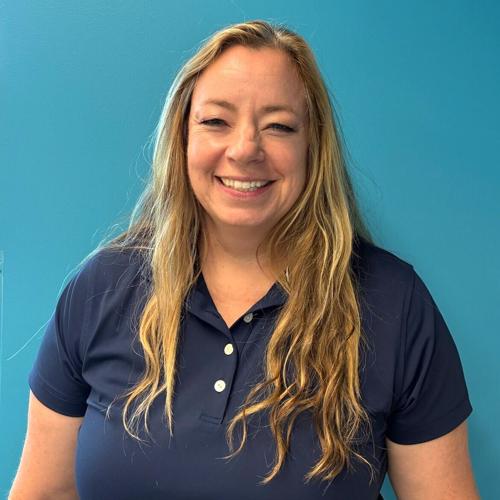





Twenty-five years after the Sept. 11 attacks, the memories of that day endure. Journal Star reporters reconnected with people who appeared in our coverage then to reflect on what they experienced and what has stayed with them.
Ground Zero 'will never escape my mind'
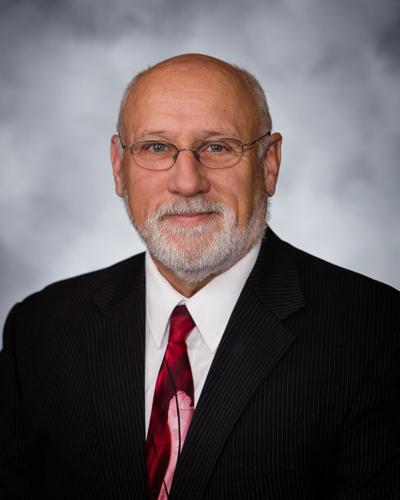
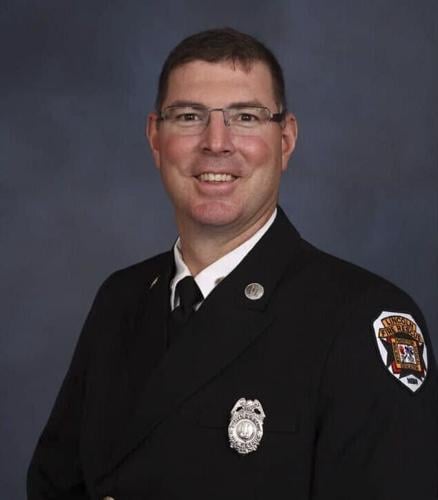
Lincoln Fire and Rescue's Mark Majors remembers the sadness, fear, anger and anxiety.
But eventually, the first responder side of him took over on Sept. 11, 2001.
“When a large incident happens… a lot of those emotions, they stay with you, but they kind of go to the wayside,” Majors said. “We want to be in the right place at the right time to just lend some assistance. If it’s handing out water, if it’s being part of a bucket line that we all watched, I think we all kind of had that anxiety, like, ‘Let’s go.’”
People are also reading…

Lincoln Fire and Rescue Battalion Chief Mark Majors
Just a year prior, Majors had joined the relatively new Nebraska Task Force 1 as a rescue specialist. In 2001, he completed the extensive 80-hour, hands-on structural collapse course.
Watching the TV that was no bigger than 27 inches, Majors couldn’t even begin to imagine what he would see when he arrived in New York City about 10 days later during his first deployment as a task force member.
“The size and the height and the width of the disaster of Ground Zero downtown was something that will never escape my mind,” Majors said. “Seeing it on TV, and then seeing it with your own eyes is two separate things.”
Majors was part of the second Nebraska Task Force 1 group that deployed to Ground Zero. By that point, rescues had turned to recovery efforts as first responders swarmed New York.
After arriving on a chartered plane, it took several hours for Majors to get through security checks and get credentialed. Every 12 hours, a new badge was issued to identify those allowed at Ground Zero.
“When all your first responders come in, it opens it up as the possibility for another target,” Majors said. “It was all new to me.”
Eventually, Majors remembered loading into a bus heading to Lower Manhattan.
“There was one sign that said, ‘New York City: Closed.’ As we’re getting closer to some of the bridges, 'Lower Manhattan is closed,'" Majors said. “It was really surreal to kind of see things like that.”
The first responders were split into two 12-hour shifts with Majors focusing on logistical work during the day.
His experiences in New York City have encouraged Majors to become even more involved in the task force program.
He now works as a battalion chief for Lincoln Fire and Rescue, and continues to deploy with the task force as a team manager and task force leader, and individually as an incident support team member.
“It has opened so many doors for not only myself, but a lot of the other team members on the team and fire department members,” Majors said. “After 9/11, we had to worry about some different hazmats. ... So there was a lot of curriculum to be taught.”
— Alyssa Johnson
Airport scrambled into action
Bob McNally was essentially on his own that day.
Other Lincoln Airport executives were in Canada for a conference, leaving McNally, the airport's director of operations, by himself.
Then a plane hit the World Trade Center’s North Tower.
“Then the second (plane) hit,” he said. “It became immediately apparent: This was not an accident.”
McNally said the airport quickly got word airplanes would be diverted to land at the Lincoln Airport — about five in total, which would never complete their routes. One of those flights was United Airlines Flight 91, flying the same route as the hijacked United Airlines Flight 93, which crashed into a field in Pennsylvania.
Some passengers on United Airlines 91 were supposed to be on 93 — or had friends who were — leaving many people distraught, McNally said.

McNally
Once the chaos died down and it became apparent flights would be grounded for the foreseeable future, hundreds of stranded travelers rushed to find a place to stay, setting up at hotels and university housing with help from Lincoln-Lancaster County Emergency Management. Many rented cars, which disappeared in a hurry.
“They wanted to get home,” McNally said.
In the immediate aftermath, the airport was quiet, with the occasional visit from those hopeful flights had returned.
And after a week they finally did, but with fully armed military personnel roaming terminals and inspections of every car within a 300-yard radius of the airport — even those just dropping off or picking up passengers.
McNally said stress levels were visible on the faces of passengers, many of whom had a great deal of fear another attack could happen.
“It was hard,” McNally said. “Folks did not know what was going to happen.”
— Tomer Ronen
Answering the call
Long before Sept. 11, 2001, John Huff had a letter on his desk from the Nebraska Emergency Management Agency.
The letter was intended to gauge Lincoln Fire and Rescue's interest in joining a national disaster response program, essentially a precursor to the modern-day Nebraska Task Force urban-rescue team.
Huff, then an assistant chief, was intrigued — and so were others.
Eventually, he signed up along with a third of the nearly 280 LFR firefighters at the time.
After filling out a lengthy application, the regional task force was created in 1993, sponsored by Lincoln Fire and Rescue. It responded to natural disasters like hurricanes.
Then came 9/11. The Federal Emergency Management Agency activated the group, which quickly went to the East Coast.
“They used pagers back then, and the page said the Red IST is activated for the Pentagon, the blue team to World Trade Center. Do not call back,” Huff said. “That’s the page that I got that activated me: do not call back from FEMA.”
Thinking the page was strange, Huff called back.
He told the office staff he was going to head out with another firefighter. They would arrive at the Pentagon on Sept. 12 sometime.
“Yeah, OK, whatever,” was the response back.
“There was no conversation, there was no anything,” Huff said. “I didn’t realize in Washington planes were falling out of the sky. Every federal employee was told, ‘Go home, get out of here, evacuate.’”
On Sept. 12, he arrived to see a column of smoke rising before the sun was even shining. As they drove within 100 feet of the building, he saw the Pentagon burning.
Helping among the local fire departments and task forces, Huff remembered getting confused looks as others asked why firefighters from Nebraska were in Washington, D.C.
Huff had a short answer; he got a call and he answered it.
Looking back, Huff understands the strange communication following the devastating disaster.
Later, Huff was named chief, and until his retirement in 2015, he continued to rely on those 10 days of search, rescue and recovery at the Pentagon to help train new task force members as they prepared for disasters across the country.
— Alyssa Johnson
'We were glued'
Colleen Ogden turned on CNN during her first-period ninth-grade civics class at Lincoln East.
Her class would tune in to catch up on the day's current news events.

Colleen Ogden, retired Lincoln East teacher.
At the time, news outlets started reporting that a plane crashed into the World Trade Center’s north tower. Ogden thought it might have been an accident. Minutes later, the attacks would continue.
“We were watching when the second plane hit, and we just kept watching the news,” she said.
The now-retired educator started writing down the events of the Sept. 11 attacks as they were unfolding. For the most part, the only noise from her class came from the TV.
“We were glued,” she said.
As the day went on, other students came into Ogden’s classroom to keep up with what was happening.
“You could see the fear in these kids who would come in and want to know what was going on.”

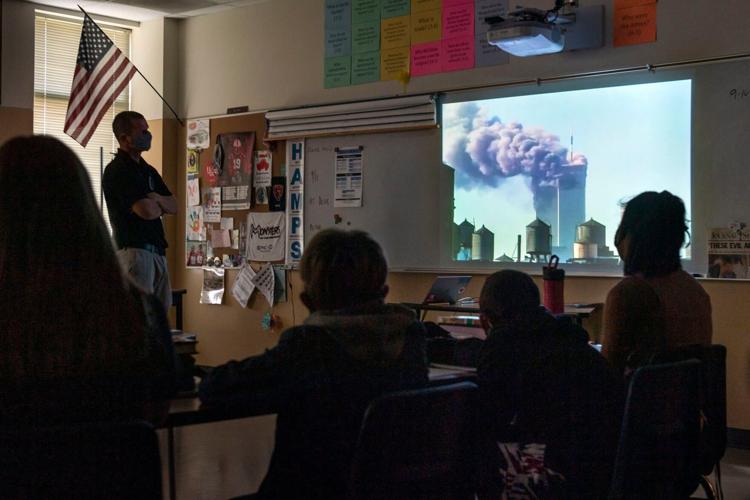
Seventh grade history teacher Mike Hix leads a lesson on 9/11 at Schoo Middle School in 2021. Hix, along with fellow teacher Cody Thatcher, were nationally recognized in 2019 for their lesson on 9/11.
She remembers a couple of students started arguing with other teachers who insisted on sticking to their lesson plans for the day.
“I couldn’t believe some teachers weren’t allowing kids to watch what was going on,” she recalled.
For the rest of the year, the aftermath of the attacks often was part of her civics class.
“One of the most impactful things for some of my kids is when the government started talking about how do we compensate families who died in 9/11,” she said. “What is a life worth?”
Congress established the September 11th Victim Compensation Fund after the attacks and has since awarded nearly $24 billion.
A week after the attacks, then-U.S. Sen. Chuck Hagel visited her class before telling the roughly 1,500 Lincoln East students that their generation will be challenged to overcome the scourge of terrorism.
“Each generation has left this country stronger and better than they found it,” Hagel said. “No generation has failed that destiny. So, too, will it be your challenge.”
— Justin Diep
Closing the distance
Judi Wittwer carried a globe into a kindergarten classroom at Zeman Elementary School on Sept. 11, 2001.
After the Twin Towers collapsed, the school counselor knew she needed to prepare students for the conversations they might be exposed to after the final school bell that Tuesday 25 years ago.
She placed the tip of her finger on New York City and told the group of 5-year-olds there were some things happening in their country that “we were a distance from.”
But that distance quickly became only geographic.
Zeman Elementary had a sizable group of refugee students, and Wittwer remembers worrying they would experience retaliation. A conversation with a second grade girl from Afghanistan sticks out in her memory.
“She looked up at me with those big brown eyes and wavy hair framing her face and said, ‘Mrs. Wittwer, I don't want America to bomb my country ... It has beautiful mountains and hills.’”

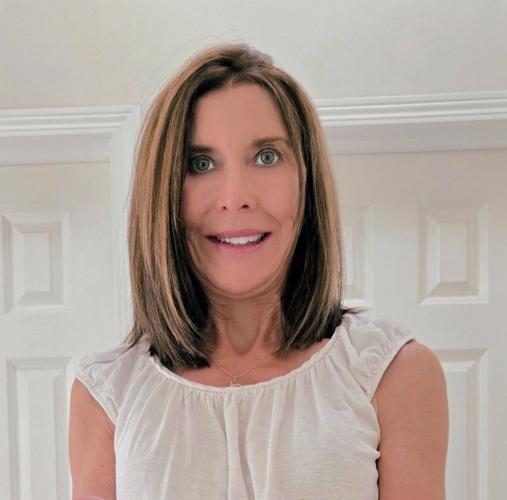
Judi Wittwer, former school counselor at Zeman Elementary.
U.S. military involvement in Afghanistan would later become the longest war in American history.
“It was hard for me not to say, ‘Oh, honey, that's not going to happen,’” Wittwer said. “I just tried to listen and say that I understood her concern.”
Wittwer continued to look out for the refugee students as the months went on. But time began to do what time seems to do, she said.
“Life resumed some normalcy — and that's the beauty of childhood.”
As the country healed from the attacks, Wittwer continued to watch friendships at Zeman span ethnicities and languages.
“It's a great way to fight bigotry and racism,” she said. “Those children grow up with one another and know that person, who maybe looks different from me, has the same needs to play and laugh and joke and kick a soccer ball.”
— Livia Ziskey
Reporter witnessed attacks firsthand
Where was Erin Schulte when the first plane hit?
She had just clocked in across the street.
"I had walked through the World Trade Center after coming up out of the subway that morning," Schulte said.
Schulte, a University of Nebraska-Lincoln alum and native of Canton, South Dakota, began her career at the Daily Nebraskan and the Journal Star's obituary desk. In 2001, at the age of 26, she occupied an enviable position reporting on finance for the Wall Street Journal's WSJ.com online vertical.

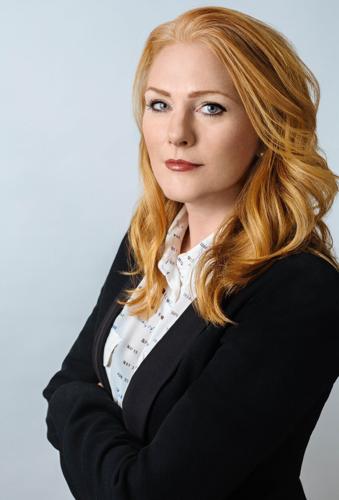
Erin Schulte, 51, is a senior editor at Inside Climate News and University of Nebraska-Lincoln alum who witnessed 9/11 personally.
"We had to be at the office really early because I would write a pre-market opening story," she said.
That morning, the newsroom was abuzz about the accident over at WTC 1. By the afternoon, she was counting human bodies as they fell from the upper floors of both towers.
It haunts her to this day — but she had a job to do.
"I don't remember whether someone tasked me with this or whether I think I just decided ... this was their last moment and to be a witness to that and say 'this happened'," Schulte said. "Which is, of course, kind of the main job of any journalist."
Schulte, now 51, said it also galvanized her as a transplant to the Big Apple. She witnessed New York's diverse population instantly turning to help one another the same way small towns on the Great Plains pride themselves on doing. Days after the attack, she penned a column in the Journal Star thanking Nebraskans for their support.
"When there is a crisis, New Yorkers come together," she said, noting that she saw a similar response during the early, deadliest days of the COVID-19 pandemic in 2020.
Today, as a senior editor at environmental publication Inside Climate News in Washington, her job has turned once again to the subject of man-made catastrophe.
"This is even a much bigger, more intractable, existential problem," she said.
In the wake of the pandemic and working knee-deep in climate news, Schulte isn't sure that America would react to such a tragedy the same way today.
But the effects of climate change come closer and closer to home daily. When it comes to global warming, does Schulte think that humanity can pull together the same way New York and the country did on Sept. 12?
"I mean, one can hope."
— James Hoyt
'Where do we go from here?'
On the morning of Sept. 11, 2001, Monica Manning did Tae Bo.
The cardio workout was trendy in the 1990s, often done while following a video of others doing the combination of taekwondo and boxing.

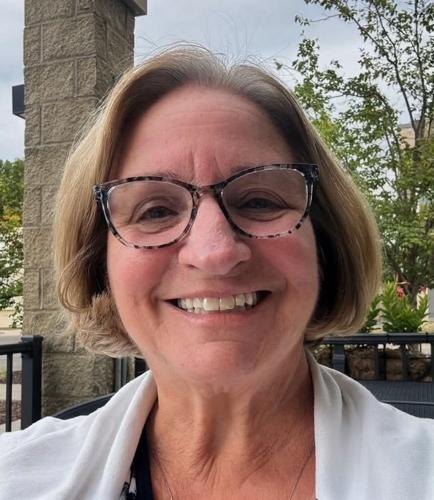
Monica Manning
"It was a VHS tape, and so I was doing that in my apartment that morning," Manning said. "I had to stop it and rewound it and turn my TV on to 'The Today Show.' Here was Katie Couric and Matt Lauer sitting at the desk talking about this airplane."
At the time, Manning was a 24-year-old Lincoln Parks and Recreation employee working after-school programs at Calvert Recreation Center. Manning celebrated her 25th anniversary with the city in March and now is a Parks and Recreation athletics supervisor.
In a Journal Star story published on Sept. 12, Manning said she had turned the TV on expecting to watch a morning show and instead saw buildings on fire, smoke everywhere and people screaming. She had a hard time fathoming what she was watching.
"I just always hoped I would never have to live through any kind of war," she said that day.
She didn't immediately remember talking to the Journal Star, but she did feel a "whole rush" of feelings thinking about the attacks 25 years later.
"I ended up having all of those old memories of how I felt that day, where everything was so dark and heavy, and all the disbelief that was circling," Manning said. "It's a lot of feeling lots of uncertainty at the time too. What does all this mean? Where do we go from here? What's going to happen next?"
People were worried there'd be more attacks, Manning said, and in Nebraska, potential targets were thought to be the railroads or Offutt Air Force Base.
One positive thing from the day was it brought the country together, Manning said. She said she saw the unity in all the flags that were on display and the patriotic hit songs that came out after.
— Peter Breen
Governor was surveying tornado damage
Mike Johanns, who served as Nebraska's governor from 1999 to 2005, was in the small town of Jackson looking at tornado damage when he received news that a plane had flown into the World Trade Center's North Tower.
"My first reaction was that it must have been a very foggy day. Some private pilot lost their way and ended up running into the World Trade Center. My first thought was not about terrorism," he said.
When the South Tower was hit and it became clear that this wasn't an accident, Johanns said his schedule for the day "completely went out the window" and his total focus was shifted to responding to the Sept. 11 attacks.
"The first thing we did was activate the National Guard so we would have them at the airport because there really wasn't a security system in place for flying," Johanns said. "We did whatever we could do to support the president."
President George W. Bush arrived in Nebraska at Offutt Air Force Base near Bellevue traveling aboard Air Force One shortly after the attacks. At Offutt, he met with Vice President Dick Cheney and national security advisers via secure videoconference from the base's underground command bunker.
Johanns said remembering 9/11 also means remembering the U.S. soldiers who fought in the Afghanistan and Iraq wars that followed.
"It's cliche, but freedom is never free. There are people who have given so much to keep us free," he said, recalling the number of going-away events he attended and calls he made personally to families in Nebraska who had lost loved ones serving in the Middle East.
For those who weren't alive in 2001, Johanns said it is important to remember 9/11 because "it could easily come back."
"I wish I could tell you, 'Don't worry, it's not ever going to be a problem during your lifetime.' But I think one of the things we learned when we found out what 9/11 was all about, was how easily this occurred," he said. "It's just unbelievable how one act of terrorism on that one day changed our world."
— Anna Kleiber
A sobering gameday
In the hours after the 9/11 attacks, Butch Hug and other Nebraska athletics staffers worked the phone lines.
They discussed security measures and planned myriad scenarios for when and how Nebraska’s game against Rice, originally scheduled for Saturday, Sept. 15, 2001, could be played.
Eventually, word came from the Big 12 Conference that the contest would move to Thursday, Sept. 20 — a date that required a quick turnaround to pull off.
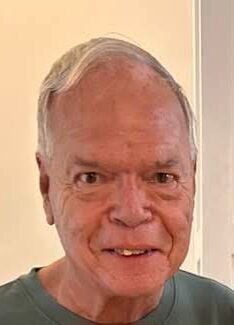
Butch Hug
“It didn’t take many phone calls to get people involved,” Hug said. “We’d ask, ‘Would you help us do this?’ And it was always, ‘Yes,’ because people really responded.”
In his role as Nebraska’s assistant athletic director for events, Hug had to mobilize over 2,000 gameday support staffers in areas such as ticketing, concessions, parking, medical personnel and law enforcement.
“We said we were going to do this, and there wasn’t anything like, ‘Oh, I don’t know if I can do this,’” Hug said. “It was just a (united) response where everybody did their part.”
The day of the Rice game is one that’s etched into the memory of Hug and many others.
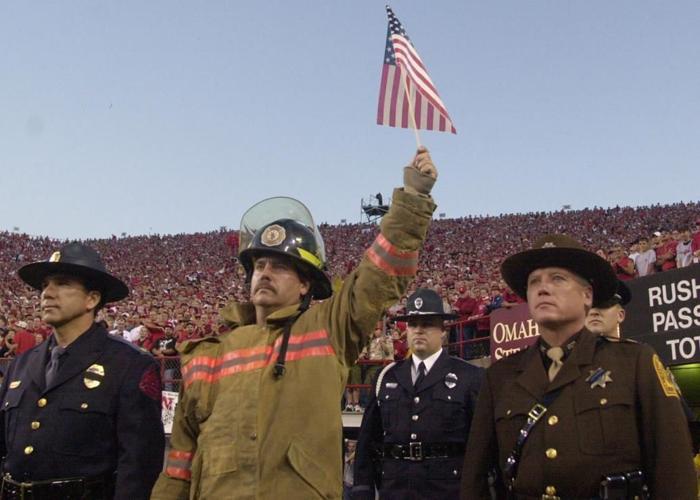
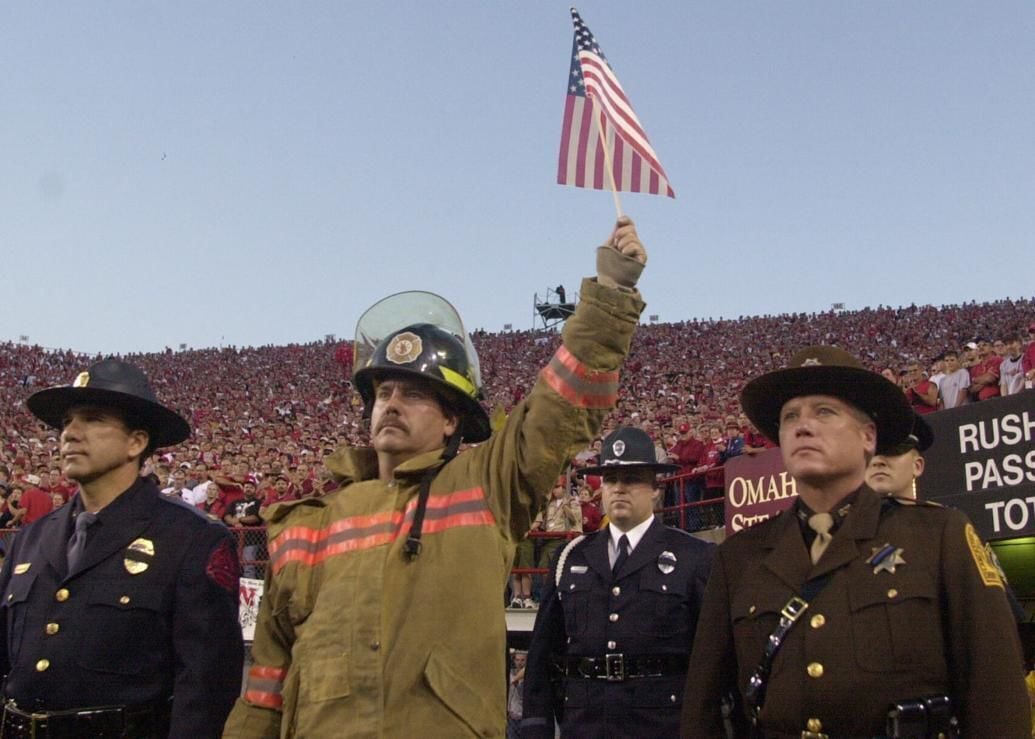
Volunteers raised money for victims of the attack outside Memorial Stadium, where an eerily quiet and introspective atmosphere surrounded the buildup to the game.

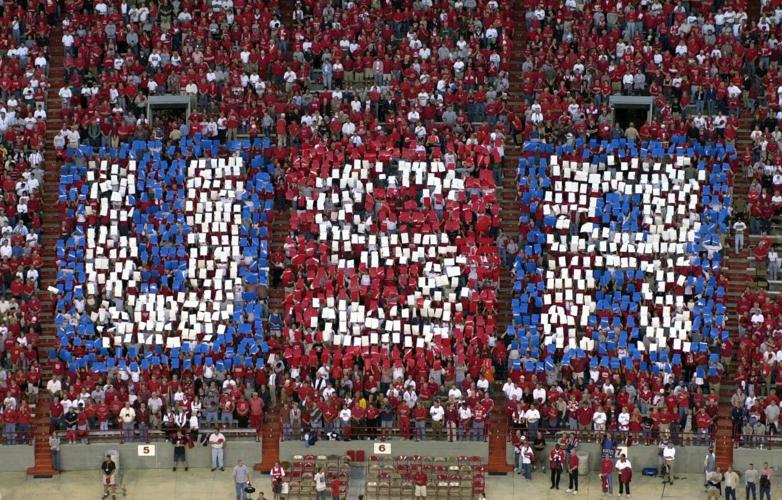
Husker football fans at Memorial Stadium use cards to flash "USA" before the Nebraska-Rice game on Sept. 20, 2001.
That changed when several law enforcement and fire department members emerged for the Tunnel Walk, producing a roar from the Husker crowd.
Nebraska took care of business on the field, where it put together a 48-3 win over Rice that served as much more than a regular Husker football game.
“It was Nebraska’s opportunity to get people’s feelings and minds away from the crisis that had occurred,” Hug said.
— Luke Mullin
9/11 at 25: Looking back through the Journal Star's pages

Page 1 of a Lincoln Journal Star Extra Edition published Tuesday, Sept. 11, 2001.

Page 3 of a Lincoln Journal Star Extra Edition published Tuesday, Sept. 11, 2001.

Page 5 of a Lincoln Journal Star Extra Edition published Tuesday, Sept. 11, 2001.

Page 6 of a Lincoln Journal Star Extra Edition for 9/11 from Tuesday, Sept. 11, 2001.

Page 1 of the Lincoln Journal Star on Wednesday, Sept. 12, 2001.

Page 1 of the Lincoln Journal Star on Thursday, Sept. 13, 2001.

Page 1 of the Lincoln Journal Star on Friday, Sept. 14, 2001.

Page 1 of the Lincoln Journal Star on Sunday, Sept. 16, 2001.

Page 1 of the Lincoln Journal Star on Monday, Sept. 17, 2001.

Page 1 of the Lincoln Journal Star on Tuesday, Sept. 18, 2001.

Husker Extra on Friday, Sept. 21, after the Nebraska-Rice game.

Page B1 of a 9/11 10-year-anniversary Lincoln Journal Star edition on Sunday, Sept. 11, 2011.

Page B2 of a 9/11 10-year-anniversary Lincoln Journal Star edition on Sunday, Sept. 11, 2011.

Page B3 of a 9/11 10-year-anniversary Lincoln Journal Star edition on Sunday, Sept. 11, 2011.

Page B4 of a 9/11 10-year-anniversary Lincoln Journal Star edition on Sunday, Sept. 11, 2011.

Page B5 of a 9/11 10-year-anniversary Lincoln Journal Star edition on Sunday, Sept. 11, 2011.

Page B6 of a 9/11 10-year-anniversary Lincoln Journal Star edition on Sunday, Sept. 11, 2011.

Page B7 of a 9/11 10-year-anniversary Lincoln Journal Star edition on Sunday, Sept. 11, 2011.

Page B8 of a 9/11 10-year-anniversary Lincoln Journal Star edition on Sunday, Sept. 11, 2011.

Page B11 of a 9/11 10-year-anniversary Lincoln Journal Star edition on Sunday, Sept. 11, 2011.

Page B12 of a 9/11 10-year-anniversary Lincoln Journal Star edition on Sunday, Sept. 11, 2011.

Page B13 of a 9/11 10-year-anniversary Lincoln Journal Star edition on Sunday, Sept. 11, 2011.

Page B14 of a 9/11 10-year-anniversary Lincoln Journal Star edition on Sunday, Sept. 11, 2011.