




Henry Fonda, manager of Omaha’s first nightclub.
'Tis true, among other details of Fonda's formative years, about the most acclaimed actor who’s a graduate of an Omaha high school.

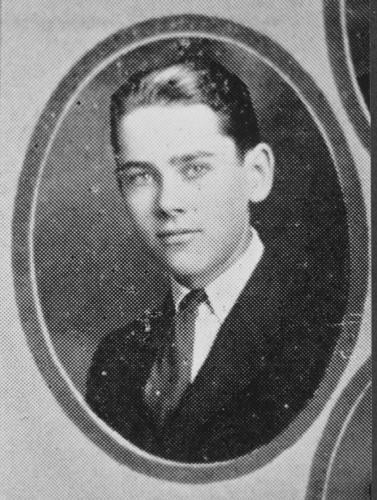
Henry Fonda's 1923 senior class photo in Central High's yearbook
No offense to his birthplace, Grand Island, but Fonda should be known as an Omahan first and foremost.
The Oscar winner’s grandparents and parents were Omahans who ran in society circles. His maternal grandfather, Henry Silas Jaynes (1848-1921), an executive of the Chicago, St. Paul & Omaha railroad, is the namesake of Jaynes Street north of Dodge.
William Brace Fonda and his wife, the former Herberta Jaynes, were married in Omaha in June 1903. They moved to Grand Island for his career in May 1904. Henry was born May 16, 1905, and the Fondas moved back to Omaha in March 1906, as William joined the family business of advertising novelties.
People are also reading…
Thus, for all but the first 10 months of his life until leaving the city for good in 1930, Henry Fonda was an Omahan.
The Fondas lived at 4107 Lafayette St. in 1906, then moved to 4709 Cass St. in Dec. 1907.
“Without the straps I’d have mishaps,” was an answer attributed to Henry in a March 1908 Omaha Daily News quip contest, “What would you do if the streetcar company did not furnish straps?”
Already, he had a ghostwriter. Henry wasn’t even 3.
His first stage role was at 5. He was a “candy doll” in the cast of “Toy Shop” at the Brandeis Theater in May 1910. The children’s operetta was a benefit for the Child Saving Institute. Many of Omaha’s elite, such as the Cudahys, Kountzes, Millards and Paxtons, had children in the cast.
That year, his mother woke up 5-year-old Henry. “Don’t let the girls (he had two younger sisters) hear us. They’re too young to be interested and Father works too hard to lose his sleep,” she said, leading him to a window.
“Remember this … Hailey’s comet,’’ she told him. “It comes around only once every 76 years. Seventy-six years is a long time. I didn’t want you to miss such a sight. Now you’ll always remember it,’” recounted Fonda in his 1981 autobiography, “Fonda: My Life.”
He did. Same for the Easter tornado of 1913 and, as a 14-year-old standing with his father near the Douglas County Courthouse, the 1919 lynching of Will Brown.
Henry attended kindergarten at Saunders School. Most of the primary grades were at Dundee School while the family lived at 5108 (originally 5106) California St. from September 1911 to March 1917.
The remainder of sixth grade and all of seventh grade were at Saratoga School while the family rented a house at 5616 Florence Boulevard (one block north of Jaynes Street, coincidentally). Eighth grade was back at Saunders as the family rented at 433 N. 39th St., north of Joslyn Castle.
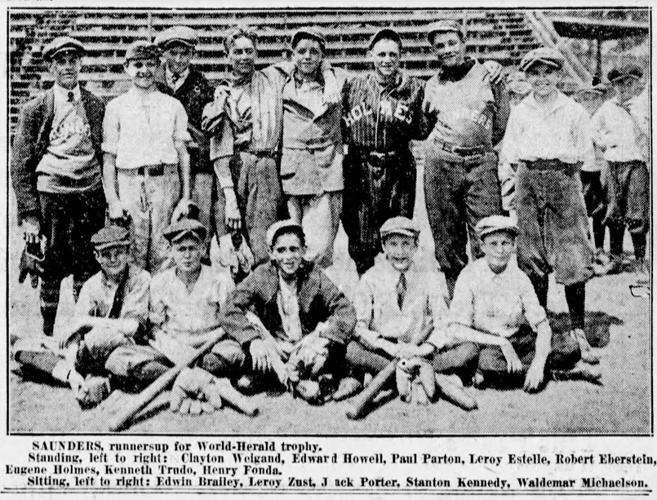
Henry was a drum corps member in the Boy Scouts, which he supported into adulthood. He managed and was a utility player on the Saunders baseball team.
At Central, he achieved the rank of second lieutenant in the school cadet corps. Beyond that, his school extracurricular activities were few before graduation in 1923. He was working odd jobs, including a 3-to-11 shift at Northwestern Bell Telephone.
“Henry has great ability in art. He can detect a good picture or a pretty girl with no trouble at all,” was his senior quote in the school yearbook.

Henry Fonda, back row at far right, managed and played for the 1919 Saunders School team that was city runner-up.
Hoping to land a full-time job with Northwestern Bell in Minneapolis, Fonda attended the University of Minnesota for two years studying journalism and working as a cartoonist for the school daily. He was among those who pinch-hit drawing Barney Google comic strips (his appeared Feb. 23, 1925) for the Minneapolis Tribune while cartoonist Billy DeBeck was ill.
He flunked out, attributing it to exhaustion from his job at a community center in north Minneapolis.
“Every night I’d fall asleep over my books, dead tired,’’ he recalled for his book. “At the end of my sophomore year I was so exhausted that when they passed out the blue books for the final exams, I just sat in class and drew pictures instead of answering the questions.”
Fonda came home to 4907 (or 4911) Chicago St., where the family had moved in 1920. Mortgage records show his parents owned two lots.
Much has been written about his entry into show business, starting with Marlon Brando’s mother, Dorothy, encouraging him to read for a part at the new Omaha Community Playhouse in 1925.
From his 1981 book: “I was lying around the house when my mother came in and asked, ‘Do me a favor, Henry. Do Brando’s on the line. Just listen to her.”
His audition for the role of Ricky in “You and I” was with the Playhouse’s original director, Gregory Foley, at the Aquila Court Apartments.
“Henry Fonda does well in the juvenile (read: young actor) role,” World-Herald critic Keene Abbott said of the opening night performance at the Mary F. Cooper Studio theater, 4016 Farnam St.
It landed him a paying role as John Hay, Abraham Lincoln’s private secretary, in George Billings’ “Memories of Lincoln” two-man show that traveled Iowa and Illinois in early 1926.
It hooked him with drama. He said he became “totally involved” in stagecraft at the playhouse, once borrowing a station wagon to pick up a couch for a prop. He was stage director set designer for “In Araby,” in spring 1926.

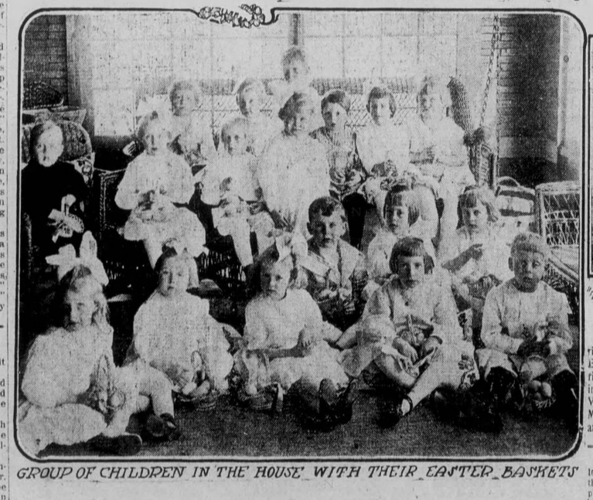
Henry Fonda, seated in middle of the photo, attended an Easter party in 1911 with his kindergarten class at the Paxton home in Fairacres.
It didn’t pay the bills. He went to work as a clerk at the Retail Credit Company, starting at $30 for a 55-hour week. He also was selling hand-painted chiffon scarves.
Fonda’s first star turn was the title role in “Merton of the Movies,” which opened the 1926-27 Playhouse season. He told the Central High Register school paper that acting was still a hobby and not his future profession.
“Why wish for Glenn Hunter, the original Merton of stage and screen to come to Omaha? Why ask for Glenn, when Henry Fonda is with us to portray Henry Leon Wilson's famous Simsbury Sheik who thought he would uplift the drama, but discovers he has a ‘low comedy’ face and a gift for imitation that kids hokum actors until the audience wriggles with laughter out of their seats, the Omaha Daily News reviewer wrote. “A deaf person could follow this play. It's all told in Henry's face.”
At the close of the season, Fonda and Hunter Scott, a grandson of pioneer Omahan N.P. Dodge, turned the Cooper studio into Omaha’s first nightclub, Club Trocadero, open on Friday and Monday nights only. Fonda and Ted Sherdeman, pianist for the “Gigolo” house orchestra, wrote several original songs for the club’s June 24, 1927, invite-only opening. The décor was of an Italian festival scene.
Club Trocadero was ahead of its time. Its doors closed in less than two months.
Foley added to Fonda’s responsibilities for 1927-28, naming him assistant director for a $500 stipend. He acted in some plays and in another helped direct his father, ironically once strongly against his son pursuing show business, in a lead role.
The summer of 1928 was Fonda’s big break. He successfully auditioned for the Cape Playhouse in Massachusetts, performing alongside the likes of Broadway actors Peggy Wood (Mother Abbess, “The Sound of Music”) and Laura Hope Crews (Aunt Pittypat, “Gone with the Wind”), and did more summer stock with the University Players of Falmouth, Massachusetts.
Fonda honed his craft in repertory theater on the East Coast the next few years, appearing on Broadway for the first time in a walk-on role in 1929’s “The Game of Love and Death.” It ran six weeks. While living meagerly in New York, often unable to come up with the nickel subway fare, Fonda took on an actor roommate in 1932.
Jimmy Stewart. Theirs was a lifelong friendship, rooming together in Hollywood once Stewart got there until Fonda married the second of his five wives.
During his last extended stay in Omaha, two months in 1930, Fonda received a union waiver to perform in Barrie’s “A Kiss for Cinderella.” He designed the play’s set and helped new Playhouse director Bernard Szold pick the co-star, 13-year-old Dorothy McGuire, starting her award-winning acting career.

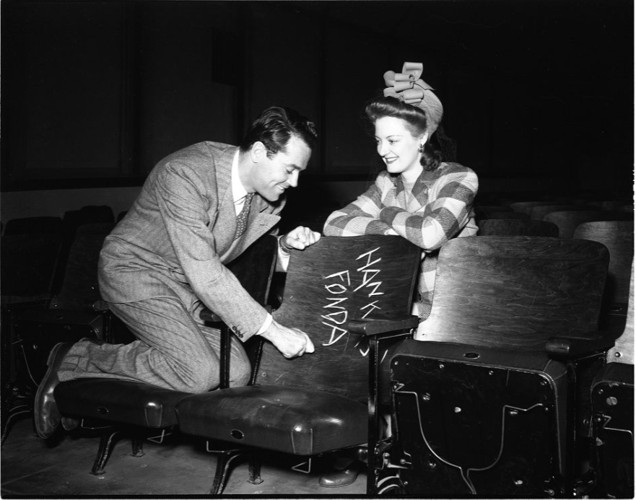
Joy Doorly watches Henry Fonda sign, with chalk, a seat in the Omaha Community Playhouse in 1941 when the theater was at 40th and Davenport Streets.
Fonda’s vehicle to Hollywood was 1934’s “The Farmer Takes a Wife” on Broadway, a role he landed from his work in that year’s musical revue, “New Faces.” While he was completing rehearsals, Herberta Fonda died of heart failure. He was unable to come to the funeral.
“The Farmer” went to the big screen. The “world premiere” was July 6, 1935, in Dundee, at the bedside of William Brace Fonda. Twentieth Century-Fox rushed a print of the film and a portable projector to the home of Henry’s sister, Harriet Peacock. Henry was filming “Way Down East,’’ and could not be there for the screening. The elder Fonda died three months later, Henry visiting him the week before, but unable to return to the funeral because he was beginning a new film in Hollywood.
Fonda remembered his Omaha and Nebraska roots generously, visiting frequently, until his death in 1982.
Jane Fonda’s acting debut was with her father and McGuire in a 1955 Playhouse production of “The Country Girl,” raising money for a new theater. Henry attended the 1957 groundbreaking and toured it in 1959 before its opening.
In 1975, in the first of three Omaha visits that year, Henry Fonda received a standing ovation at the opening night of the renovated Orpheum Theater in January. He narrated an hour-long film about the Nebraskans who made it big in show business.
During his May visit for his one-man show at the Orpheum, “Darrow,” about famed defense attorney Clarence Darrow, he dedicated the old Dundee School bell that hadn’t been rung, until days before, for 29 years.
“I dream still … not that I’m a boy, but I still see that walk along 51st Street to school in my dreams,” he told The World-Herald.
He came back in November for a black-tie dinner at Joslyn Museum.
Henry Fonda’s last Omaha visit was January 1981 for the playhouse’s fund-raiser, “An Evening with Mr. Fonda,” during which he talked about his career. Jane and Peter Fonda and Dorothy McGuire attended.
He was the Omaha boy who had made good in Hollywood.
Our top Omaha staff photos & videos of August 2026

Red Bull acrobatic pilot Kevin Coleman performs during the Defenders of Freedom Air and Space Show at Offutt Air Force Base on Saturday, Aug. 8, 2026.

during the Juneteenth parade in Omaha on Saturday, Aug. 15, 2026.

Brett Lindstrom, non-partisan candidate for Nebraska governor, carries boxes of signatures for his nonpartisan governor bid into the Marriott Cornhusker Hotel in Lincoln on Monday, Aug. 3, 2026.

Jeremiah Morris, 13, goes up for a shot against Omaha Police Capt. Paul Hanson during a National Night Out event at the Christie Heights Community Center in Omaha on Tuesday, Aug. 4, 2026.

Conor Oberst of Bright Eye performs during Maha Festival at Heartland of America Park Omaha on Saturday, Aug. 8, 2026.

Frankie Harris celebrates with his caddie, Tyler Lipscomb, after defeating Alistair Docherty in a playoff to win the Pinnacle Bank Championship at Indian Creek Golf Club in Omaha on Sunday, Aug. 9, 2026.

Rev. Daniel S. Hendrickson, Creighton University President, center right, celebrates during a ribbon cutting ceremony for Creighton University's Magis Hall in Omaha on Tuesday, Aug. 11, 2026. Magis Hall is Creighton University's newest residence hall that will house 409 sophomore students.

Nebraska's Andi Jackson and Harper Murray speak with reporters during a press conference at the Hawks Championship Center in Lincoln on Thursday, Aug. 13, 2026.

N-yajah Jackson, 13, and the Royal House of Diamond dancers perform during the Juneteenth parade in Omaha on Saturday, Aug. 15, 2026.

Shelley Larsen, Assistant Managing Editor, is announced as the 2025 Dorr Award winner at the OWH Newsroom in Omaha on Wednesday, Aug. 5, 2026.

Brinker Harding, Republican nominee in Nebraska's 2nd Congressional district discusses a variety of topics during an interview at his home in Omaha on July 17, 2026.

A look inside Pinnacle Bank Arena during the Red-White Scrimmage in Lincoln on Sunday, Aug. 16, 2026.

Omaha Police officer Ryan Keele with his K-9 partner, Kano, at the Gary and Mary West Regional Canine Training Facility in Omaha on Tuesday, Aug. 18, 2026.

Nebraska assistant coach Marcus Satterfield during a football practice at the Hawks Championship Center in Lincoln on Tuesday, Aug. 18, 2026.

A life jacket loaner station is seen at Wehrspann Lake in the Chalco Hills Recreation Area in Papillion on Wednesday, Aug. 19, 2026. The station is dedicated to Wyatt "Stooky" Bernal, who died in July after drowning in the lake.

Coleen Sullivan, 11, reacts during her sixth grade class at Buffett Middle School in Omaha on Wednesday, Aug. 19, 2026.

Former Omaha Mayor Jean Stothert unveils Jean Stothert Street during a ceremony in Omaha on Thursday, Aug. 20, 2026.