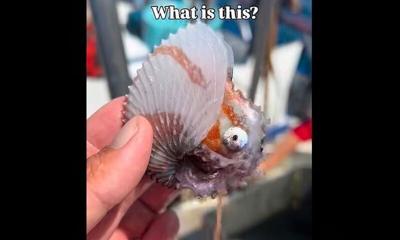

A fishing trip out of Newport Beach, Ca., last week produced an extraordinary catch of a type of octopus that constructs its own shell in which to roam ocean currents.
The argonaut, or paper nautilus, was reeled aboard a boat operated by Davey's Locker Sportfishing, which asked social-media followers: "What is this?"
The accompanying footage shows the argonaut moving its tentacles from inside its shell and gazing through one of its large eyes.

Crewman displays live argonaut.
Regarding a female argonaut’s translucent shell, National Geographic states: "After mating, it begins secreting calcite from the tips of two of its arms, a continuous process. That forms the delicate, papery shell. It lays its eggs inside, then squeezes in.”
NatGeo adds: "The shell serves another purpose: a ballast tank. The argonaut rises to the water’s surface, gulps in air, then seals it inside. It then dives down until the trapped bubble counteracts its own weight.
People are also reading…
"It then can bob, without having to expend energy keeping its position in the water column. Paper nautiluses also can swim quite quickly—faster than a human diver—by using jet propulsion.”
Male argonauts are smaller than females and do not create shells.
Several of Davey’s Locker Sportfishing’s followers correctly identified the argonaut, but mostly by its paper nautilus moniker. But some were guessing. An example: "Looks like a little octo found a temporary place to crash, lol.”
Argonauts are as legendary as they are mysterious.
From the Ocean Conservancy: "These gorgeous and unusual critters have captivated people for centuries. Aristotle even speculated that they used two of their webbed arms as a 'sail' to capture breezes and drift along the ocean surface.
"This idea was even included in the novel Twenty Thousand Leagues Under the Sea—Jules Verne wrote about a 'shoal of argonauts traveling along on the surface of the ocean’ that he compared to an 'elegant skiff.’"
Presumably, the argonaut caught off Newport Beach was released after it was admired by passengers and crew.