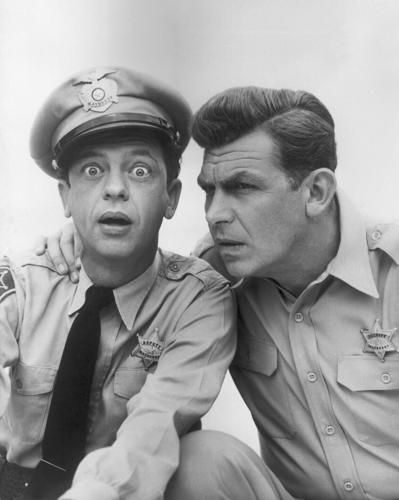

Barney Fife stole a few minutes of my time. Again.
I was surfing through television channels for background entertainment while getting some work done when Mayberry’s hilarious deputy sheriff arrested my plans that night.
“I ain’t got time to stand around here and discuss trivial trivialities,” said Fife, played by Don Knotts, in an old rerun of “The Andy Griffith Show.”
I laughed. Again. The next thing I knew, 20 minutes sailed past and I didn’t get any work done while revisiting my favorite small town in North Carolina. I laughed again, this time at myself.

"Please bring me my wine. We haven't had that spirit here since 1969.”
Nostalgia can be incarcerating. It handcuffs our fondness for the past and throws away the key for a few minutes or a few hours at a time. “Come back here for a spell,” it says.
A spell indeed. Come back to our glory days of yesteryear. Come back to when we were younger, happier, healthier. Come back to a time filled with so many vivid memories of our lives. Or seemingly so.
People are also reading…
Memories are not always faithful to the truth. They’re often our impressions of the past, not actually what happened in its entirety.
Most of us are willing prisoners anyway.
Nostalgia is defined as a “sentimental longing or wistful affection for the past.” The word’s history dates back to Greek origins: “nostos,” meaning “returning home”; and “algos,” meaning “longing” or “suffering.” It was coined by a 17th century medical student to describe a psychological condition afflicting Swiss mercenary soldiers who wandered far away from their homes.

Remember when parenting was simple?
Our contemporary understanding of the word has shifted from its emotionally painful origins to one that is now soothing for most people of a certain age. Nostalgia can be so soothing that it can reduce pain perception, according to a research study in the journal Neurosci.
“Nostalgia is a predominately positive emotion that people easily perceive in their lives,” Joe Yazhuo Kong, one of the study’s authors, said. “By managing their discomfort, rather than eliminating or reducing the unpleasant stimuli, people can use nostalgia to reframe their painful experiences.”
Many of us already do this without the clinical confirmation through such things as old cartoons, childhood games, retro candy and old movies. Observing those images -- and the memories they evoke -- lessen the perception of pain, the study concluded.
Nostalgia is an illusion for those who haven’t realized that today is tomorrow’s nostalgia,
I’d like to believe I’m not chronically infected by nostalgia, yet I find myself battling bouts of wistfulness every now and then. I recently did some shopping at a mall and once again I envisioned stores that have been closed for years or decades. My sixth sense is seeing dead stores, I guess.
Life can become a mall of memories for us, filled with shops and events that exist only in our head. I sometimes have to tell myself, “Stop it!”
I repeatedly resist getting inflicted with terminal nostalgia, a deceiving condition that too often glorifies the past while conveniently ignoring the present. Just ask any baby boomer these two simple words: “Remember when … ?” It’s like giving a cocaine addict a free line on a carnival mirror of distorted memories. They can be on a high for several minutes. Or hours.
Nostalgia is an addictive emotion. Too many people I know overdose on it every day. Especially on social media, the great enabler of our generation. The advertising world taps into the seductions of nostalgia to lure customers, sell products and recreate a world that exists only in our head. It’s brilliant. And it’s diabolical.
Nonetheless, pondering the past has its short-term benefits. It can provide comfort and a sense of rekindled optimism.
The trick is to recognize the importance of nostalgia without getting lost in its maze of idyllic memories. It’s human nature to revisit the past, but we shouldn’t live there, I tell myself. Though it can feel like being slapped in the face by a squirt of Aqua Velva aftershave, we need to return to the present when the song ends or, in my case, when the TV show ended that night.
As Barney Fife would say, you’ve got to “nip it in the bud."