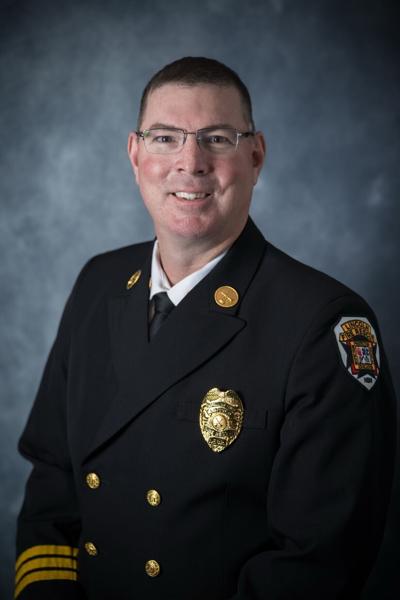





Lincoln Fire and Rescue's Mark Majors remembers the sadness, fear, anger and anxiety.
But eventually, the first responder side of him took over on Sept. 11, 2001.
“When a large incident happens … a lot of those emotions, they stay with you, but they kind of go to the wayside,” Majors said. “We want to be in the right place at the right time to just lend some assistance. If it’s handing out water, if it’s being part of a bucket line that we all watched, I think we all kind of had that anxiety, like, ‘Let’s go.’”

Battalion Chief Mark Majors made his first Task Force 1 deployment to New York following the Sept. 11 terrorist attacks.
Just a year prior, Majors had joined the relatively new Nebraska Task Force 1 as a rescue specialist. In 2001, he completed the extensive 80-hour, hands-on structural collapse course.
Watching the TV that was no bigger than 27 inches, Majors couldn’t even begin to imagine what he would see when he arrived in New York City about 10 days later during his first deployment as a task force member.
People are also reading…
“The size and the height and the width of the disaster of Ground Zero downtown was something that will never escape my mind,” Majors said. “Seeing it on TV, and then seeing it with your own eyes is two separate things.”
Majors was part of the second Nebraska Task Force 1 group that deployed to Ground Zero. By that point, rescues had turned to recovery efforts as first responders swarmed New York.
After arriving on a chartered plane, it took several hours for Majors to get through security checks and get credentialed. Every 12 hours, a new badge was issued to identify those allowed at Ground Zero.
“When all your first responders come in, it opens it up as the possibility for another target,” Majors said. “It was all new to me.”
Eventually, Majors remembered loading into a bus heading to Lower Manhattan.
“There was one sign that said, ‘New York City: Closed.’ As we’re getting closer to some of the bridges, 'Lower Manhattan is closed,'" Majors said. “It was really surreal to kind of see things like that.”
The first responders were split into two 12-hour shifts with Majors focusing on logistical work during the day.
His experiences in New York City have encouraged Majors to become even more involved in the task force program.
He now works as a battalion chief for Lincoln Fire and Rescue, and continues to deploy with the task force as a team manager and task force leader, and individually as an incident support team member.
“It has opened so many doors for not only myself, but a lot of the other team members on the team and fire department members,” Majors said. “After 9/11, we had to worry about some different hazmats. ... So there was a lot of curriculum to be taught.”