
The 49-year-old Lincoln man who died Thursday morning of a self-inflicted gunshot wound amid an hourslong standoff with police was supposed to be barred from possessing the gun he used to shoot himself, according to court records.
Jamie Mitchell had been the subject of an emergency domestic abuse protection order issued in January that specifically prohibited him from possessing or purchasing firearms, according to civil court filings.
Authorities never seized Mitchell’s cache of firearms despite multiple court filings from the 34-year-old woman who sought the protection order warning police that Mitchell owned multiple guns, which she said were always loaded — often with a round in the chamber.
People are also reading…
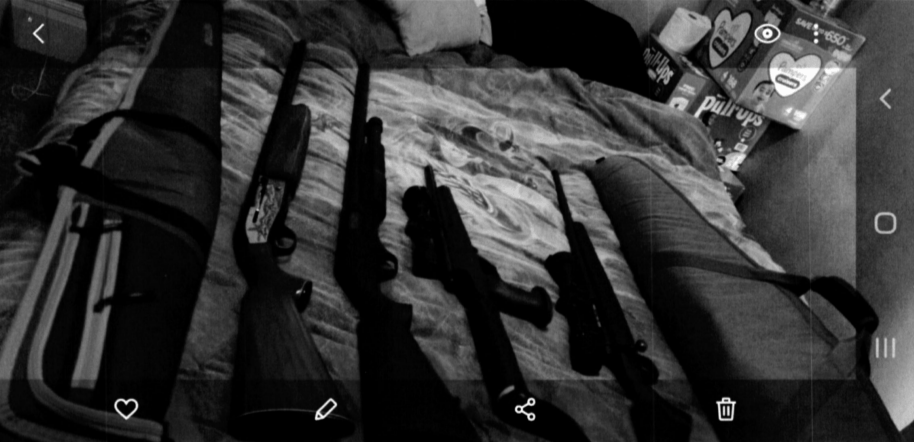
The 34-year-old woman who sought a protection order against Jamie Mitchell included a photo of at least four guns laid out on a bed, which she alleged belonged to Mitchell. The protection order, issued in January, barred the 49-year-old Lincoln man and former city employee from owning firearms.
When the woman sought the protection order against Mitchell, a former city employee, in January, she said she did so in part because of his cache of firearms, she said in an affidavit seeking the order.
In her sworn affidavit, the woman told Judge Joseph Dalton that she had, at times, been afraid to enter Mitchell’s home to retrieve her children “because of the guns in the house” at 1535 N. 28th St.
And, she said, Mitchell had a gun within arm’s reach of both him and his preschool-aged children as they unwrapped presents on Christmas in December. The 34-year-old attached a photo of the scene to her court filings, along with a photo of at least four guns laid across a bed in what she alleged was Mitchell’s home.
Dalton signed the emergency protection order Jan. 5, ordering Mitchell to stay away from the 34-year-old’s home and workplace, limiting his communications with her to only focus on arranging visits with his children and barring him from owning or buying guns, according to the order.
A Lancaster County Sheriff’s deputy served Mitchell with the protection order at his house on Jan. 6, according to court filings.
Chief Deputy Ben Houchin said when serving protection orders deputies notify recipients that they’re no longer allowed to possess firearms, giving them an opportunity to get rid of their guns on their own accord.
“We don’t safe keep weapons,” he said. “We put it onto the individual that they have to get rid of them and have somebody else take them so they are not in possession of them anymore.”
Houchin said deputies would only seize the weapons if the subjects of protection orders were found to be in violation of those orders after they are served.
Deputies served an amended protection order on Mitchell in April after the 34-year-old woman filed a request to modify the initial order to add her new home address among the list of locations that Mitchell was barred from.
Included in the woman’s April filing was a second reason for the request to modify the order:
“Jamie still owns guns and has (them) in his possession,” she wrote in the April 24 filing.
Dalton signed an amended protection order April 25, adding the woman’s new address and again barring Mitchell from possessing firearms.
A Lancaster County Sheriff’s deputy served the updated protection order the same day, but did not seize the firearms that Mitchell had been ordered to get rid of more than three months prior.
Houchin, the office's chief deputy, maintained on Friday that the deputy who twice served Mitchell with the protection order did not know he was still in possession of the guns — despite the 34-year-old woman’s written warning.
“At that time, there was no information … that said he had any (firearms),” Houchin said. “So we did not know of a violation.”
And, he said, any report that Mitchell still had firearms — which would have been a violation of his protection order, which is a misdemeanor offense — would have been routed to the Lincoln Police Department since Mitchell lived within city limits.
The Police Department's public information office deferred questions on the case back to Houchin.
Mitchell’s weapons went unseized until the early hours of Thursday morning, when police breached his home after hearing a single gunshot at the end of an hourslong standoff.
The lead-up to the standoff started hours beforehand, when the 34-year-old woman reported to police that Mitchell had contacted her — violating the terms of the protection order — at around 4 p.m. Wednesday, Houchin said.
As police investigated that alleged violation, another acquaintance of Mitchell reported he had made verbal threats of violence toward nearby Clinton Elementary School and a city department.
"At that point in time — with the way the world is now and the threat of active shooters — (police) jumped all over it," Houchin said, emphasizing that the threat of violence had evolved from a single potential target to the community at large.
LPD's SWAT team converged on Mitchell's house, near 27th and Holdrege streets, at around midnight to arrest him, Houchin said, and breached Mitchell's front door but did not enter the house.
Police negotiated with Mitchell for more than four hours, according to the sheriff’s office.

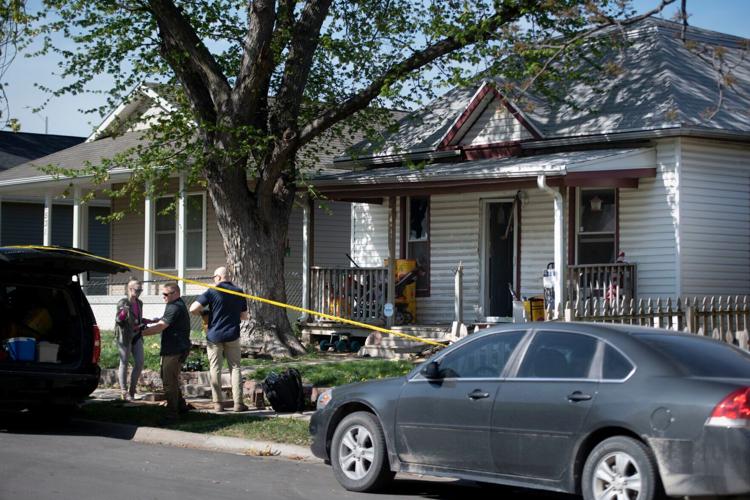
Lancaster County Sheriff investigators search a car parked in front of a home that was the scene of a standoff that ended in suicide on May 4 at 1535 N. 28th St.
Then, at 4:49 a.m. Thursday, police rushed into the home after hearing a single gunshot and found Mitchell wounded, Houchin said.
Lincoln Fire and Rescue crews, who had been waiting at the scene, took the 49-year-old to a local hospital, where he died of his injuries, Houchin said.
Lancaster County Attorney Pat Condon ordered an autopsy to determine the cause of Mitchell's death.
Mitchell's death is considered to have happened in police custody, which means a grand jury will be convened to investigate the events that led up to his death and determine if police acted criminally in the standoff. The sheriff’s office is investigating Mitchell’s death and the police department’s actions in preparation to present evidence to the grand jury.
The 49-year-old had been an equipment operator for the city's Transportation and Utilities Department from 2002 until he resigned Feb. 10 without explanation, said Barb McIntyre, the city’s human resources director.
Houchin indicated LTU was the city department Mitchell later made threats toward.
Mitchell's death comes amid a tumultuous session in Nebraska's Legislature, where senators last month approved an expansion of gun rights in the state while eschewing proposed gun reform.
The Legislature in April passed Sen. Tom Brewer's LB77, which will allow Nebraskans 21 and older to carry concealed weapons without a permit while invalidating any local ordinances limiting the carrying or storage of weapons.
Meanwhile, a proposed "red flag" law dubbed the Suicide Risk Protection Order Act, introduced this session by Sen. Jane Raybould of Lincoln, faced broad opposition at a Judiciary Committee Hearing in February.
The bill (LB482) would have allowed family members or law enforcement agencies to seek a protective order — similar to a domestic abuse order — in cases where gun owners experiencing mental health issues pose demonstrable danger to themselves or others.
If petitioners provided sufficient grounds showing that the gun owners posed a threat of harm — either in an evidentiary hearing or in an emergency affidavit — the bill would have allowed judges to order the person's firearms be seized and held by law enforcement for up to a year, or longer if extensions were sought or granted.
"In this case, law enforcement would have intervened," Raybould said in a phone interview Friday, referring to Mitchell's death amid Thursday's standoff.
Instead, the freshman senator's bill remains stalled in committee.
"It's heartbreaking. I mean, it's heartbreaking when you see that this individual was going through a mental health crisis and that — that's the treatment they need," Raybould said, before lamenting the limitations in the state law that serve as roadblocks in protecting ailing gun owners from themselves.
"That's really the tragedy of this all," she said.