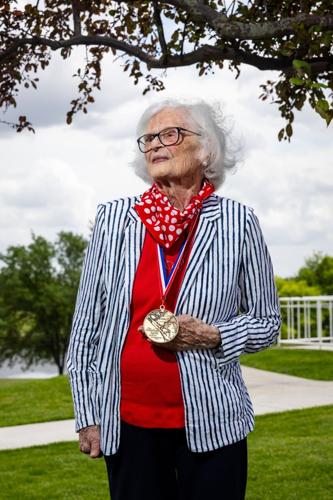
When Iris Herse was just 17, she made a decision that would add her legacy to the history books.
At 100 years old, Herse carries a century of American history. She's lived through major events like World War II, the bombing of Pearl Harbor, the civil rights movement, the fall of the Berlin Wall, 9/11 and much more.
She's also played an active role in shaping America's history.
Herse is one of few surviving Rosie the Riveters, the symbol that represented more than 6 million American women who entered the workforce during World War II to build war supplies after most able-bodied men went to serve in the military.
"We did the jobs that men couldn't really do, and we did the jobs that we didn't think we could do," Herse said.
Herse grew up on a farm in northeastern Nebraska and remembers Uncle Sam posters everywhere saying, "Big Uncle Sam needs you." Her older brothers, classmates, male friends and loved ones all enlisted in the military.
People are also reading…
After hearing her high school principal play a radio speech from President Franklin D. Roosevelt explaining Pearl Harbor had been bombed, Herse and her older sister, Avis, knew that they needed to help aid the war effort.
“I saw my mom and dad tell everyone goodbye and it was such an unknown war with no communication,” Herse said. “We wanted to help our loved ones, and we were just two of thousands of young people."
The sisters said goodbye to their family farm and made their way down to Mead, Nebraska, where they worked at the Nebraska Ordnance Plant, helping to build bombs in support of the U.S. war effort.
"We had no idea what it was gonna be like or what we were gonna do," Herse said.
Herse said that they stayed in dormitories and stayed at the plant 24 hours a day. Every day in the morning she said that they would get undressed, put on their jumpsuits and tie their hair up. Factory workers were also searched because they couldn't have any metal on them.
"No hairpins," Herse said. "We had to put on their shoes and then we just walked in." "My job was a row of us, it was around the clock, and everything was manual."
Herse said that what she did wasn't unusual.
"Everybody was so patriotic," Herse said.
She said she worked on making boosters that would go into the bomb while Avis drove a forklift transporting materials. Herse recalls thousands of bombs being made. The production was so big that she never saw the entire campus she was working on.
Herse said that when they were working on the floor they would all face a certain way so that they could go to the window if something didn't work. After the shift, they had to take strong showers because the gunpowder would build up and give their hair an orange glow.
"We were making 50 to 65 cents an hour, and we were happy to do it," Herse said.
Herse worked as a Rosie from November 1944 to that next spring. They only left the plant once a week on Saturdays when they were bussed to Wahoo, to spend time shopping for groceries, but the real challenges were the nights.
"The sad part was we’d go to the dorm at night, and we could be happy and we could be sad because some of our friends had received word that their loved one was killed,” Herse said.
At the time Herse was in a relationship with her later husband who was training in the Naval Air Corps. She had no idea that her brother-in-law had gone through the Battle of the Bulge, one of the most brutal battles of the war.
"It was hard for all of us," Herse said. "We were 17, 18, 20s."
“We all laughed together and we all cried together. We were we really were bounded. We just really, we wanted it to end. We wanted our loved ones home.”
Herse said that the idea that they were helping bring their loved ones home is what kept everyone at the plant motivated.
"I remember the first Christmas where we were there, you know I’ll be home for Christmas, the song is so popular. So sad," Herse said.
Being with her sister meant everything to Herse.
"I wouldn’t have gone without her,” Herse said. “We were just so close together and we went to work together, and you know, we were together the whole time to help each other, so I would not have gone without Avis. I wouldn’t have gone without her.”
The little communication at the time made it extremely difficult for anyone to know what was happening.
Herse said she remembers the mail guy honking his horn from a mile out as they ran to see if there was any news. Letters that came in the mail were often redacted with black lines crossing out parts of the message, but Avis just needed to know that her husband was alive.
Herse said that they were very fortunate.
"My brother and everybody came home. Took Bob (her brother-in-law) a long time to readjust after going through what he had gone through, but he did,” Herse said.
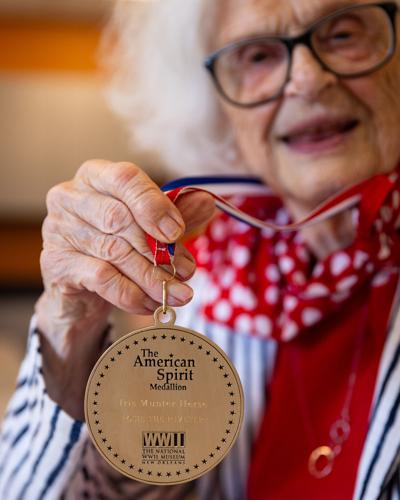
In early June, Herse was flown out to the National Rosie the Riveter Convention, held at the National World War Two Museum in New Orleans. The event honored 30 Rosies from around the United States who all aided in the war effort. They were all honored with American Spirit Awards.
Herse said the event was wonderful and that the museum was beautiful.
“We all had the same stories," Herse said. "We all worked hard and never once dreamt that would be part of our life."
“Men that had been in the war would come up and congratulate us and say we couldn’t have won the war without you because they were all fighting and we were doing the building," she said. ... "I was the only (Rosie there) that actually worked in the bomber plant."
Herse said that the most memorable part of the event was when the Rosies got their specialized engraved medals that had their names.
"It was very meaningful," Herse said. "At the time we just all did it, everybody. It wasn’t that I did anything special, cause we all did the same.”
"It’s hard to explain," she said. "It’s hard to explain when they put this (medal) around my neck. I was proud, proud to be an America. And I hope that everybody that lives here feels the same way. We felt like, had we not have done what we did, would the Untied States be different?”
Another part of the event included Rosie-Student Exchange, where high school students from each state interviewed a Rosie.
“I thought it was a wonderful thing for them to do at the same time," Herse said. "To have all the 100-year-olds and then the young ones, mingling together. going through the war, seeing the war, and then talking to us who were in it.”
Although Herse has made a great contribution to American history, she still remains humble.
“I never considered it as, I didn’t sacrifice any of my life for it, I did it for my country,” Herse said.
Herse has lived at Immanuel Lakeside retirement home since 1999 and has enjoyed every day of it. She said that she is grateful for all the people, the friends that she has made and the staff that support her.
Herse said that she's had many blessings including friends, religion, loving parents, grandchildren and great grandchildren. She said she is just appreciating everything that she gets to experience as America hits its 250th birthday.
In an interview with The World-Herald she brought the iconic Rosie the Riveter poster that started it all. It was lined with the phrase "We can do it." She said that the phrase holds a lot of meaning to her.
"It means that we can do it," Herse said. "And we did it. They called us to duty. We were like servicemen and we can do it.”
Our best Omaha staff photos & videos of June 2026
Creighton women’s basketball coach Jim Flanery plays freeze tag with Jensen Lindgren Annual Creighton Abilities Basketball Camp at Creighton University in Omaha, on Friday, June 5, 2026.
Grayson Dix, left, and Creighton physical therapy student Weston Hirschi work on a dribbling drill at the Annual Creighton Abilities Basketball Camp at Creighton University in Omaha, on Friday, June 5, 2026.
“The Kiss” by Sophie Ryder is seen in the newly opened Polina Gardens located at 727 S 13th St. in Omaha, on Wednesday, June 3, 2026.
Creighton physical therapy student Nick Friedman and Aiden Keckeisen are greeted with cheers as they arrive at the Annual Creighton Abilities Basketball Camp at Creighton University in Omaha, on Friday, June 5, 2026.
The Polina Gardens located at 727 S 13th St. in Omaha, opened to the public on Wednesday, June 3, 2026.
Karol Ulmer, right, talks to her grandnephew, Luke Arp, 4, at Polina Gardens located at 727 S 13th St. in Omaha, on Wednesday, June 3, 2026.
Don Janousek, right poses for a picture with his grandson, Ethan Janousek and his Afghan hound, Arctic Storm, at Janousek Florists 4901 Charles St.. in Omaha, on Wednesday, June 3, 2026.
Workers pour concrete on the Farnam Street bridge deck over highway 75 in Omaha, on Monday, June 1, 2026.
Ted Harris rigs his pole while fishing in Benson Park in Omaha on Wednesday, June 3, 2026.
Hunter Welchert, 7, points towards the next fishing spot as his uncle, Joshua, rigs his pole in Benson Park in Omaha, on Wednesday, June 3, 2026.
From left, family members Miguel Martinez, Kye Martinez, 3, and Chebna Altimeau spend time at the Cascade Fountain at Gene Leahy Mall Omaha on Tuesday, May 26, 2026.
A cyclist bikes from the Field Club Trail to the South Omaha trail near the silos near 35th and Vinton Streets in Omaha, on Tuesday, June 30, 2026.
North Carolina's Carter French (18) watches Oklahoma celebrate after winning game three of the College World Series championship series at Charles Schwab Field in Omaha, on Monday, June 22, 2026.
A woman is overcome with emotion as Omaha police are on the scene of a shooting that left a man and woman dead in a suspected murder-suicide near 82nd Avenue and Bondesson Street in Omaha, on Wednesday, June 17, 2026.
Omaha police officers install a car seat into a cruiser for a one-year-old who was on the scene of a shooting that left a man and woman dead in a suspected murder-suicide near 82nd Avenue and Bondesson Street in Omaha, on Wednesday, June 17, 2026.
Oklahoma's Xander Mercurius (23) pitches against Georgia during the fourth inning in game eight of the Men’s College World Series at Charles Schwab Field in Omaha on Monday, June 15, 2026.
West Virginia's Paul Schoenfeld (6) dives for a ball hit by Troy's Sean Darnell (37) during the third inning in game one of the Men’s College World Series at Charles Schwab Field in Omaha on Friday, June 12, 2026.
Flattened corn can be seen in a field after storms left damage in Cass County, Nebraska north of Union, on Thursday, June 11, 2026.
A train is blocked by a fallen tree on tracks north of Adams Street, just west of Highway 75 after storms left damage in Cass County, Nebraska north of Union, on Thursday, June 11, 2026.