



LINCOLN — Nebraska Gov. Jim Pillen said he made the case to President Donald Trump this week that the best way to help cattle ranchers long-term is to create opportunity for them to get involved in packing their product.

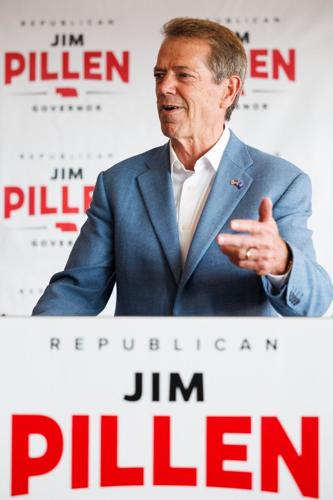
Gov. Jim Pillen speaks during a press conference in Lincoln on Aug. 25.
Pillen, in a phone interview Friday, said it appeared Trump heeded input he received from the ag community — including Nebraska ranchers and federal officials — after the president faced backlash last week for lifting tariffs on up 300,000 metric tons of imported beef in an attempt to lower grocery store prices.
Trump on social media early Friday said the four major meatpackers are a "powerful monopoly" that can "make life miserable for our wonderful farmers and ranchers." The president then said he was working on documents to authorize producers to process their own food.
People are also reading…
The details of Trump's plan introduced on social media were not immediately clear on Friday, but Secretary of Agriculture Brooke Rollins posted that she would announce changes Monday that lift red tape for processing, fight consolidation, expand truth in labeling and help ranchers sell across state lines.
Pillen was in Washington D.C. on Monday for a U.S. Department of Agriculture event promoting healthier school meals. Pillen said he spoke with the president for 20 to 25 minutes during his visit.
The governor, while he said he was disappointed in last week's announcement on imports, commended Trump for trying to address consumer prices.
He relayed to the president that packers and grocers set prices and that prices are high because of historically high demand for beef.
"We can import beef until the cows come home, if you will, and history will show that it will not change the price one iota for the consumers, Pillen said.
He said the beneficiaries of tariff-free imports are packers and grocers.
"The packers are going to make more money, and the grocers are going to make more money," Pillen said. "Cattlemen get paid less, and that will not change the price because ... the packers and the grocers set the price for as much as they can get."
Pillen, who runs a hog operation based in Columbus, noted that he and other hog producers bought a processing plant for their pigs. He highlighted that beef producers similarly came together to start the Sustainable Beef plant in North Platte. He suggested the federal government provide low-interest loans to help meatpacking plants get up and running.
The big four meatpackers are Tyson Foods, JBS USA, Cargill and National Beef. JBS and National Beef are owned by Brazilian companies. Pillen said shifting packing to more domestic, family farmer ownership has national security implications and shores up U.S. food security.
Pillen said he thanked the president for agreeing to rescind his 90-day executive order lifting tariffs on beef if grocery prices do not come down.
The average price of ground beef per pound was $6.89 in July, up from $6.25 per pound in July 2025 and $5.50 per pound in July 2024, according to Bureau of Labor Statistics data shared by the Federal Reserve Bank of St. Louis.
While consumer demand is affecting prices, economists also point to a historically small cattle herd due in part to drought and high input costs.
The price at which beef continues to sell led ag advocacy groups, including the Nebraska Farm Bureau, to refer to the "strength of the cattle market" as "one of the few bright spots within agriculture."
Pillen also pushed back on the notion that beef prices are too high, noting that producers have seen numerous difficult years and that prices are keeping up with demand.
"Everybody knows how great Nebraska beef is. Everybody is figuring it out that it's the greatest value there is," Pillen said, noting that the price of ground beef per ounce is much less than the average candy bar per ounce. "My view of the world is the price is not high. The price of beef is not a problem.
"If it was, people wouldn't be buying it."

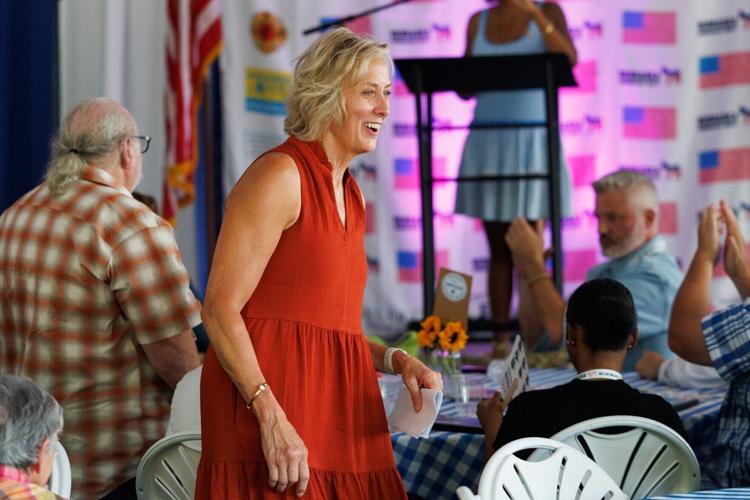
Lynne Walz, Democratic candidate for Nebraska governor, is applauded during the Nebraska Democratic Party Ben Nelson BBQ in Omaha on Aug. 22.
Much like his executive order last week drew a sharp response, Trump also faced pushback when he boosted imported beef from Argentina last year.
U.S. Sen. Deb Fischer said in a social media post she was "extremely disappointed" by Trump's decision.
"We all want lower grocery prices, but, as I’ve said for months, we cannot do it at the expense of American producers. Flooding the market with foreign beef hurts our livestock industry and undermines the long-term solution: growing the U.S. cattle herd to meet demand," Fischer said.
U.S. Sen. Pete Ricketts similarly said online that "short-term policy shifts do not equal long-term solutions" and that the administration should work to support Nebraska farmers and ranchers so they can grow their herd sizes to better meet consumer demand.
Pillen's opponent in the governor's race Lynne Walz said on social media that "allowing foreign beef imports to enter the market will hurt Nebraska cattlemen. This comes at a terrible time just as ranchers are about to sell calves."
Walz, a Democrat and former state lawmaker from Fremont, criticized Pillen, a Republican and staunch Trump ally, of supporting trade policies that hurt Nebraska's agricultural economy.
Photos: Nebraska Gov. Jim Pillen meets with cabinet for roundtable briefing

Gov. Jim Pillen addresses the cabinet during a roundtable briefing at the Nebraska State Capitol in Lincoln on Monday, April 20, 2026.

Gov. Jim Pillen addresses the cabinet during a roundtable briefing at the Nebraska State Capitol in Lincoln on Monday, April 20, 2026.

Lt. Gov. Joe Kelly speaks during a roundtable briefing with members of the governor’s cabinet at the Nebraska State Capitol in Lincoln on Monday, April 20, 2026.

Rob Jeffreys, Nebraska director of correctional services, speaks during a roundtable briefing with members of the governor’s cabinet at the Nebraska State Capitol in Lincoln on Monday, April 20, 2026.

Katie Thurber, Nebraska Department of Labor commissioner, speaks during a roundtable briefing with members of the governor’s cabinet at the Nebraska State Capitol in Lincoln on Monday, April 20, 2026.

Bryan Tuma, executive director of the Nebraska Crime Commission, speaks during a roundtable briefing with members of the governor’s cabinet at the Nebraska State Capitol in Lincoln on Monday, April 20, 2026.

Neil Sullivan, director of the Nebraska Department of Administrative Services budget division, speaks during a roundtable briefing with members of the governor’s cabinet at the Nebraska State Capitol in Lincoln on Monday, April 20, 2026.

Col. Bryan Waugh, superintendent of the Nebraska State Patrol, speaks during a roundtable briefing with members of the governor’s cabinet at the Nebraska State Capitol in Lincoln on Monday, April 20, 2026.

Gov. Jim Pillen speaks during a roundtable briefing with members of the governor’s cabinet at the Nebraska State Capitol in Lincoln on Monday, April 20, 2026.

Bryan Tuma, executive director of the Nebraska Crime Commission, is presented with an honorary Admiral in the Nebraska Navy during a roundtable briefing with members of the governor’s cabinet at the Nebraska State Capitol in Lincoln on Monday, April 20, 2026. Tuma is retiring on June 5 after 45 years working in Nebraska law enforcement.

Gov. Jim Pillen answers a question from a reporter during a roundtable briefing with members of the governor’s cabinet at the Nebraska State Capitol in Lincoln on Monday, April 20, 2026.