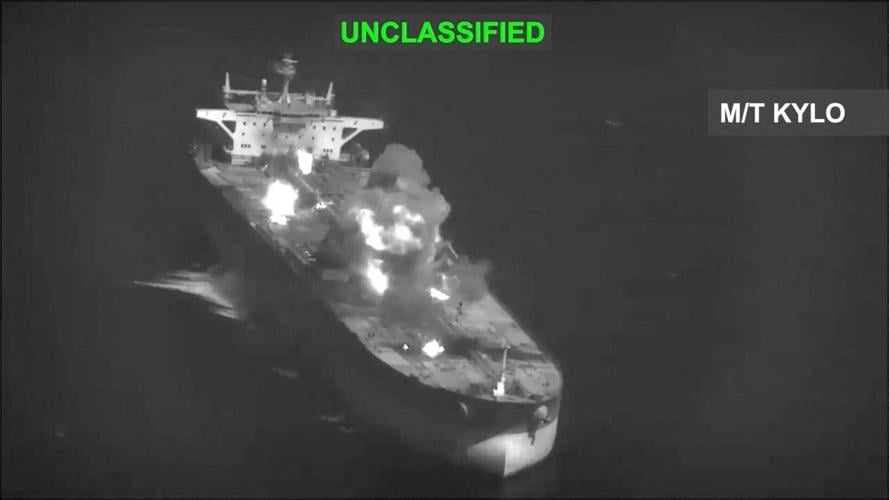





DUBAI — U.S. forces struck three Iranian oil tankers Saturday, U.S. Central Command said, including one off the coast of Kharg Island, near Iran's key oil export hub.
The strikes were carried out after Iran's Islamic Revolutionary Guard Corps launched ballistic missiles at two U.S. Navy ships, Central Command said.
“Let the message to the IRGC be clear: If you shoot at two of our ships, we will impose an even higher economic cost — taking out three of yours," said Adm. Brad Cooper, head of U.S. Central Command.
Tasnim, the semi-official Iranian news agency, reported earlier that four U.S. missiles hit a tanker in the area of Kharg's anchorage. Tasnim quoted local sources as saying there were no casualties and the tanker's crew was being evacuated.
No American personnel were harmed, Central Command said.
People are also reading…
There was no immediate official announcement by Iranian authorities.
The exchange of attacks follows an escalation in the past week that threatens to deepen a conflict that has dragged on since the U.S. and Israel launched strikes on Iran on Feb. 28, disrupting global energy supplies and drawing opposition from a majority of Americans before November elections.

Fire and smoke rise in this screengrab taken from a handout video, released Saturday, during what U.S. Central Command says are strikes on Iranian oil carriers at an unknown location.
Americans hit with record-high Labor Day Weekend gasoline prices
The national average gasoline price will probably hit $4.03 on Labor Day, far surpassing the previous record of $3.83 per gallon set in 2012, said GasBuddy analyst Patrick De Haan. Labor Day is typically a final summer getaway for many Americans, with many people traveling by car or plane.
The national average price of gasoline stood at about $4.13 per gallon Thursday, up almost a dollar from last year's average, according to price-tracking service GasBuddy. Analysts say $4 per gallon is a pain point for many consumers.
Gasoline prices, among the most visible economic indicators for U.S. consumers, can quickly shape perceptions of the broader economy. With prices hovering above $4 a gallon for much of the year, the issue became a persistent concern for President Donald Trump and his Republican Party.
Trump pledged to lower energy costs. In recent weeks, he stepped up criticism of refiners and fuel retailers, accusing them of profiting from elevated pump prices. On Aug. 14, he said Americans should be willing to pay a "tiny little bit more" for gasoline to ensure Iran could not obtain a nuclear weapon.
Prices of distillates, which include diesel and heating oil, also increased, driven in part by ongoing attacks on Russian refining facilities, which raised concerns about supply disruptions.
Retail fuel prices and crude oil typically move in the same direction because crude feedstock is the dominant cost for producing the fuel.
Colorado, Utah, Idaho, Montana, Wyoming and North Dakota recorded some of the steepest price gains since the war started. California, Hawaii and Washington currently have the nation's highest average gasoline prices.
Refined products exports are up more than 10% compared with last year, according to the U.S. Energy Information Administration.

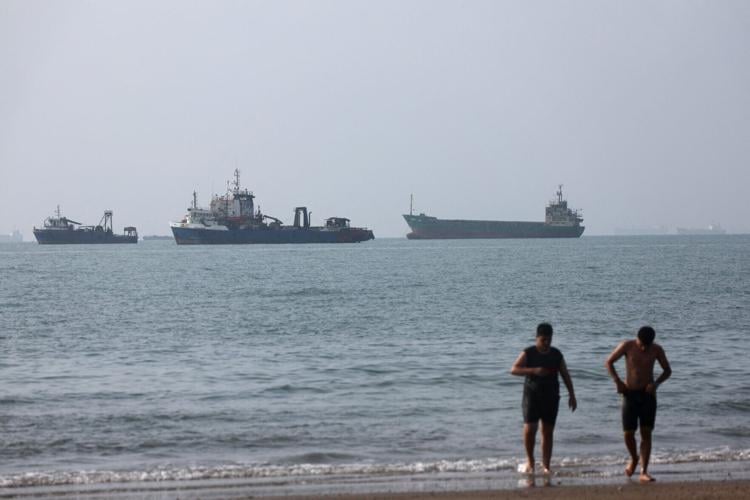
Vessels are seen Saturday in the Strait of Hormuz near the beach of Bandar Abbas, Iran.
Persistently high gasoline prices are primarily a supply story, said Kuan Dosmuratov, research analyst at consultancy Wood Mackenzie. Concerns about disruptions to energy shipments through the Strait of Hormuz lifted both crude prices and refining margins, while attacks on Russian refineries tightened fuel inventories across the board.
Currently, there are few operational and policy levers that can be pulled to boost fuel supplies. U.S. refinery utilization stands at 98%, the highest level since 2018. The government already extended the Jones Act waiver, allowing easier fuel shipments between U.S. ports. Washington also ended summer-blend gasoline requirements early to try to cap prices.
U.S. gasoline inventories fell by 1.2 million barrels last week to 205.7 million barrels, the Energy Information Administration said Wednesday. This compares with the five-year average for the month of August of 217.6 million barrels.
Prices for other refined products rose sharply, as well. U.S. diesel prices this past week hit a new record while air travelers over the Labor Day holiday were expected to pay 20% more for tickets than a year earlier, according to AAA.
"The public doesn't obsess with diesel but I see a better than even chance that retail numbers will surpass the all-time record of about $5.82 per gallon from June 2022," Tom Kloza, chief energy adviser at Gulf Oil, said. "It presents a worrisome future."

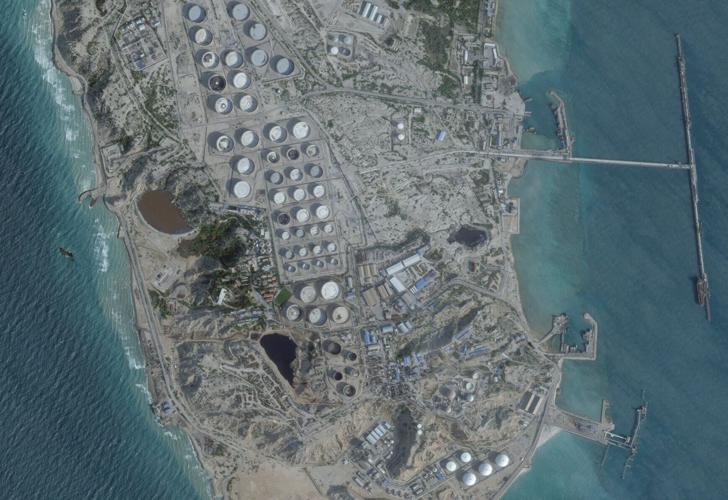
A Feb. 25 satellite image shows an oil terminal at Kharg Island, Iran.
Trump's threats over Kharg Island
Trump said Aug. 31 that Kharg Island was being "blown to smithereens." Iranian authorities vowed a strong response if Kharg is attacked.
Iran is the third-largest producer in the Organization of the Petroleum Exporting Countries and exported 90% of its crude via Kharg Island before the war, but flows were disrupted since a U.S. blockade of Iranian oil exports began in April.
A U.S. attack on Kharg would further pressure Iran's oil industry and its wider economy, which is already reeling from the U.S. naval blockade.
The U.S. imposed its blockade on Iranian ports after Iran effectively shut the Strait of Hormuz, an important waterway that carried one-fifth of the world's oil supply before the war.
Brent crude futures closed at their highest level since July 24 on Friday, at $96.28 a barrel, as tensions in the Middle East drive global supply concerns.