




LONDON — An explosion that ripped through a wedding celebration in southern Iran on Tuesday, killing four people and injuring at least 68 others, likely resulted from a direct hit by a U.S. munition and not a ricochet off another target, according to an analysis by weapons experts who reviewed images and video verified by Reuters.
The incident in the small town of Kuhestak reignited concerns about the civilian toll in the U.S. war with Iran and marks the most dramatic case since a missile struck an Iranian primary school in February, killing scores of children and teachers inside.
The U.S. Central Command said its forces carried out strikes across Iran’s south Tuesday, targeting Islamic Revolutionary Guard Corps air defense sites, radar systems, and communications facilities. The barrage came in retaliation for earlier Iranian attacks on U.S. military assets around the Gulf.
People are also reading…
On Thursday, U.S. President JD Vance said the United States was investigating the strike. The U.S. military said it was aware of reports and was looking into them.
Iran’s delegation to the United Nations did not immediately respond to a request for comment.

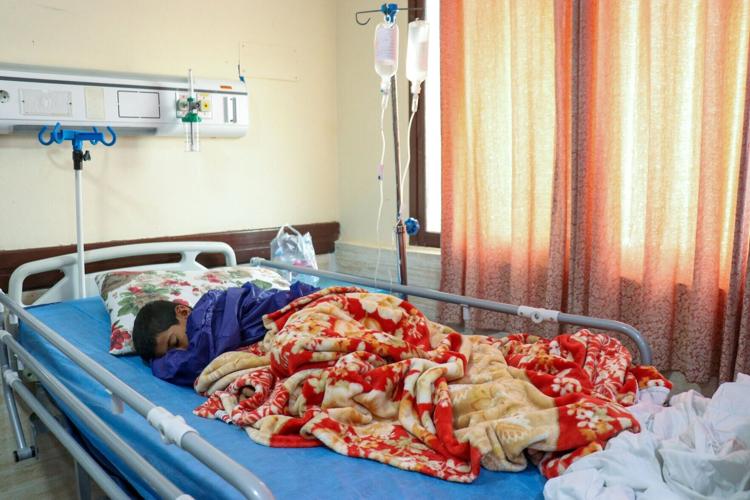
An injured victim lies in a hospital bed, following a reported attack near a wedding, near Sirik, a coastal area on the Strait of Hormuz, Hormozgan province, Iran, September 2, 2026. Razieh Poudat/ISNA/via WANA (West Asia News Agency) via REUTERS ATTENTION EDITORS - THIS PICTURE WAS PROVIDED BY A THIRD PARTY. ISRAEL OUT. NO COMMERCIAL OR EDITORIAL SALES IN ISRAEL. NO ACCESS FOR ISRAELI MEDIA. NO USE BBC PERSIAN. NO USE VOA PERSIAN. NO USE MANOTO. NO USE IRAN INTERNATIONAL. NO USE RADIO FARDA. DIGITAL: NO USE BBC PERSIAN. NO USE VOA PERSIAN. NO USE MANOTO. NO USE IRAN INTERNATIONAL. NO USE RADIO FARDA. TPX IMAGES OF THE DAY
On the night of the attacks, dozens of residents gathered in a home in Kuhestak for a wedding ceremony, according to eyewitnesses. During the party, a munition likely struck the building's roof, according to photos and video verified by Reuters and reviewed by experts.
Reuters shared video and images of the incident with four military weapons experts who said the damage was consistent with a direct hit, as opposed to secondary damage from a munition ricocheting off a separate target. Three of the experts said the munition was likely a U.S. weapon, rather than an errant Iranian air defense missile.
One of the experts said the weapon might have simply missed its objective.
"Given the number of bombs that have been dropped, this does occur from time to time even with the most sophisticated guidance systems," said Gareth Collett, a retired British Army brigadier who specialized in counterterrorist bomb disposal and holds a doctorate in explosives engineering.
Two U.S. officials, speaking on condition of anonymity, said the U.S. military carried out strikes in the area of Kuhestak on Tuesday, specifically targeting the town’s telecommunications tower.
That tower is almost 150 yards from the site of the wedding celebration, according to satellite imagery. The tower was hit about 9:30 PM local time, according to Iranian media.
One of the U.S. officials said the government is looking at various scenarios related to the casualties at the wedding, including whether they were caused by a U.S. strike, some sort of ricochet of an Iranian air defense missile, or an errant interceptor itself.
The count of four deaths and 68 injuries came from Balochestan Human Rights Documentation Network and Haalvsh, which monitor and document human rights abuses.
Trevor Ball, a former U.S. Army explosive ordnance disposal technician and current weapons technical analyst for Armament Research Services, was among the experts who reviewed the photos and video at Reuters’ request.
"The damage seen appears to be from a munition which detonated on contact with the roof, or just above the roof," he said, adding it was apparently a direct hit.
"The visible blast damage could not result from fragments from the nearby strike on the communications tower striking the area."
He said it was likely a U.S. weapon.
Collett agreed with Ball’s analysis.
"The weight of evidence leans towards a U.S. 500 lb. airdropped munition as opposed to an Iranian air defense missile," he said.
Sebastian Schutte, a Research Professor at the Peace Research Institute in Oslo, Norway, also reviewed the visual material. Based on available evidence, he agreed that the hole on the roof was not the result of a ricochet off the telecommunications tower.
The three experts said it was unlikely that a misfired Iranian missile destroyed the home.

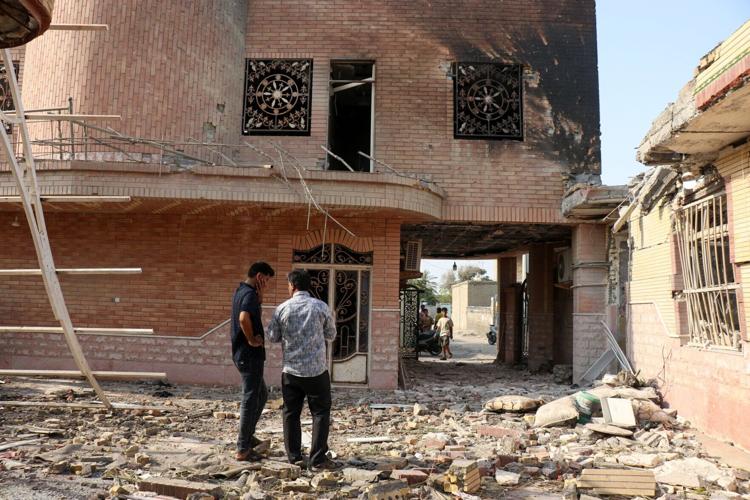
Rubble lies around damaged houses Wednesday after a reported attack near a wedding gathering in Kuhistik, Sirik, Iran.
Schutte said the angle of the impact was inconsistent with an air defense missile, and Collett said there was no evidence of the kind of fragmentation that would normally be present with an air defense warhead.
The incident comes more than six months after a missile destroyed a primary school in Minab on Feb. 28, hours after the start of the U.S. and Israeli attacks on Iran that launched the current conflict. That hit killed more than 175 children and teachers, according to Iranian officials.
The Pentagon hasn’t publicly released the findings of its investigation into the Minab strike, which was the U.S. military’s biggest civilian casualty incident in decades. But Reuters first reported on March 5 that an initial, internal U.S. military investigation showed U.S. forces were likely responsible for that strike on the opening day of the war with Iran.
On Thursday, residents of Kuhestak held a funeral for those killed in the wedding strike. Mourners filled the procession, carrying a casket and holding posters above their heads as a funeral prayer played in the background.
Women wearing black full body cloaks with bright red traditional face masks distinctive to the southern coastal region of Iran, threw flowers on 4-year-old Amir Mohammad Karimi’s small casket as it passed.
"The situation in Sirik is sad and mournful, and people are still in shock," said one eyewitness.