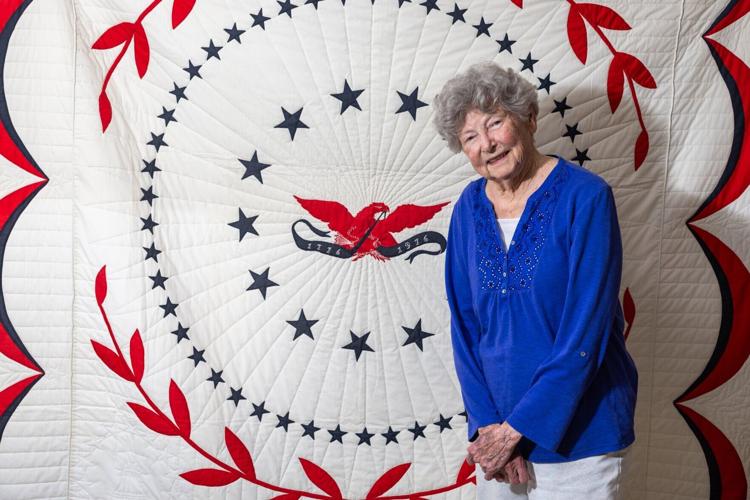
Ginny Landkamer wasn't thinking of the State Fair.
People are also reading…

Ginny Landkamer, whose quilt marking the bicentennial took home the best-in-show prize at the Nebraska State Fair in 1976, still keeps the quilt at her home in east Lincoln. "I was totally surprised," Landkamer recalled about winning the prize.

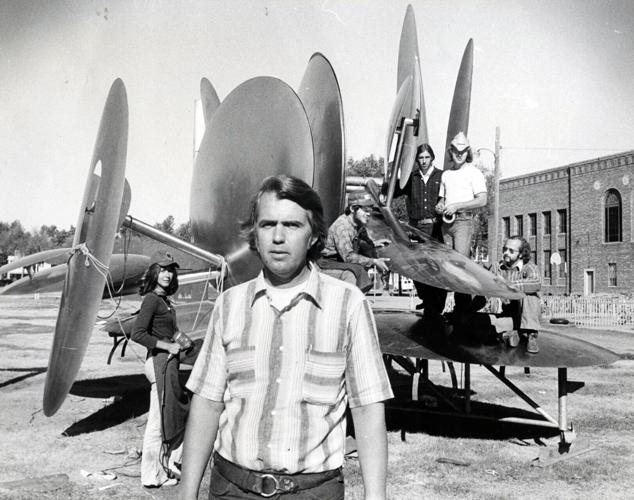
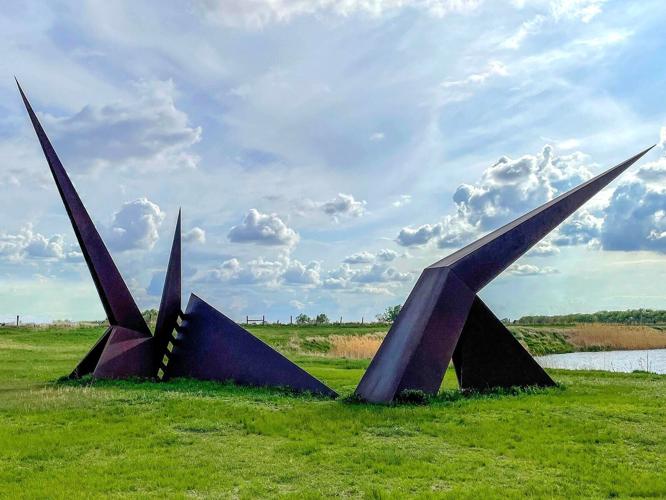
"Nebraska Wind Sculpture" by George Baker, foreground, was one of the Interstate 80 bicentennial sculptures. Today, the floating artwork sits behind fencing on a pond near Kearney.

“Erma's Desire," a sculpture near Grand Island that was installed as part of the Interstate 80 bicentennial sculpture project in 1976, sparked controversy because of its name.

John Raimondi

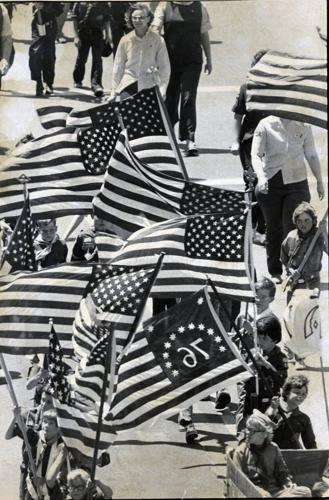
Cub and Boy Scouts march in the American Legion and Lincoln Bicentennial Commission's parade on June 26, 1976. The boys had to struggle with flags bigger than they were.
Doug Bereuter

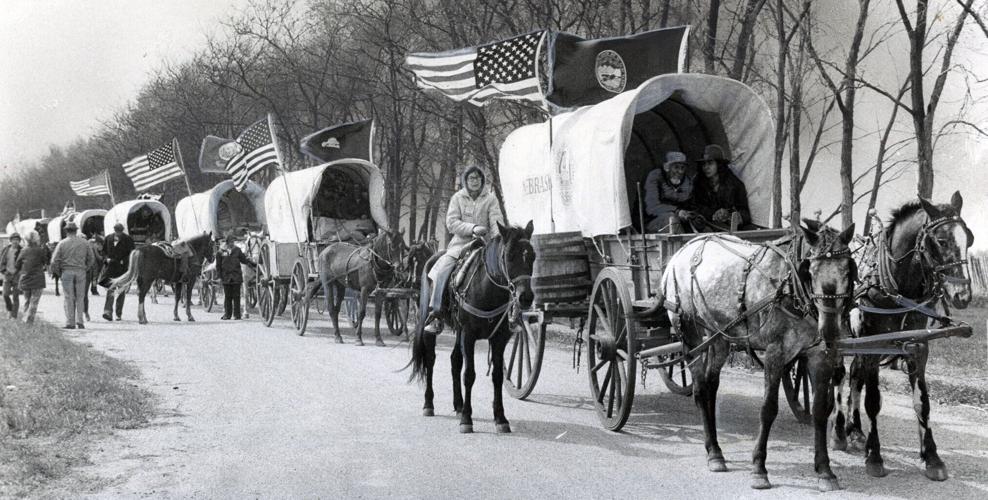
A bicentennial wagon train traversed Nebraska to mark America's 200th anniversary.
Photos: Nebraskans mark the bicentennial

Bicentennial collection ... Mrs. Simpson displays an enlarged facsimile of $4,000 gold medal.

In the last weeks of summer, when swimming no longer brings excitement and the thrill of being out of school has ended, teenagers often get bored and look for something to keep them busy. Faced with that situation, Martin Webb, 14, of 6015 Sprague Street, and Mike Null, 15, of 4116 North Sixty-fourth Street, decided to join Bicentennial enthusiasts by painting pictures of flags. Mike, seated, and Martin painted a modern flag and one with 13 stars on Mike's family garage door.

Keller (with beard) and Mierau... inspect Bicentennial artistry by 45 students.
"Nebraska Wind Sculpture" by George Baker, foreground, was one of the Interstate 80 bicentennial sculptures. Today, the floating artwork sits behind fencing on a pond near Kearney.

This Uncle Sam wants you to have a safe Fourth of July. He, or rather she, is Marcia Beck, one of a group of Northwestern Bell Telephone Co. emplovees who celebrated a "Safe Fourth” party Friday on the plaza of the First National Bank. Instead of candles, tiny American flags decorated the Bicentennial birthday cake, which was served by Ms. Beck in a homemade Uncle Sam suit.

Zorinsky, Lynch and Mayor's assistant Eugene Brailey raise the Bicentennial Flag... as Hruska, second from left, looks on.

Bradford Graves of New York City is pictured in June 1976 at work on the Interstate 80 sculpture "Crossing the Plains" at the York westbound rest area. The sculpture, hewn of stone from the same quarry that provided limestone for Nebraska's Capitol, was dedicated along with six others on July 4, 1976. An eighth sculpture was dedicated in September. The arrangement of stones, in accordance with the four points of a compass, looks back to the days when travel was determined by celestial observation rather than highway maps. The sculpture project originated with Thomas A. Yates, who had the idea for a single sculpture on the Interstate to attract tourists to the State Museum, and from Norman Geske, who proposed the expanded project to the Nebraska American Revolution Bicentennial Commission in 1973. Controversy surrounded the Bicentennial project; many Nebraskans objected to the abstract designs and lack of Nebraska artists.
Cub and Boy Scouts march in the American Legion and Lincoln Bicentennial Commission's parade on June 26, 1976. The boys had to struggle with flags bigger than they were.
A bicentennial wagon train traversed Nebraska to mark America's 200th anniversary.

Not many 2-year-olds know much about patriotism and flag saluting. Nor are they too concerned about the history of flags. But David McCombs, foreground, appeared to be anxious to learn all he could about flags and their history over the weekend. The son of Mr. and Mrs. Herb McCombs of Kimball, Neb., got his history lesson at the Springfield Bicentennial celebration, as Bill Milks of Springfield gave a brief history of the American flag. Other festivities included a craft fair, beard contest, talent show and Bicentennial dress revue.