“If we can show [our students] that ‘I believe in you’ then the hard is less hard — and we’re in it in the hard with you.”
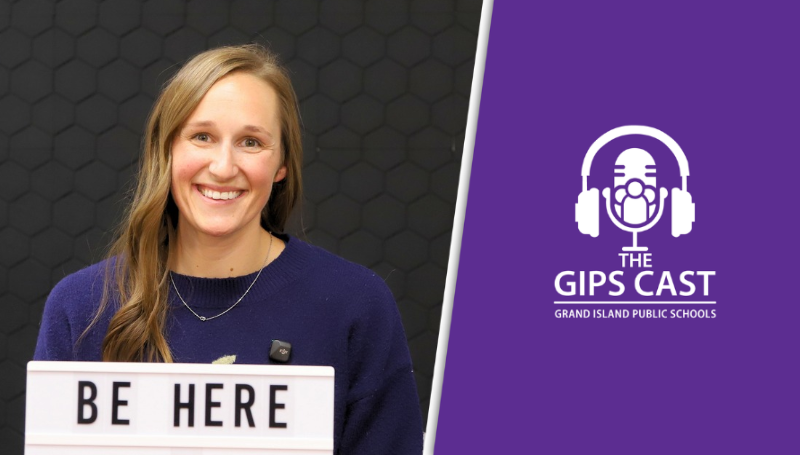
Miss Hannah Luber, Wasmer Elementary principal, joins the podcast to talk about “Be Here. Belong.” and how she seeks to make each day the best day for her students and staff.
Along the way, she unpacks a few initiatives the Wasmer Wildcats are focusing on in the school year:
- What does belonging mean at school?
- How do we set high expectations for students?
- “Lizard Brain” vs “Wizard Brain”
- Being named GIPS Administrator of the Year
People are also reading…
Be sure to subscribe on Apple Podcasts, Spotify, iHeart Radio, or your favorite podcast platform.
Episode transcript
Hannah Luber 00:00
Hannah Luber, principal of Wasmer Elementary. Let's talk.
Mitchell Roush 00:05
Welcome back to 'The GIPS Cast', a conversation-based podcast bringing you the stories of Grand Island Public Schools in Nebraska. Now today's guest is not only an enthusiastic educator; she was recently recognized as the Administrator of the Year here at GIPS, we're happy to have Miss Hannah Luber, the principal of Wasmer Elementary, with us on the podcast today, and she's ready to talk about all of the great things happening in her school. Let's dive in, Miss Luber, principal of Wasmer Elementary. Thank you for being here.
Hannah Luber 00:39
Yes, thank you for having me.
Mitchell Roush 00:41
Yeah, let's hang out. Let's chat.
Hannah Luber 00:42
Deal. I'm ready.
Mitchell Roush 00:43
Awesome. So this will be a fun chat because we're talking about your students and we're talking about the thing that you love the most. So it should be easy.
Hannah Luber 00:50
Yes. Yeah. Two things I love. It's going to be great.
Mitchell Roush 00:52
Awesome. So big picture question for you. Why did you want to be an educator? You've been doing this for a while now. So why why do you want to be an educator? Why are you still an educator?
Hannah Luber 01:02
I there's a couple reasons. Number one, I loved all of my teachers growing up. I just thought they were the coolest people on the planet. I loved to learn. I'd play school at home. Any of my neighbors that see this are going to be like, yes, we played school.
Mitchell Roush 01:19
That absolutely tracks.
Hannah Luber 01:20
That's first things first. But then I think as I got older, I was like, "Wow, I can make a difference."
Mitchell Roush 01:27
Yeah.
Hannah Luber 01:28
So it's a two-fold of I want to make a difference, but I also say a lot like I want to leave you better than I found you. So whether it's students or now adults, my like leadership lens has shifted to more adults. But it's just how can I make sure that I'm impacting you enough to make your next step better, a better place?
Mitchell Roush 01:46
And I mean, it sounds cliche, but it's cliche for a reason. Like, there really isn't a better way to make an impact on the world than to educate the next generation of students. Right. Right. Like, you're literally making tomorrow better.
Hannah Luber 02:02
Yes. Yep. And that's something that I don't think we realize day to day. You know, like when we're teaching all day, or even in this role now, but especially in the classroom, you don't always think of what will 10 the next 10 years look like for this child until you really like go to a graduation, right? So this last year was my first class. I graduated.
Mitchell Roush 02:23
That's so cool.
Hannah Luber 02:24
It was. I had tears driving there. It was just —
Mitchell Roush 02:28
You're just so proud of all the kids.
Hannah Luber 02:30
You know, it really was. And when afterwards someone said, "Well, do you remember me?" Yes, I do remember you because just as much as we impact you, you impact us
Mitchell Roush 02:41
1,000%.
Hannah Luber 02:41
And that's something that I don't think kids realize either. That everything they do and say really does. We hold on to bits and pieces. We not obviously we're not going to remember every little detail, but it really is a two-way street.
Mitchell Roush 02:53
You remember your students,
Hannah Luber 02:54
Yes.
Mitchell Roush 02:55
That like you remember every single one of them.
Hannah Luber 02:57
Yes. Yeah, and it might not be a name. Like let's be honest, and especially as the years go on, it's like I might not remember their specific name at the time, but I can remember a situation. Absolutely.
Mitchell Roush 03:08
Okay, so I'm gonna bird walk a little bit and tell you a little anecdote that I didn't prep you for. Okay. Okay. So just a couple of weeks ago, yeah, like two weeks ago, I was at Howard Elementary, and I was talking to Tami Garner, the secretary at Howard, right? And I love Tami, and I always show up a little bit early when I go to Howard because I want to hang out with Tami for a bit, right? And so she was checking in with me, and she was like, "Your girls, where do they go again?" And I was like, "They go to Wasmer." And she was like, and I said, "What?" And she goes, "I got to tell you something." And I said, "What?" And she goes, "So I knew Hannah from when she played club volleyball days, and she was like, I knew instantly, even at that age, that she was going to be an educator and she was going to make a difference." And I was like, Well, we love having her at Wasmer, so we're really happy. But I got to tell you, she said that.
Hannah Luber 03:57
Yeah, that's pretty special.
Mitchell Roush 03:58
Yeah.
Hannah Luber 03:58
Thank you, Tami. That's Tami's one of the best. Yes, and you know what? I go early to also talk to Tami. Yes, absolutely.
Hannah Luber 04:05
She's a great person.
Mitchell Roush 04:05
So shout out Tami!
Hannah Luber 04:07
You're amazing!
Mitchell Roush 04:09
You are in year two of being a principal at Wasmer, so you came back, which is great. We love that. I've got this. I've said it before on this podcast. I've got this theory that all of our building leaders have at least one superpower, and it's fun for me to try to identify them as I work with them and all the work that I do. And as I watch you, and I've been in your classroom before too at Star, but as I watch you lead your building and connect with students and connect with your staff, it really seems like championing students, but at the intersection of setting high expectations seems to be one of your superpowers. I'm completely projecting that. Is that do you feel that's your vibe? And if so, why is that?
Hannah Luber 04:53
Yes, I would say I agree with you because in the kids at Wasmer and even staff, I say. Love and structure go hand in hand.
Mitchell Roush 05:02
Yes, I love that saying.
Hannah Luber 05:03
Yes,
Mitchell Roush 05:03
love and structure go hand in hand. That's a good one. All right, so unpack that for me.
Hannah Luber 05:07
Okay, so first we must love our kids, and they must know that we love them because that's like the foundational of all things education is having your relationship with our kids, and if they know we deeply care, they'll do anything. Yeah, which is great.
Mitchell Roush 05:25
Which also means sometimes pushing them a little
Hannah Luber 05:27
bit. Yes, because
Mitchell Roush 05:28
I know you can do this, or you need to do this.
Hannah Luber 05:30
Yep. Yeah. That if we can show I believe in you, the hard is less hard, and we're in it in the hard with you. Yeah. Yes, we're here to support you, and then the structure are just those routines and consistency, right? Like we talk about decrease of variability. Okay, what does that mean? Well, it means we're going to do the same thing every day, so that you can truly focus on learning. If our routines are the same, I don't have to worry about okay, what's this? What's next? What's next? No, it's this. It's the learning. The learning can take place.
Mitchell Roush 05:57
This is huge for parents to hear too, right? Like we're we're going to have parents watching this, listening to this as well too. So when you're when you're talking to a parent about like we're setting high expectations for our kids, this is what you're talking about.
Hannah Luber 06:08
Yes, yeah, absolutely. And in a way that it is different from home is the kids have the same schedule every day.
Mitchell Roush 06:15
Yeah.
Hannah Luber 06:16
So if we can create that consistency, I know that sometimes at home people have athletics, people jobs, all sorts of things. Like life outside of school isn't always going to be the same every day.
Mitchell Roush 06:27
We're all busy.
Hannah Luber 06:27
Yes, everybody's busy. Every and it looks different for everybody. But if we can provide that consistency during our day in supporting students with a structure and love, we want them to succeed just as much as parents do.
Mitchell Roush 06:41
Absolutely, and that's the common ground, right? Like we all want that same thing, which is I want my kids to do great in school. You want their kids to do great in school. We hear this a lot because we live behind the curtain in the educational world with that concept of safe, predictable learning environments. If a parent hears you say that, right, or structure or routine, and expecting a lot out of our kids. This is what we mean.
Hannah Luber 07:04
Yep. Yeah. And we did a fun like at the beginning of the school year, talking about visualizing your morning. And we did as a staff, like, okay, everybody, visualize your morning. What What did you do from the time you woke up until the time you came? Every step. Here's what you do to get ready to come to school. Yes. And you know it was hard. It was really hard to think of. Okay, I do this and that, and then the next layer of that was, okay, you spilled your coffee. Just an example, you spilled your coffee. What happened? Well, then you forget. Did I shut the garage door? Did I turn off the? You know, did I turn off the straightener? Did I do the things? Well, kids are no different.
Mitchell Roush 07:38
Right.
Hannah Luber 07:38
It's no different for our kids that if we're kind of in that same routine, and that is something that we can model ish at home. Yeah, you know, in in certain ways, and it's unique to every household. But
Mitchell Roush 07:50
there are things around the edges you can do to set that up. Right, I see that with my own kids, where I know that this isn't unique to mine, but like I know sometimes brushing teeth in the morning is not like a great time, sure, right? But what are some things we can do around those edges, knowing that brushing teeth is going to take longer, right? So, did we plan the outfit the night before, or is lunch packed for the next day if they're not going to eat the school lunch today? Like these little things around it give you the buffer for if brushing teeth takes longer, you're okay. Yep,
Hannah Luber 08:19
that the whole morning isn't completely lost, but no, toddlers are the same way. So I feel the whole, I feel the whole brushing teeth also.
Mitchell Roush 08:27
So you did that activity for your staff. What was that like? What did they discover? How did that shape the conversation with them?
Hannah Luber 08:32
That it was hard to visualize, and that tied into the executive functioning piece, and that it really was if we are going to be consistent. Think about how it would impact yourself first. So I wanted us to live it first to ensure what is this going to look like for students. So we really have tied in that visualization piece for routines, and that was the beginning of the school year. But we still have a lot of staff saying, "Okay, we're going to go and line up. Visualize it first. Okay, someone show me now. Everybody show me. You know. Yes. So kind of build in those routines.
Mitchell Roush 09:06
Absolutely. And then setting high expectations for your students. I know that you believe in this a lot, and so I want to hear you say it. Right. Which is that concept of you're not setting high expectations to make things hard for the kids. It's because you know they're capable of doing it. What's the difference there?
Hannah Luber 09:23
We need them to see we believe in them.
Mitchell Roush 09:25
Yeah,
Hannah Luber 09:25
we do. And sometimes I think when we say that to kids, I I know you can do this. I believe in you, whether it's an academic task or not. Truly, sometimes it might be like the child around wah wah wah, but it's like oh, if only they could see what we see in them, and I think that by us setting the bar high and those high expectations, it's like okay, see, see and feel your success now.
Mitchell Roush 09:50
Yes.
Hannah Luber 09:51
Okay, now what about tomorrow, or what about in this subject that you normally haven't? You know, we can build that confidence over time.
Mitchell Roush 09:58
And how, like, it's it's repeatable.
Hannah Luber 10:00
Yes.
Mitchell Roush 10:00
Either both, it's okay that it's repeatable, or you've just discovered for the first time it's repeatable. So, like you, you did great in facilitating partner work at your tables right now in this class right now, and that was great. Can you do that again tomorrow?
Hannah Luber 10:13
Yes. And then to hear, like I had a kid today say, today was the best day I've had all year.
Mitchell Roush 10:18
Love it. That's why we're here.
Hannah Luber 10:20
That is why we are here, and that to the point where kids can say, "I am proud of myself," or "Look what I did." There is truly nothing better than a kid, me getting a phone call. Miss Luber, can you come? So and so has something to show you. Yes, I will be there.
Mitchell Roush 10:33
I am there. Yes, I am there. Or to
Hannah Luber 10:35
anybody, you know, it's like, okay, who else do you want to show? And really showcasing that because, and especially if it's something that's been difficult for someone, what a better way than to be like, "You did it. What's next for you?" Absolutely.
Mitchell Roush 10:47
And that speaks to growth mindset and problem solving and perseverance. All things that we want all of our students to to have in terms of like competencies.
Hannah Luber 10:56
Yes. Yep. To go out and be a functioning member of society.
Mitchell Roush 11:00
Absolutely. That's all we want. We're talking district wide about belonging and how that's so important and why we think that connects to our strategic plan. We think if students feel like they belong at school, they're probably going to perform better academically. If they feel like they belong at school, they're probably going to attend more frequently, right? Or some of the anecdotes we talk about that. So you're in a building every day, right? You're you're tasked with helping you know 300 plus students see themselves and see their potential, and you're also tasked with your 50 plus 60 plus staff for seeing themselves and the role that they play in all of that work. That's a lot. So, how do you define student belonging, and why is it important? What does it look like in your day to day?
Hannah Luber 11:42
I'd say to define it, you kind of hit on it a little bit. To be seen, valued, and respected is how I would truly how I internalize what belonging means, and it's beyond an academic task. It's the high fives.
Mitchell Roush 11:58
Yeah.
Hannah Luber 11:58
It's the running down the hallway with you know it's maybe a kid holding someone's hand to go somewhere or a staff member. It's where a a kid can truly be their authentic selves without reservation because they know I'm going to be here for you at the end of the day. Your teacher's going to be here. Support staff will be here for you, and your friends will be here.
Mitchell Roush 12:19
Absolutely. Ah, that's such a big deal. Yeah. Right. If they can, if they can be their authentic selves at school every day, then the on ramp to all the other things is like open all of a sudden. Yes.
Hannah Luber 12:30
Absolutely. And it goes same with adults.
Mitchell Roush 12:33
Yeah. Right. Yeah. I mean,
Hannah Luber 12:36
I think about that. Of like, what a better feeling. You just know when you're like, wow, you can lighten the load a little bit, and while we all have expectations, students, staff, everybody has expectations. But if you can show up and be you, does it really feel like work?
Mitchell Roush 12:53
I was thinking as you were talking about you know being your authentic self, and as that intersects with high expectations, right? The setting a tone of yes, we're happy to be here, but also saying while we're here, let's like discover something new or let's do something hard today. And I think those two things have to be connected. Would you would you agree?
Hannah Luber 13:17
Yes.
Mitchell Roush 13:18
Yeah.
Hannah Luber 13:18
Right. Well, and that goes back to where we're not just trying to survive the day. It really is what's next for that student, or 10 years from now. Yeah,
Mitchell Roush 13:27
it's building. Yes, I love that. One of the things you've done is about like I want to tee you up. All right, so I don't want to I don't want to spoil this, but like sending kids to the office and calling home. Yeah. Okay. Yeah. When I say that, like we may have parents or community members that hear that and have a very specific thing that it might even be triggering. Like I got sent to the office and I got a call home. Right. That's not what that means with you. That's not what that means at Wasmer. So unpack that for me. Why are kids getting sent to the office and calling home
Hannah Luber 13:58
to share something great they did. Yeah. Whether it's academic, behaviorally, I mean, it is part of our student of the month protocol now. A little change since we did in the afternoon, but last year it was you know be able to call home, and you were exactly right because there are some times that are they sick because that's standard, right? Yeah. I'm getting a phone call because my child is sick, or something bad happened.
Mitchell Roush 14:22
Yeah,
Hannah Luber 14:22
and we wanted to flip that narrative, and to be able to have students share that was hard for kids to be able to be like, and this is how I earned it, and this is why I am the responsible student of the month, or we had perseverance student of the month. It was hard for kids to explain, so for them to be able to say this is what I did and this is why I earned this in my class, huge.
Mitchell Roush 14:47
It's a big deal, and to celebrate with their parents, to see you, their staff, their principal celebrating them. But to your point, to be able to verbalize it. Full disclosure, listeners, like. I received one of these phone calls last year, right? So my my daughters go to go to Wasmer. My oldest daughter last year, I get a phone call and it's from Wasmer Elementary. All my phone was like, "Oh my gosh, what's going on?" And it's my daughter, and she said, "Dad, I'm calling you today from Miss Luber's office," and she unpacked for me why she was recognized for being a responsible leader in her classroom, and again, that that might feel like a really small moment, but there's intention behind trying to make those small moments matter, and that was really cool for me as a parent, right? To to to get that and to break that stigma of like, why is the school calling me? But unpack for me a little bit like why why do these little moments matter? Why does recognizing this for kids matter?
Hannah Luber 15:45
I think number one, parents don't hear it enough.
Mitchell Roush 15:48
Yeah,
Hannah Luber 15:49
and over the phone,
Mitchell Roush 15:51
right?
Hannah Luber 15:51
I'd say the Wasmer staff incredible about finding parents after school, you know, but not everybody has that flexibility in their schedule to be able to be at dismissal,
Mitchell Roush 16:01
and
Hannah Luber 16:01
then arrival is not really a great time. You know, just all those logistical things. So I'd say it doesn't happen over the phone a lot.
Mitchell Roush 16:08
Yeah,
Hannah Luber 16:09
and that just recognizing positive things. I think kids hear it all day. You know, kids hear we have Wasmer tickets, so they are hearing this is how you are safe, respectful, or responsible, or kind. Great job at this. Great job at that. But parents don't get to hear outside of conferences, even I'd say how incredible their kids are. And man, we have some incredible kids.
Mitchell Roush 16:35
Absolutely, who are capable of doing some pretty awesome stuff.
Hannah Luber 16:39
Yes, yes.
Mitchell Roush 16:40
Some of which they didn't know they were capable of when they started the school year.
Hannah Luber 16:44
Yep. And in a variety of ways. Like it's not just academic, and it's not just behaviorally. But a lot of times, like even when parents or teachers are talking to parents, it's specific to the kid.
Mitchell Roush 16:56
Yes.
Hannah Luber 16:57
And very explicit. So we're just wanting to like continue to build that rapport with parents, and that in the event if we do need to have a call that's hey let's problem solve something, well we already have a relationship that's like we see your child, we value your child, and we know these are their strengths.
Mitchell Roush 17:15
Absolutely.
Hannah Luber 17:15
So we
Mitchell Roush 17:16
we're individualizing to know them deeply, and you're also you know, using these touch points to build a connection with the family, so they're not only hearing from the school when my kid has a nosebleed. Yes, yes, yes,
Hannah Luber 17:28
yep. Oh golly, yep, the stomach ache, or absolutely, and
Mitchell Roush 17:32
even just the the framing of helping students understand that they have the power to make a decision. And so here's where I'm going with this. The last time I was in your building to take pictures in some classrooms, right? Which I do every month. Me and my team we pick a different school to go to and take pictures and stuff, so we can capture what's going on in classrooms. And I remember I was following along, and I was probably not helping because I was distracting. I'm a guy in the hallway with the camera, right? But I was following along a class with my camera to get a hallway shot of them going to their special, and I remember you were walking by the other direction. You may not even remember this because this was like every day for you. You were going the opposite direction or whatever, and you noticed that there were a couple of students in the line that were being a little bit disruptive. They weren't being you know mean and they weren't being outrageous; they were just being a little bit disruptive and not following expectations. And I remember you stopped, you said hi to those kids, you addressed them by name, and you said, "I think you can make a better decision. Can you show me?" And they were like instantly, like, "Yes, absolutely!" And they just did it right. And that stuck out to me because that's an intentional thing. The way that you notice those students, you recognize them by name, and there are a lot of different ways you could have chosen to correct behavior. And you chose to be positive with a smile to identify them and to help them understand that they've got a choice to make rather than just coming down hard. I rambled for a long time, but like I feel like that's rooted in everything we're talking about right now.
19:02
Yep. Yeah. Well, and that kind of ties into also at Wasmer we do lizard and wizard brain.
Mitchell Roush 19:08
Okay, lizard and wizard. Let's do it. I heard my kids talk about this. Oh, good. It's sticking. Okay,
Hannah Luber 19:13
so lizard brain is like your frontal lobe. You make a decision that you probably shouldn't have, and it's usually it could be when a student is in like fight or flight. They're angry. Emotions are high. They make an impulsive decision. Right. Or confused.
Mitchell Roush 19:26
Or frustrated. Or tired. Yes. Oh. Oh. 100%.
Hannah Luber 19:30
When basic needs aren't met, if kids are tired or hungry, hangry. Hangry. Hangry. Three. The third one. Yes. They do things they probably wouldn't do had they not been.
Mitchell Roush 19:39
Yeah.
Hannah Luber 19:39
And so that's your lizard brain, and then your wizard brain is making those positive choices. So our job is, and we say a lot, like stop and think.
Mitchell Roush 19:48
Yeah.
Hannah Luber 19:49
Stop what you want to do. Visual things. Yes. Yeah. What should I be doing? Because you know that's an adult life skill, and we're.
Mitchell Roush 19:58
I could get better at that to be. Yes,
Hannah Luber 20:01
because there are times when it's like I'm gonna say or do this, and then who hasn't been like, I probably shouldn't have done that. Yeah, that didn't that
Mitchell Roush 20:07
didn't go the way I thought it was going.
Hannah Luber 20:08
Yeah, by design. What I thought. Yeah. So we're trying to just teach those in kids on you know it's okay to feel all the things. Yeah. It's okay because you're human. None of us are robots. But it's just again, like you said, how do you make a better choice?
Mitchell Roush 20:21
Absolutely,
Hannah Luber 20:21
that's it. And we're here for you. We're here for the learning of it. Luckily, that was a quick, quick redirect. But and we we do tell the kids a lot. We are all human. Do you think I've ever been mad? Yes. Right. I've been mad. It's just what I do when I am. And that's where we would like kids to be.
Mitchell Roush 20:39
And connected to that, you know, I've I've done I've had the opportunity to interview people on like 75 of these episodes, and in addition to filming videos and doing articles around the story, I've talked to a lot of teachers in our district, which is one of my favorite parts of my job. But here's one thing that I have found consistent when I'm talking to a teacher and I'm talking to them about their philosophy, about why they do what they do. It doesn't matter if they're preschool, if they're 12th grade, if they coach a sport, whatever it is that they do. Every teacher says something along the same lines, which is one of our core responsibilities is to create an environment where it's safe for kids to make mistakes. And man, that's so foundational to everything we're trying to do here, right? Is that that concept of do you feel like you belong to be your authentic self? And it's okay. You made you made you made a choice today, and it was a mistake, or we learned from it. Is that is that something you're seeing in kids in your building and how they're responding?
Hannah Luber 21:39
See, for the most part, mistakes are embraced and it's modeled. That's the coolest part. Is I've been in a lot of rooms. One, especially as we're learning new math.
Mitchell Roush 21:48
Oh, I
Hannah Luber 21:50
you know I read this wrong, or can you guys give me a second? Well, kids are giving our teachers grace, yeah, a ton of grace, and I think that just speaks volumes. And even they will say, "Yes, I made this mistake, and this is what I learned," so that kids can do the same.
Mitchell Roush 22:05
I love that.
Hannah Luber 22:05
And other kids will be like, "Oh, it's okay. You just made a mistake. Yeah, it's okay. You know, it's like, and we're gonna go on our merry way. It's like part of. It's a norm.
Mitchell Roush 22:14
It
Hannah Luber 22:14
is,
Mitchell Roush 22:14
and that's part of again. I would think feeling like you belong.
Hannah Luber 22:18
Absolutely.
Mitchell Roush 22:19
Absolutely. Coming back to the phone call piece, I want I want to walk this through for anybody that may not understand. Like, take me through like a student that gets to make a positive phone call home. Like, what what does an example of that look like, and what does that experience look like?
Hannah Luber 22:33
Well, prior to me coming to Wasmer, they had well, there's two two examples. Yeah. Number one, they had these almost like postcard things that were truly like a positive office referral. So some of the teachers that had been there, obviously prior to me, would send kids down. So let's say it was an academic task. It'd be like, I'm nominating so and so because they got proficient on their math test. Let's just say. So they come down. I would try to take a picture of it. I'm working on that. Getting better at that. It's all good. You got a few things
Mitchell Roush 23:06
to do in your day to day. One thing at a time. And
Hannah Luber 23:09
then it would be like, okay, let's call, and then dial the number. And then most of the time, I say like, hey, this is Miss Luber. I have so and so in my office. You have a couple minutes. They have something exciting to share. Yeah, and I try to do that so that it's not like anxiety. You know that it brings me up. You know why? The principal
Mitchell Roush 23:29
called me. Oh no.
Hannah Luber 23:31
Yeah. So and then the kid can say, Hey, this is what I did. And if it is academic, then I'm able to ask like, Well, what led to this? Yeah. What changes did you make? And really dive into it. Other than I did really well on my test. Okay, yes, you did, but what about the 10 things that led up to that? You listen to your teacher. You follow directions. You try hard. You're participating. You know, it's like really embracing those positive behaviors along the way to promote success. The other one for the student of the month would have been they were truly nominated by their teacher, and then that person would get to call. And we had different themes every month, but then they would be able to say, "This is why I earned it." And a lot of times they would share, and this is what I get because I'm the student of the month. Yes,
Hannah Luber 24:16
and so
Mitchell Roush 24:17
that verbalizing is so key. It's so key because it's not just. Yes, it's important to be recognized for doing something great. But man, if they can tell you, if they can tell you why they were responsible or respectful or safe or anything like that, that's that's a big deal.
Hannah Luber 24:35
It's huge, and I that's hard for kids.
Mitchell Roush 24:37
Hannah Luber 24:38
and especially if that's just who they are, and a lot of our kids. Like I always say, be the person I know you are.
Mitchell Roush 24:44
Yeah,
Hannah Luber 24:45
because
Mitchell Roush 24:46
be the person I know you are. I say that to myself in the mirror now. Here's
Hannah Luber 24:49
my affirmation for the day. And any of my former students that are listening or watching this are probably nodding it. Yes, she's told me that before. Yes, I've heard that before. But then, honestly, like the parents saying, "I'm so proud of you. I wish I could record that." Because that those are the memories that I am so lucky to have to get to witness the, you know, like their their smile.
Mitchell Roush 25:15
Fills their child up.
Hannah Luber 25:16
It does. Yeah, it does. And I know they they get to hear that. I don't always get to witness it though, so
Mitchell Roush 25:21
yeah,
Hannah Luber 25:22
it's a win for me too. It's yeah, like
Mitchell Roush 25:24
that fills your bucket, and you're you're cultivating that connection of parents and students being invested in the educational experience together.
Hannah Luber 25:32
Absolutely, yes, and then they're able to call. Like I don't remember the question you asked earlier, but it really made me think: if we're setting the foundation with the positives. Then, if if something does arise that truly does need a solution, it's well. I know I can talk to you
Mitchell Roush 25:48
absolutely because
Hannah Luber 25:49
we've already been like vulnerable, transparent with each other. That's the thing that we can get to whatever it is, whether it's like enriching something and pushing students academically, or maybe it's okay something's going on that's kind of funky. We're noticing something off.
Mitchell Roush 26:03
Hannah Luber 26:04
We already have that foundation, and we're able to trust each other.
Mitchell Roush 26:08
It makes a difference. And just those friendly reminders that we're all human and we're talking to humans. Yes. Thank
Hannah Luber 26:15
goodness. And
Mitchell Roush 26:15
we all want the same thing. Our parents want our kids to do well, and our staff want our kids to do well.
Hannah Luber 26:20
Yes.
Mitchell Roush 26:20
And if we can be reminded of that, we're doing okay.
Hannah Luber 26:22
Absolutely.
Mitchell Roush 26:23
You recently, at the beginning of the year, were recognized as Administrator of the Year for Grand Island Public Schools, which is really cool, I would imagine, right? Yeah, and probably a surprise. Yes. Yes. So let's talk about that for a second. What, like, you're here because of the kids, and you're here because you believe in the power of public education. Anybody that knows you knows that, but it's got to feel meaningful to know that the work you're doing is making a difference. So, talk talk to me about this. What does being administrator of the year mean to you?
Hannah Luber 26:56
I'm still honored every day. Like truly, I think the word is honored.
Mitchell Roush 27:01
Yeah,
Hannah Luber 27:01
I'm honored that somebody thought highly enough of me to nominate me.
Mitchell Roush 27:06
Yeah,
Hannah Luber 27:07
and when they were reading the letters out loud, it we get them, and I'm like, oh my goodness, is that me? Oh my! And so it was.
Mitchell Roush 27:18
I saw the video, by the way. We're not gonna post it, but I saw it was Michelle was sitting next to you and like doing the sneaky phone thing or whatever, and I saw and I saw your face of like, oh, that's me.
Hannah Luber 27:30
Oh, truly. And then she had a tear coming down. I'm like, okay, it's either she knows this person or something. But I think like to read the words of my colleagues,
Mitchell Roush 27:39
yeah,
Hannah Luber 27:40
that was so sincere. That moment before even being nominated or being selected, those letters mean the world. But I truly think what it means for me is everybody that's invested in me, it's projected.
Mitchell Roush 27:59
Hannah Luber 27:59
you know whether it's colleagues from Star, from Wasmer, that my students that I've had, and I don't mean that lightly. Like my kids,
Mitchell Roush 28:09
your kids,
Hannah Luber 28:09
those moments and administrators that I've had, that people coach me up, the people that have impacted me. That's what this award means: is that it was
Mitchell Roush 28:21
us? Yeah,
Hannah Luber 28:21
a true group effort.
Mitchell Roush 28:22
No one does this work alone. Like it, it is impossible to to do public education without a village.
Hannah Luber 28:30
Yeah. Oh, a village. Uh huh. Yes.
Mitchell Roush 28:33
Absolutely. Absolutely. That's so cool. And so, administrator of the year. That's so awesome. Congratulations.
Hannah Luber 28:40
Thank you.
Mitchell Roush 28:41
Yeah,
Hannah Luber 28:41
appreciate it. I'm still on a cloud. Even hearing that, it's like, oh,
Mitchell Roush 28:44
it's a big, it's a big honor. But to to your point, it's it's a it's a signal of what drives you and why you're here,
Hannah Luber 28:52
and a reflection of every step along the way.
Mitchell Roush 28:56
Yeah, absolutely. So, Miss Luber, I ask everybody that guests on this podcast the same question because I love the answers and so I want to ask you what is one thing about public education you want people to know?
Hannah Luber 29:09
We are trying our best. We are trying and we are doing our best to meet your students where they are and to get them where we know they can be. Yeah, and to do what that means, whether it's extra resources, you name it, we're trying, and a lot of times that problem solving, those brainstorming, that collaboration, they happen outside of school. Yeah. So we get the joy of being with your child, but it doesn't stop the moment your kid leaves because we're going to do what we can to get your kids where we know they can be.
Mitchell Roush 29:38
Absolutely, and we want the best for them.
Hannah Luber 29:40
Yes, we are
Mitchell Roush 29:41
trying hard every day. Yes, to do the best for him.
Hannah Luber 29:43
Absolutely,
Mitchell Roush 29:44
it's a good word.
Hannah Luber 29:45
Thank you. It's
Mitchell Roush 29:45
a good word, Miss Luber. Thank you. So, is there anything else you'd like to share?
Hannah Luber 29:50
I'm just honored you selected me to talk about belonging, and truly, I hope that our staff and students. Students feel that at Wasmer Elementary. Whether you're a parent, anybody that walks through that door, I hope they know they are welcomed, they are valued, and we need them. We need everybody. We need all hands on deck to truly make a difference.
Mitchell Roush 30:13
Couldn't have said it better myself. Thank you for all 18 of our schools. We need that, and we welcome that. So, Miss Luber, thank you for being here, but more importantly, thank you for what you're doing every day for your staff and students.
Hannah Luber 30:25
Absolutely, thank you.
Mitchell Roush 30:26
That's it for this episode of 'The GIPS Cast'. Again, major shout out to Miss Hannah Luber for all of the great work that she's doing at Wasmer Elementary with her staff and for students. It was great to have her with us on the pod today, and thank you, listeners, for joining us, we wouldn't be here without you. And if you enjoyed this show, make sure you give us a rating or a review on your favorite podcast platform, and it'll help others discover us along the way. Check out gips.org; that is our district website and your source for all the information, resources, and updates from Grand Island Public Schools. We'll be coming back at you soon with some more great stories from our district.
--