
BOSTON — Millions of Americans are unknowingly financing electric grid projects before they get any benefit.
Policymakers, in an urgent bid to overhaul the aging U.S. electric grid, increasingly let utilities charge customers for power plants and transmission lines long before they are built, boosting near-term bills in exchange for promised savings decades down the road, according to a Reuters review of regulatory disclosures.
The incentives come amid soaring demand from data centers that power artificial intelligence, which also raises power bills for households and businesses already reeling from rising energy costs.
Traditionally, utilities seeking to build expensive infrastructure projects had to secure loans from banks and investors, and are only allowed to pass along those costs to customers after projects are finished.
People are also reading…
But those projects can be financed in advance under the so-called Construction Work In Progress incentive, a benefit that supercharges cash flow and reduces borrowing costs for electric utilities. The fees typically total several dollars per month on an average household bill, multiplied across millions of customers.
At least 40 U.S. states now have some form of CWIP incentive, according to a Reuters review of several thousand pages of electric utility rate disclosures. That’s twice as many as a decade ago, when a survey by economic consultant The Brattle Group found fewer than 20 states with CWIP provisions.

An Amazon Data Center is under construction March 23 in New Carlisle, Ind.
Reuters also interviewed two dozen industry officials, analysts and consumer watchdogs to reflect the effects of these policies on the buildout and repair of the grid and on the electricity bills.
Reuters found CWIP policies were used to finance a range of large energy and infrastructure projects, including the Vogtle nuclear reactors in Georgia, which experienced significant cost overruns and delays; a Nevada transmission project that is increasing bills now for financial benefits expected decades in the future; and a Virginia offshore wind farm that collected about $2 billion in ratepayer charges before beginning operations.
The nation's electric grid's reserve buffer became dangerously thin in several regions, increasing the chances for rotating blackouts, according to U.S. energy regulators. Grid operators predict electricity demand will increase more than 2% per year through at least 2045, after experiencing average annual growth of about 0.5% from 2009 to 2024.
Many of the new state CWIP policies were introduced in just the past few years, as the tightness on the grid worsened, according to the Reuters reporting.
Missouri Gov. Mike Kehoe, for example, last year reversed the state's 50-year ban on CWIP incentives to meet rising power demand from data centers. Arkansas, Kansas, Oklahoma and North Carolina also adopted CWIP provisions since 2024.
"Governor Kehoe believes CWIP incentivizes new power generation while reducing long-term financing costs passed on to ratepayers," the governor's office said in a statement. "Without CWIP, customers see dramatic increases in their monthly utility bills when a new facility comes online. CWIP allows these costs to be recouped over a longer period, reducing price shocks to customers."
Business and consumer groups criticize CWIP for forcing up power costs for projects that may never benefit them.
"All this does is shift the financial risk to the ratepayer," said Paul Cicio, president of the Industrial Energy Consumers of America, a trade group that represents large manufacturers. "The average ratepayer has no idea this is happening."

Waiting for payout
U.S. power prices already rose by about 40% over the past five years to pay for massive investment in the aging electric grid, according to the U.S. Energy Information Administration, with double-digit increases over the past year in data center hot spots like Virginia, Maryland and Pennsylvania.
"Huge rate increases have caused a monumental affordability crisis for electricity," said Ben Inskeep, program director for Citizens Action Coalition of Indiana, an Indianapolis-based consumer watchdog group. "CWIP incentives are adding insult to injury for these customers."
Utilities and states say CWIP incentives are critical to kicking off the kinds of projects needed to shore up the grid after decades of underinvestment, and the provisions can lower costs to ratepayers over the long term by reducing financing costs.
In Nevada, for example, Berkshire Hathaway-owned utility NV Energy charges an average customer about $4 a month to cover financing charges on long-range, high-voltage power lines scheduled to be in service in 2028, according to the utility’s disclosures.
The utility says using CWIP to help finance the project is cheaper than raising money from Wall Street, something that ultimately will save ratepayers money.

However, the calculated benefit — in the form of lower rates — could be as little as 0.1% and take half a century to materialize, says Mark Garrett, a consultant for Nevada’s Bureau of Consumer Protection.
"A ratepayer would need to stay on the system for 52 years before receiving any net benefit from the CWIP model," he said. "This means that an average 40-year-old ratepayer would be 92 before seeing any benefit from the CWIP approach."
NV Energy did not return messages seeking comment on Garrett’s analysis.
In Virginia, home to the biggest concentration of data centers in the world, electric customers already paid utility Dominion Energy D.N about $2 billion for an $11.5 billion offshore wind farm still under construction, amounting currently to a peak charge of $11.23 on an average monthly bill, according to regulatory disclosures.
Dominion executives say the CWIP structure will save ratepayers $2 billion over the entire 30-year lifespan of the project.
Overall, Wall Street analysts describe the capital spending by U.S. electric utilities as an investment super-cycle that will exceed $1 trillion over the next five years. That spending is a big win for utility company profits because they earn a regulated rate of return on capital spending that ranges from 9% to 12%, according to financial results analyzed by Reuters.

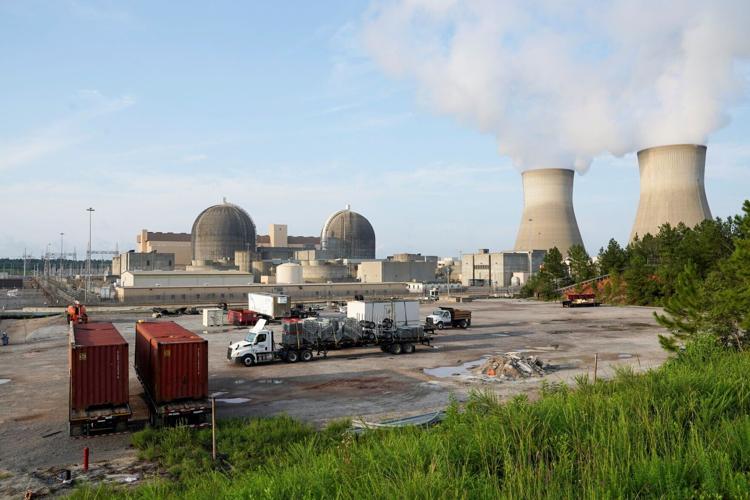
Reactors 1 and 2 are seen Aug. 13, 2024, at the nuclear-powered Vogtle Electric Generating Plant in Waynesboro, Ga. Construction of reactors 3 and 4 at the plant faced massive cost overruns.
A cautionary tale?
CWIP incentives are often coupled with provisions that shield utilities from delays, cancellations and cost overruns, leaving ratepayers to pick up the tab, said Jason Walter, a University of Tulsa economics professor.
"If a project, particularly a nuclear one, cannot attract private capital without a public backstop, it is a clear signal that it may not be a financially responsible investment," he said. "Forcing captive ratepayers to act as the bank for speculative projects serves no clear public purpose."
The structure triggered public backlash in some cases.
In November, Georgia voters unseated two Republican public service commissioners, fueled by an anti-CWIP referendum over massive cost overruns from the construction of the two Vogtle nuclear reactors.