A unanimous Nebraska Supreme Court on Friday rejected a legal challenge to the ballot measures that put medical marijuana before the state's voters in 2024, who overwhelmingly approved it.
People are also reading…

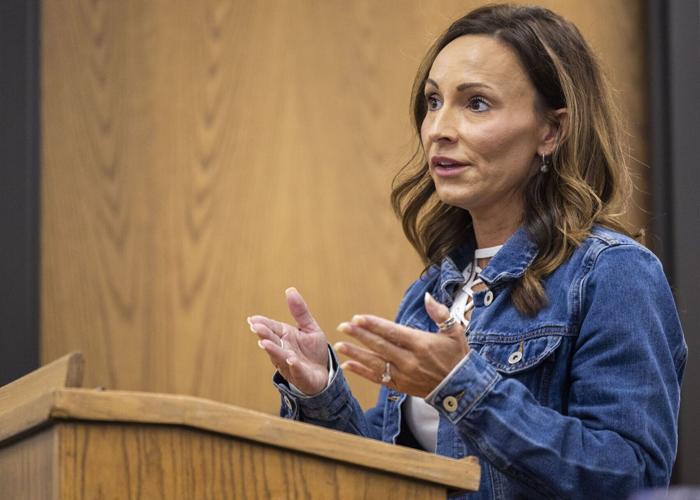
Crista Eggers, director of Nebraskans for Medical Marijuana.
Top Journal Star photos and videos for September 2026

Arron Klassen grooms a calf belonging to a friend from Fullerton ahead of the Steer Producer and Jackpot Feeder Show at the Nebraska State Fair on Tuesday, Sept. 1, 2026, in Grand Island.

From left, Milford's Libby Reil (7) Braelynn Mueller (13) Adalyn Cisneros (2) Bryn Grossart (6) and Ashlynn Miller (14) celebrate after a point on Tuesday, Sept. 1, 2026, at Freeman High School in Adams. Milford beat Freeman 3-1.

President Jeffrey Gold speaks during the State of the University address Thursday at the Capitol.

Republican U.S. Sen. Pete Ricketts, left, and independent candidate Dan Osborn, right, debate at the Nebraska State Fair on Tuesday in Grand Island.

Pedestrians walk over the east bridge at Holmes Lake as fragrant water lilies in bloom grow on the north shore on Monday, Aug. 31, 2026.

Nebraska's Danny Odem (16) celebrates with Jamal Rule (25) after the game on Saturday, Sep. 5, 2026, at Memorial Stadium. The Huskers defeated the Bobcats 49-21.

Nebraska's Dawson Merritt (40) tackles Ohio’s Victor Rosa (4) during the first half on Saturday, Sep. 5, 2026, at Memorial Stadium.

Ohio’s Tyler Gillison (9) and Charlie Christopher (30) bring down Nebraska's Jamal Rule (25) just short of the end zone during the first half on Saturday, Sep. 5, 2026, at Memorial Stadium.

Ashland-Greenwood's Liam Curtis (3) runs through a tunnel of teammates and young fans on Friday, Sept. 4, 2026, at Memorial Stadium in Ashland. Ashland-Greenwood was up 21-0 going into halftime against Syracuse.

Lincoln Mayor Leirion Gaylor Baird looks out the window while waiting for City Council Chair Brody Weber before a press conference announcing the city’s proposed alternatives to the Lincoln charter amendments on Monday, Sept. 14, 2026, at the Cornhusker Marriott.

Nebraska's Anthony Colandrea (10) high-fives fans after scoring a touchdown that was overturned due to a holding call during the second half on Saturday, Sept. 12, 2026, at Memorial Stadium.

Nebraska's Nyziah Hunter (1) and Quinn Clark (18) jump into the air as they join their team in running onto the field before facing off against Bowling Green on Saturday, Sept. 12, 2026, at Memorial Stadium.

Crete firefighter Tim McLaughlin carries an American flag up the North Stadium steps during the 9/11 memorial stair climb Friday at Memorial Stadium.

Lincoln East's Lydia Jansen (7) leaps into the air as she joins her team in a pregame cheer before a softball game on Thursday, Sept. 10, 2026, at the Southeast Athletic Complex.

Hobby Beacon owner John Kimmel carries a stack of wargames at Hobby Beacon on Wednesday. Kimmel is opening the new tabletop gaming store next to Super Saver near 48th and O streets.

Lincoln City Councilman Justin Carlson signs his name on a ceremonial beam during a topping-off ceremony for the Lied Center for Performing Arts’ addition Tuesday.

Nebraska's Mekhi Nelson (13) runs the ball under defense by Bowling Green's Josira Andrews (26) on Saturday, Sept. 12, 2026 at Memorial Stadium in Lincoln. Nebraska led Bowling Green 35-0 going into halftime.

Nebraska's Kwazi Gilmer (3) celebrates his touchdown on Saturday, Sept. 12, 2026 at Memorial Stadium in Lincoln.

Nebraska's Teraya Sigler (11) hits against New Mexico's Campbell Hollister (4) and Madeleine Miller (16) on Thursday, Sept. 10, 2026, at the Devaney Sports Center in Lincoln.

Nikki Edwards, from Greensboro, North Carolina, celebrates after taking first place in her race in Car CSXL 19 — a 2012 Mazda MX-5 — during the Tire Rack SCCA Solo Nationals on Wednesday at Lincoln Airpark.

Norris's Malorie Boesiger (7) hits the ball over the net against Waverly's Mia Jackson (12) on Sept. 15 in Firth.

Outside of Courtroom 22, 17-year-old Nyaden Tong (left) embraces 18-year-old Savannah Khol (right) after sitting in the gallery with several other friends for the virtual arraignment appearance for Tyler Benzel on Friday, Sept. 18, 2026, in the Justice and Law Enforcement Center in Lincoln. Both women say they are long-time friends (and in Tong’s case, a family friend) of the late 19-year-old Nyandeng “Brianna” Chol, whom Benzel stands accused of fatally shooting earlier that week. “She needs her justice—it's important for us to be there for [Brianna] and her family,” Tong said.

Belle Troupe, 9, left, and her sister Violet, 11, smile at one another as they take the stage after winning the Young Leaders award at the Inspire Awards ceremony Wednesday at Pinnacle Bank Arena.

Nebraska's Anthony Colandrea (10) and Mekhi Nelson (13) are joined by their teammates as they take the field ahead of the game on Saturday, Sep. 19, 2026, at Memorial Stadium.

Nebraska's Jamal Rule (25) celebrates his touchdown by pretending to bowl the ball during the first half on Saturday, Sep. 19, 2026, at Memorial Stadium.

Former Nebraska head football coach Tom Osborne, left, and Gov. Jim Pillen unveil a bust of Osborne during a Nebraska Hall of Fame induction ceremony at the Capitol on Friday. Osborne became the first living Nebraskan to be inducted into the hall.

Seward’s Jackson Einspahr, right, looks back to check where Papillon La Vista South’s Aiden Gehring is as they race to the finish in the boys varsity race during the Harold Scott Invitational on Thursday, Sept. 17, 2026, at Pioneers Park.

A resident reacts to a levy and valuation chart shared by LPS during a pink postcard hearing on Thursday, Sept. 17, 2026, at the County-City Building. The City Council approved a two-year budget on Aug. 24. The approximately $650 million budget will increase property tax collections by 5.36%, which amounts to about $117 million. Lincoln Public Schools is requesting approximately $385 million in property taxes, up from about $354 million in 2025-26.