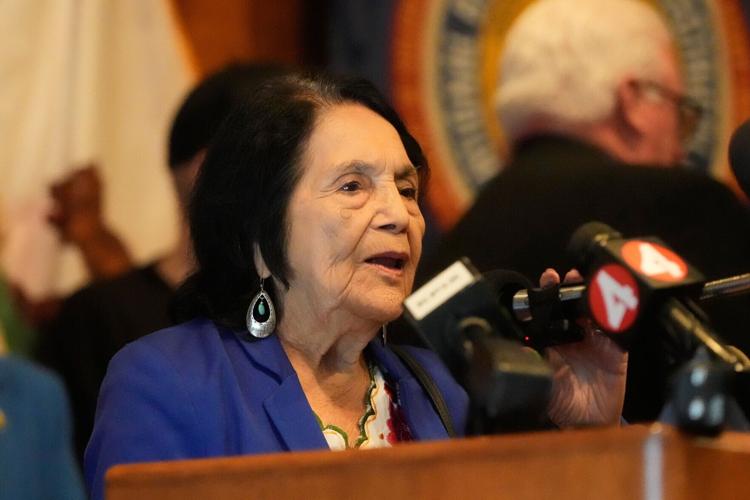
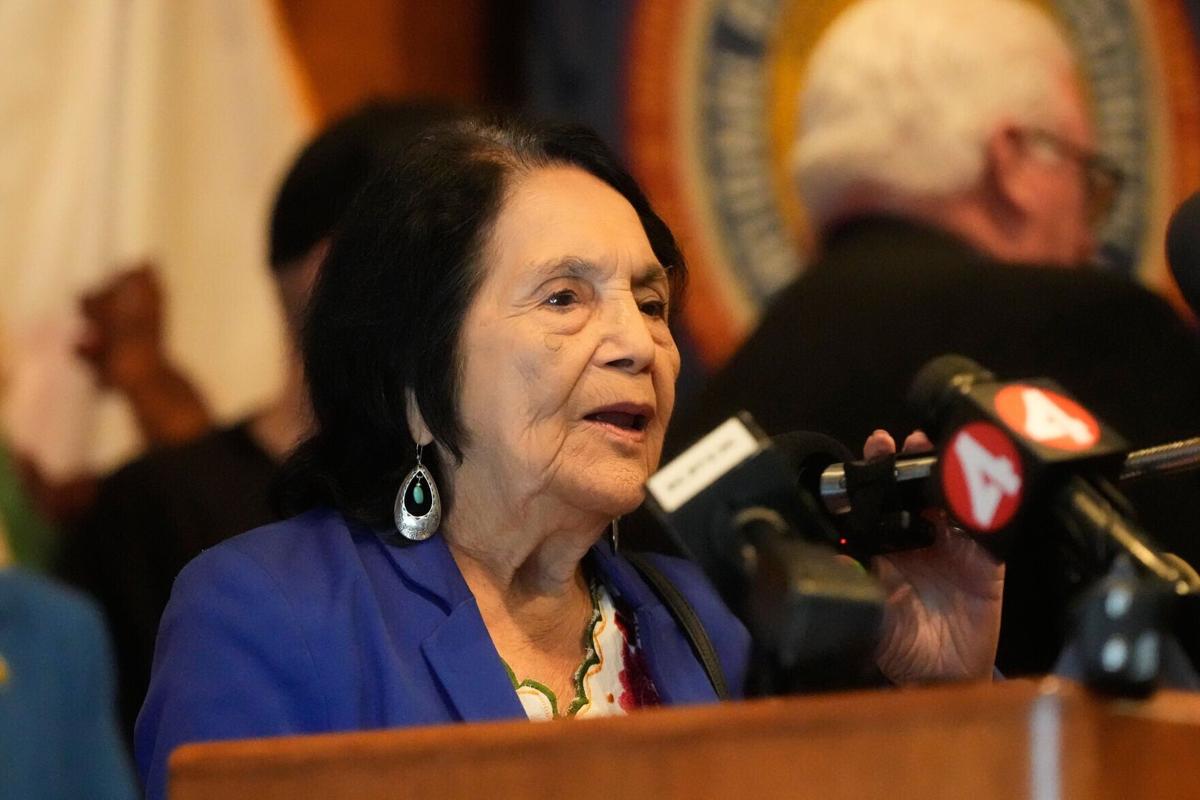
Labor rights activist Dolores Huerta revealed she was among women and girls who say they were sexually abused by César Chavez, the widely admired Latino icon who brought to light the struggles of farmhands while leading the United Farm Workers union.

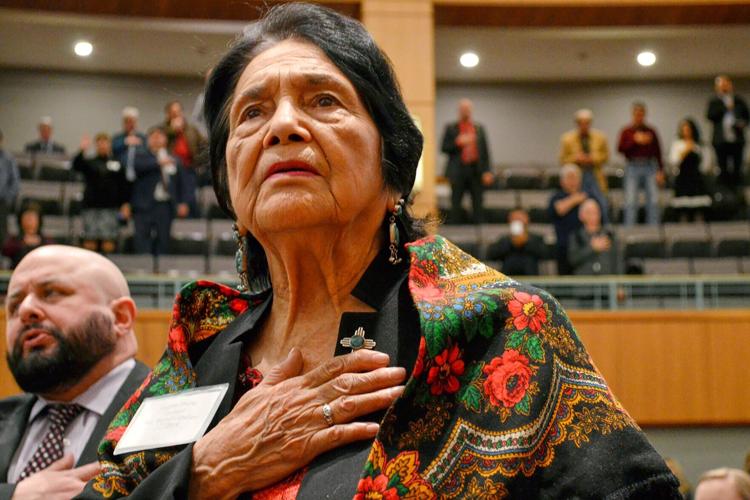
FILE - Dolores Huerta, the Mexican-American social activist who formed a farm workers union with Cesar Chavez, stands for the Pledge of Allegiance in Spanish while visiting the New Mexico Statehouse in Santa Fe. N.M., on Feb. 27, 2019. (AP Photo/Russell Contreras, File)
People are also reading…

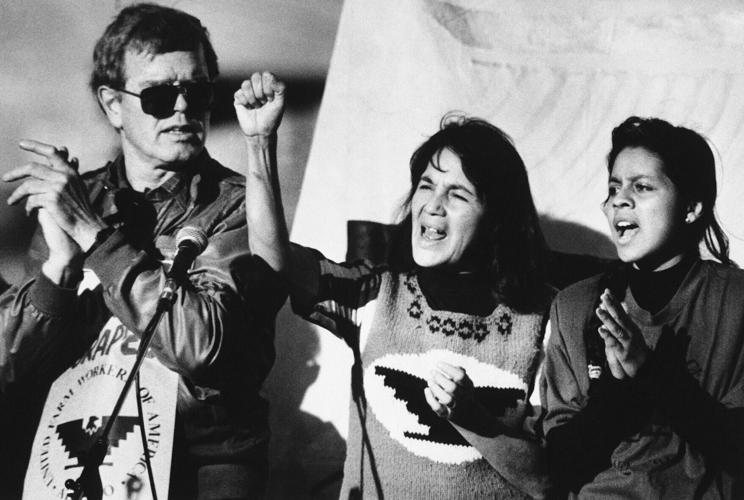
United Farm Workers leader Dolores Huerta, center, leads a Nov. 19, 1988, rally along with Howard Wallace, left, president of the San Francisco chapter of the UFW, and Maria Elena Chavez, 16, right, the daughter of Cesar Chavez, in San Francisco's Mission District as part of a national boycott of what the UFW claimed was the dangerous use of pesticides on table grapes.

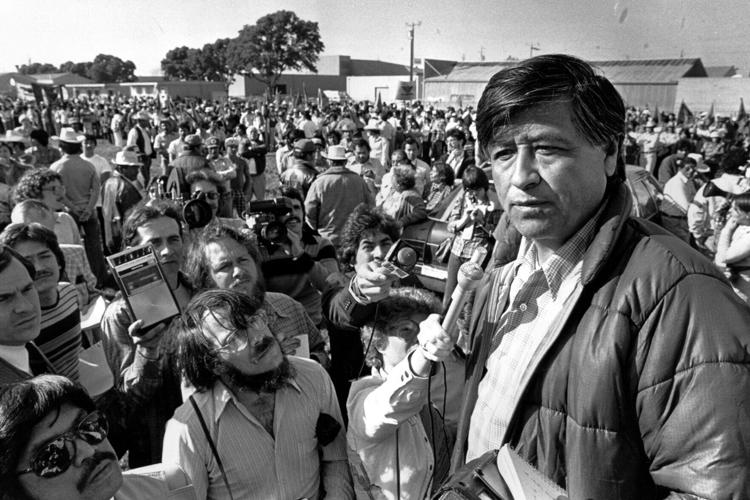
FILE - United Farm Workers President Cesar Chavez talks to striking Salinas Valley farmworkers during a large rally in Salinas, Calif., on March 7, 1979. (AP Photo/Paul Sakuma, File)

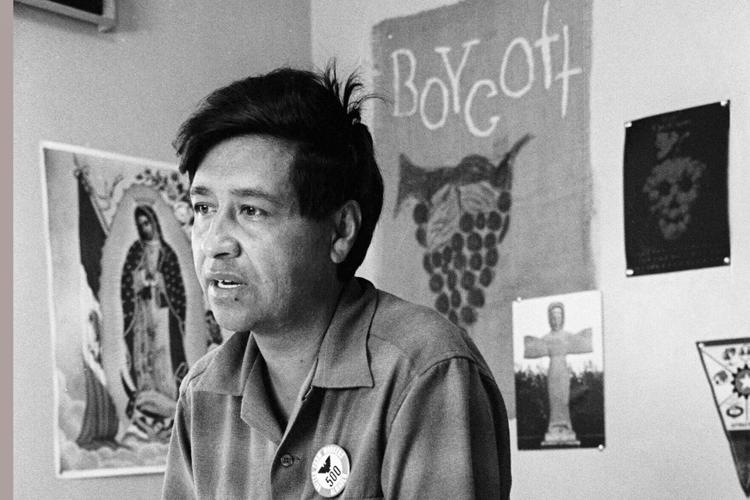
César Chavez, a farm worker, labor organizer and leader of the California grape strike, is seen in 1965 in a California works office.
15 women who made a difference (and a few who still are)
Sojourner Truth

She was born into slavery but escaped with her daughter in 1826. The African-American abolitionist and women’s rights campaigner gave a noteworthy extemporaneous speech “Ain’t I a woman?” in 1851, powerfully and simply speaking about the racism and sexism of her day.
Harriet Tubman

She was a slave who escaped in 1849 and then went back to lead other slaves to freedom on the Underground Railroad. She became a speaker on the experiences of slavery and an advocate for the rights of African-Americans and black women.
Susan B. Anthony, Lucretia Mott, and Elizabeth Cady Stanton

Stanton was a U.S. activist and leading figure in the early women’s rights movement. She also was the main author of “Declaration of Sentiments” in 1848. Along with activist Susan B. Anthony, she founded the National Woman Suffrage Association in 1869. Anthony fought against slavery and for the promotion of women’s and workers rights. She began campaigning with the temperance movement and became convinced that women should have the vote. Her work helped pave the way for the 19th Amendment (1920), which finally gave women the right to vote. Mott was one of the leading voices of the abolitionist and feminist movements of her time. She helped form the Philadelphia Female Anti-Slavery Society in 1833, and later was among the founders of the American women’s rights movement.
Elizabeth Blackwell

Born in Britain in 1821, Blackwell was the first woman to receive a medical degree in the U.S. and was the first woman to be on the U.K. medical register. She helped to smash social barriers that prevented women doctors from being accepted.
Marie Sklodowska Curie

The Polish/French scientist was the first woman to receive the Nobel Prize and the first person to win the Nobel in two categories. Her first award was for research into radioactivity, in 1903. Her second Nobel was for chemistry, in 1911. She also helped develop the first X-ray machines.
Helen Keller

The U.S. crusader for the handicapped overcame the challenges of being blind and deaf to become one of the 20th century's leading humanitarians, activists and lecturers. She also co-founded the ACLU in 1920.
Emily Murphy

She was the first woman magistrate in the British Empire, and in 1927, she joined forces with four other Canadian women who sought to challenge a Canadian law that declared, “Women should not be counted as persons.”
Hedy Lamarr

The stunning actress starred with Clark Gable, Spencer Tracey and others on the silver screen in the 1930s and 1940s. She also was a scientist, helping to invent an early technique for spread spectrum communications, which led to the wireless communications we enjoy today.
Rosa Parks

The seamstress quietly but firmly refused to give up her seat to a white man on a Montgomery, Ala., city bus in 1955, and created a firestorm of activism that quickly spread. The leaders of the local black community organized a bus boycott that began the day Parks was convicted of violating segregation laws. Her action emboldened the civil rights movement.
Wangari Maathai

Katherine Johnson

Gloria Steinem

Shirley Chisholm

Chisholm was the first black congresswoman in U.S. history and served for seven terms. She ran for the 1972 Democratic nomination for the presidency, becoming the first major-party African-American candidate to do so. She also fought for education opportunities and social justice.
Dolores Huerta

The co-founder of what would become the United Farm Workers was one of the most influential labor activists of the 20th century. Huerta today continues to work to improve social and economic conditions for farm workers and to fight discrimination.
Malala Yousafzai

The Pakistani activist was only a teenager when she began to speak out against the Taliban and its attacks on education for girls. She was shot in an assassination attempt at age 15. It only made her more determined. In 2014, Yousafzai and Kailash Satyarthi were awarded the Nobel Peace Prize for their activism. Today the Malala Fund works to ensure girls receive an education.