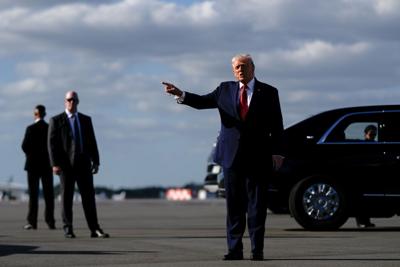
WASHINGTON — President Donald Trump has issued a flurry of pardons in recent days, including for the father of a large donor to his super PAC, a former governor of Puerto Rico and a woman whose sentence he commuted during his first term but who ended up back in prison for a different scheme.
People are also reading…

President Donald Trump points Friday after arriving at Palm Beach International Airport on Air Force One in West Palm Beach, Fla.

11 questionable presidential pardons
George Washington and the Whiskey Rebellion

In the first test of the strength of the presidential pardon, George Washington issued a pardon to John Mitchell and Philip Weigel, two men convicted of treason in the “Whiskey Rebellion” of 1794.
Though Washington’s pardon went largely unchallenged by contemporaries like John Jay and Alexander Hamilton (who implemented the whiskey tax that caused the rebellion and urged Washington to act against the rebels), there was a debate on whether the right to issue a pardon should lie with the president or with Congress.
Andrew Johnson gives accomplices a pass

Samuel Arnold, Samuel Mudd and Edmund Spangler were accused as co-conspirators in John Wilkes Booth’s plan to assassinate Abraham Lincoln, the 16th president of the United States. Arnold was a surgeon who set Booth’s broken leg after he escaped from the Ford Theater and met with Booth at least once before he shot Lincoln on April 14, 1865. Mudd and Spangler respectively plotted with Booth in an aborted plan to kidnap Lincoln and helped Booth escape after the murder. A fourth conspirator, Michael O’Laughlen, was also prosecuted and died in a Florida prison.
In 1869, Andrew Johnson, Lincoln’s successor, pardoned Arnold, Mudd and Spangler.
Woodrow Wilson will pardon for testimony

This defeat for the presidential pardon also served as a victory for freedom of the press. When the federal government called New York Tribune city editor George Burdick to testify in its investigation on whether employees of the U.S. Treasury and the U.S. Custom House were leaking classified information, Burdick plead the Fifth. In an effort to get Burdick to testify, President Woodrow Wilson offered him a “full and unconditional pardon” from any wrongdoing, which Burdick promptly refused.
The Supreme Court upheld Burdick’s refusal, in accordance with former Chief Justice John Marshall’s definition of a pardon as a “a private, though official” action that could be “rejected by the person to whom it is tendered.”
Gerald Ford decides Richard Nixon is "not a crook"

Disgraced President Richard Nixon claimed he wasn’t a crook and his successor, Gerald Ford, made it official. After assuming the nation’s highest office following Nixon’s resignation in 1974, President Ford issued him a pardon, claiming that the impact on the country would be worse if Nixon were indicted on charges stemming from his role in the Watergate scandal.
Ford’s decision wasn’t met with rousing support; his press secretary resigned, and Ford lost his run for president to Democrat Jimmy Carter.
Mark Felt gets a bye for breaking and entering

In 1980 Mark Felt (who’d later reveal himself as the Watergate informant known as Deep Throat) and Edward S. Miller were convicted of facilitating illegal searches of the homes of a group of Vietnam War protestors known as Weather Underground in 1972. The break-ins had previously been declared unconstitutional and didn’t lead to any arrests or captures.
Felt acknowledged that his actions were illegal and in violation of the Fourth Amendment, but maintained that they were necessary for the safety of the country.
Bush sweeps Iran Contra under the rug

Just before his term ended, President George H.W. Bush issued pardons to six government officials involved in the sale of weapons to Iranian terrorists against U.S. public policy, and the redirecting of funds from those sales to the anti-communist Contras in Nicaragua. Bush pardoned former Secretary of State Caspar Weinberger before he was to stand trial on charges of perjury and obstruction of justice, as well as Robert McFarlane, Reagan’s national security adviser, who’d been sentenced to two years probation for withholding evidence.
Bush also handed down pardons to former Assistant Secretary of State Elliot Abrams and three CIA officials, who faced varying charges of perjury, withholding evidence and making false statements related to the Iran-Contra scandal. Despite being vice president at the time and claiming in his diary to have been “one of the few people that knew fully the details,” Bush 41 denied wrongdoing related to the scandal and refused to discuss it.
Marc Rich gets rich in exile ... then gets pardoned

Commodities broker Marc Rich took refuge in Switzerland to avoid charges of tax evasion, violating trade embargoes, racketeering and wire fraud. During his time abroad, he even briefly made a profit selling copper to the U.S. Mint, while occupying the No. 6 spot on the country’s “Most Wanted Fugitives” list.
After securing Jack Quinn, a lawyer and former counsel to President Bill Clinton, Rich appealed to Clinton for a pardon using testimonies from Israeli leaders about his generous contributions to political and artistic causes in the country. Rich’s ex-wife, Denise, had also made donations to the Clintons and the Democratic Party totaling over $1 million. Under a veil of secrecy and questionable public relations tactics, Rich secured a pardon from Clinton just before George W. Bush was sworn in as the 43rd president.
The New York Times called the move “indefensible” a “shocking abuse of presidential power,” while the New Republic labeled the pardon as “Exhibit A of Clintonian sliminess.”
Bill Clinton shows some brotherly love

Any situation involving a president pardoning his little brother (whose Secret Service codename was “Headache”) is likely to raise eyebrows. And that’s exactly what happened when Clinton pardoned his half-brother Roger for conspiracy to distribute cocaine.
Roger’s record was wiped clean on his brother’s last day in office, but he hasn’t quite stayed out of trouble. In 2001, the younger Clinton was arrested for driving under the influence and was embroiled in legal issues throughout the 2010’s including a lawsuit claiming he was liable for an assault that happened in his home in 2011.
Way to go, Arpaio

In 2017 an Arizona court convicted police chief Joe Arpaio of criminal contempt of court after Arpaio failed to stop racially profiling and detaining illegal immigrants simply for not having documentation. Arpaio faced a fine and up to six months in jail but a month after his conviction, President Donald Trump pardoned Arpaio and expressed appreciation for Arpaio’s commitment to "protecting the public from the scourges of crime and illegal immigration."
The president’s decision was widely criticized, even by members of the Republican Party, including Speaker of the House Paul Ryan, and Arizona Senators John McCain and Jeff Flake.
D'Souza gets a pardon over dinner

Dinesh D’Souza, a former Reagan adviser known for his incendiary anti-liberal opinions and conspiracy theories, pled guilty in 2014 to charges of using straw donors to contribute to a friend’s campaign. According to The New York Times, U.S. Attorney Pete Bharara recommended prison for D’Souza, but ultimately, D’Souza only received a $30,000 fine and five years of probation.
Trump’s pardon, which came in 2018, was controversial because initially, Trump claimed he wasn’t asked to pardon D’Souza and did so because he was “treated very unfairly.” D’Souza and other sources later said Sen. Ted Cruz had appealed for D’Souza’s pardon over dinner.
Trump was also believed to have pardoned D’Souza to get back at Bharara, a former adviser who became a staunch Trump opponent after he was fired.
Trump shows a new kind of self love

In the midst of the Mueller investigation into whether or not Russia interfered in the 2016 election, Trump asserted, via Twitter, that he could absolve himself of any wrongdoing.
“As has been stated by numerous legal scholars, I have the absolute right to PARDON myself, but why would I do that when I have done nothing wrong,” the president said.
His lawyer and former New York City Mayor Rudy Giuliani also said the president could probably pardon himself. But legal precedent isn’t on Trump’s side. According to a 1974 memo from the Justice Department's Office of Legal Counsel, the president cannot pardon himself because, “no one may be a judge in his own case."
Forgiveness curries favor

More than one president has been accused of offering pardons in exchange for support. Warren G. Harding's administration is suspected to have exchanged pardons and political appointments for financial contributions. Both Franklin D. Roosevelt and Richard Nixon are believed to have pardoned people involved with organized crime (Conrad Mann and Jimmy Hoffa, respectively) because of their ties to powerful political figures or willingness to support them.