
Technology allows health care providers to learn, practice in safe environment
OMAHA -- When a cardiologist wanted to work with a manufacturer to develop and test a new type of stent for large heart arteries, a team of visualization experts at the University of Nebraska Medical Center's high-tech simulation center created a 3D model of an artery.
After the so-called Megatron stent was approved by federal regulators, Dr. Yiannis Chatzizisis, chief of interventional cardiology at UNMC, used the 3D visualization and simulations plus artificial intelligence to plan procedures using the stent, finding the right size of device and determining the correct position for it.

Yiannis Chatzizisis
In early 2021, he placed the first of the new stents deployed in the United States in two patients at the Nebraska Medical Center.
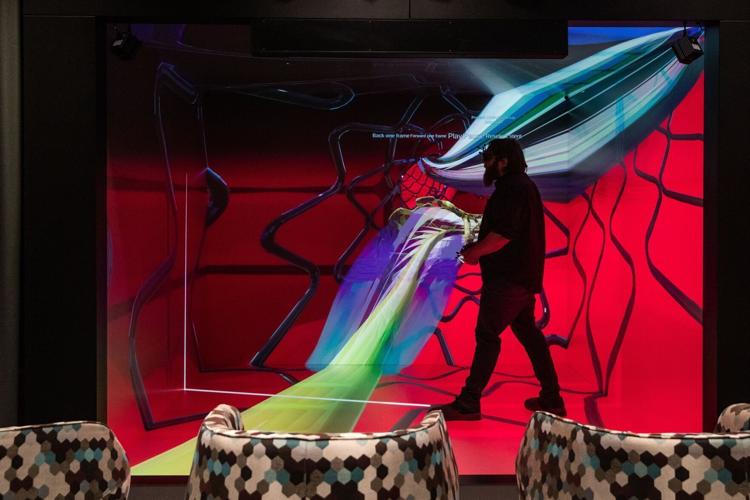
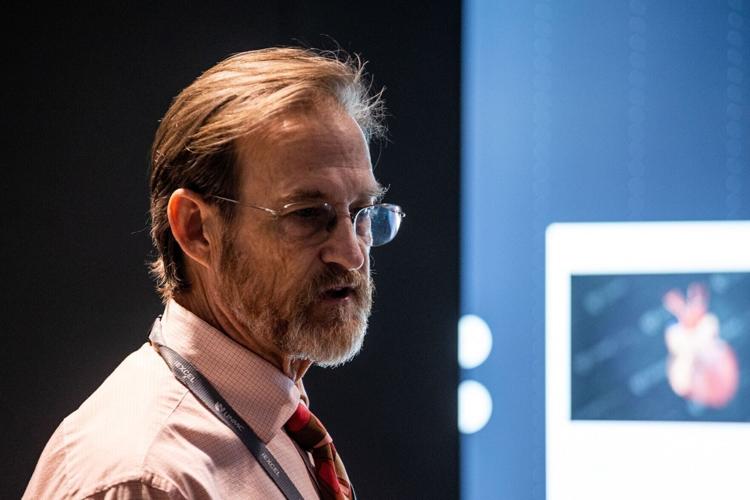
The 3D model allows medical professionals and students to walk through the arteries and study stent placement in a five-sided laser cave or see them through virtual reality headsets.
People are also reading…
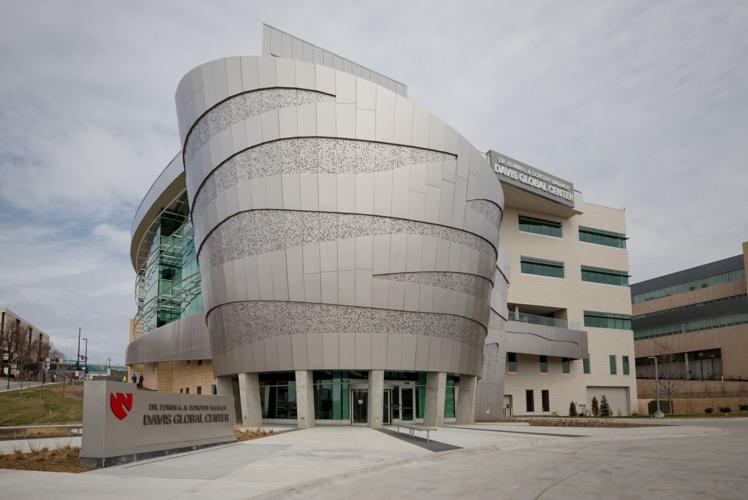
UNMC's iEXCEL (Interprofessional Experiential Center for Enduring Learning) program, housed in the Davis Global Center on UNMC's Omaha campus, features some of the latest and greatest innovations in medical simulation and visualization. But the use of simulation technology in health care dates back about two decades.
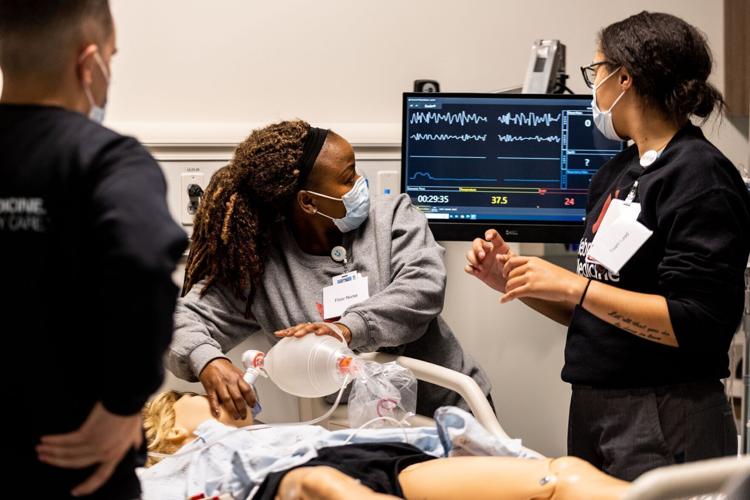
Simulation center rooms, hallways and equipment replicate what students and fully fledged health professionals will see in hospitals and homes. They're occupied by lifelike mannequins that can say words, suffer heart attacks and deliver babies. Caregivers can give the mannequins CPR, inject medications into them and intubate them. Most centers also tap a less high-tech learning tool: real people with whom students can practice taking histories, conducting assessments and other real-world skills.
"The challenge in health care was creating realistic simulations and realistic scenarios," said Pamela Boyers, UNMC's associate vice chancellor of clinical simulation.

Pamela Boyers
"As technology (has) advanced," she said, "especially in simulation and now of course visualization, it's helping us create much more realistic scenarios. For simulation to be successful, it has to be accurate, it has to be realistic. The more realistic it is, the better the learning."
The mannequins used in simulation are becoming ever more realistic, which adds a level of realism to the practice, said Colleen Steinhauser, coordinator of the simulation lab at Nebraska Methodist College. Students can inject a medication and see vital signs change. The college shares with Methodist Women's Hospital a newborn mannequin that can grunt, cry and move its arms and legs. If she's not getting enough oxygen, a blue LED comes on, tingeing her skin blue.
Boyers said health care had trailed aviation, nuclear power and the railroad industry in the use of simulation. Now, researchers measuring the outcomes of simulation on education are finding it has a big impact on patient safety and preparedness and reduces the stress on health care providers. That's because they can practice in safe spaces without fear of harming a patient until they feel — and test — proficient.
That's particularly important in fast-paced clinical environments, such as the intensive care unit, where there is a lot of equipment, Boyers said.
"I think there's an even greater need for simulation centers now than there was even 10-20 years ago," she said.

Eric Peters
Dr. Eric Peters, medical director of Creighton University's medical simulation labs, said he was a resident the first time he got his hands on equipment used in some of the procedures in which he participated.
Today, Creighton's medical students start to learn some of those skills in their first year. "When they're hitting the ward, they're not nervous to be involved," he said. "They're excited to be involved. They're not scared ... they've had their hands on this stuff."
During a gastroenterology block, students use replicas of real devices and perform simulated endoscopies. They can see the inside of a colon or a stomach on a screen and find polyps in the colon or ulcers in the stomach. During surgical simulations, if they cut an artery, students can see it bleed on the screen. Instructors can show them how to handle the bleed and other complications.
Said Jan Stawniak, the Creighton labs' education director: "It's not learn as you go. It's learn before you go."

Jan Stawniak
Connor Aylor, a first-year medical student at UNMC who's from Lincoln, recently learned how to use an ultrasound device at iEXCEL. When it comes time to use that skill and care for real patients, he'll already know what to do.
"This is a safe area where we can practice these skills so that when we go to a patient, we're not worried about the technology or what we're supposed to be doing," Aylor said. "We know that, so that's ready to go."
Simulation also can be used to help prepare students for situations they may not encounter in their clinical training. During the height of the COVID-19 pandemic, simulation provided an alternative when students couldn't get into hospitals and other clinical spaces to train.
Third-year nursing students at Bryan College of Health Sciences in Lincoln recently practiced caring for a cancer "patient," a high-tech mannequin, with a blood clot in her leg. In the simulation, when they helped her to the bathroom, she suffered a blood clot to the lung and became short of breath. The students listened to her lung sounds, gave oxygen and called a health care provider.
"We learned a lot," said student Oakley Pfeifer. "It's good because we don't always get the full circle on clinicals."
Said fellow student Natalie Kleint: "This gives us the worst possible complications so we're prepared on the floor."
Down the hall in the college's simulation center, meanwhile, nurses from Bryan East Campus worked to develop a new scenario involving a laboring mother with an amniotic fluid embolism, a rare but serious condition in which amniotic fluid — the fluid that surrounds a baby in the uterus during pregnancy — enters the mother's bloodstream.
Once it's finalized, the scenario — which ends with a doctor performing an emergency cesarean section and a team whisking the baby to the neonatal intensive care unit — will be used to train health care professionals within Bryan Health, said Barbara Sittner, simulation center director and professor of nursing. The college's $1.5 million simulation center, housed in a former nurses' dormitory, was renovated in 2019.
Faculty and health care providers also take various training sessions on the road and into the community, Sittner said. Last year, a team went to 12 small rural hospitals affiliated with Bryan that don't normally deliver babies. One of the hospitals where they conducted the training sessions has had two unplanned births since April with no complications. "They felt a lot more confident in their skills," she said.
Use in the community also is increasing, Sittner said. Before football practices started this fall, a team conducted a simulated heat stroke response for athletic trainers at Lincoln's Seacrest Field. The training was initiated by the Nebraska State Athletic Trainers' Association and included practicing cooling overheated athletes and removing helmets and pads.
Many health care simulation centers have been focused on specific disciplines, such as nursing or medicine, UNMC's Boyers said. But iEXCEL is among the leaders in a shift toward mega-simulation centers geared to training people from multiple disciplines with the goal of fostering interprofessional collaboration and teamwork.
The learning center is housed in the $121.8 million Dr. Edwin G. & Dorothy Balbach Davis Global Center which opened in 2020 and was funded through a public-private partnership made up of state, city and federal government and philanthropists.
The center, she said, stands out in that it replicates the total health system, from home to hospital and back, which allows learners to practice transferring simulated patients throughout the health care system. Even the hallways are lined with cameras so instructors can assess trainees' transfer skills.
"In the patient safety literature," Boyers said, "transfer of care between and among teams or levels of care is actually where patients can be most vulnerable to error."
Three of four floors in Southeast Community College's two-year-old, $25 million health sciences building are part of the interdisciplinary center that also replicates the span of health care. It includes an apartment for home care experiences, a clinic with exam rooms and counseling space and a medical center with patient care rooms simulating an emergency room, intensive care, labor and delivery, and long-term care areas.
Technology also connects the Lincoln interdisciplinary center to the college's six satellite learning centers and Beatrice and Milford campuses, which also have at least two patient care areas supporting rural health care education, said Jill Sand, health sciences dean.
As for iEXCEL, it existed as a program for about five years before it moved into the center in January 2020, said Michael Hollins, iEXCEL's associate executive director for community and business strategy.
The first floor of the center houses a team of design and programming experts who work with clinical specialists to create highly detailed and accurate 3D content and bring it to life.
The content, such as models of the brain and heart, can be displayed in the center's holographic theater on a three-story Sony Infinity Wall.
"What's important is we're not really tying ourselves to the technology, but rather creating the world's most accurate content that can go to just about any piece of technology," Hollins said.
Students can view holographic lectures by Dr. Robert Norgren for their neurology block. It features a visualizations of a brain that can be pulled into its component parts. Once students have learned the anatomy, they practice procedures on cadaver tissue in the surgical suites on the third floor.
The center's second floor houses a replica home and hospital setup.

UNMC artistic director of iEXCEL visualization Bill Glass speaks during a demonstration of an iWall at the Davis Global Center in Omaha.
The team also has models that can be adapted — some can be displayed on a phone — so doctors can walk patients through surgeries, said Bill Glass, artistic director for iEXCEL visualization. In one case, the team quickly developed a visualization so a physician could walk a patient through treatment for an aneurysm. Usually, the physician would show a patient a two-dimensional CT scan. "If you're not a trained medical anatomist or physician," Glass said, "you don't really know how to make sense of those."
In another case, the team made a visualization so surgeons at Children's Hospital & Medical Center could test whether a ventricular assist device would fit inside the rib cage of a teen with an enlarged heart.
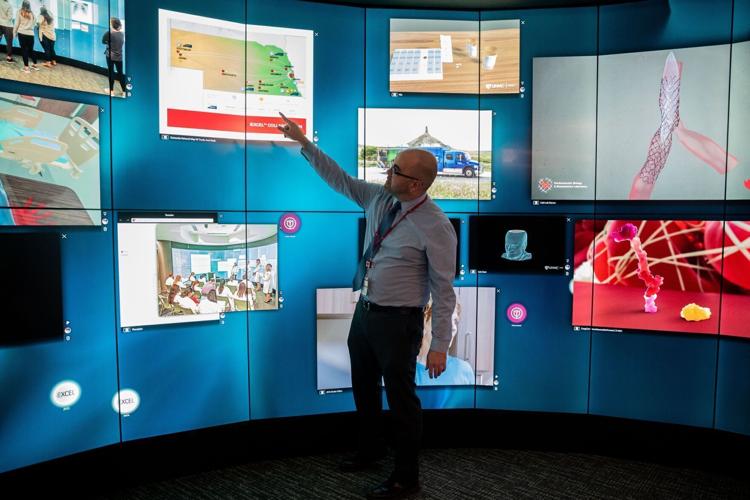
A 30-panel iWall, known as the Helix, is largely used for collaborative learning, said Paul Dye, iEXCEL's manager of educational technology and design. Similar walls have been installed in Scottsbluff, Kearney, Norfolk and Lincoln.
"We can connect all those walls together in real time, so we can have a real-time learning session with one subject-matter expert in one location," he said.
Meanwhile, the team has most of the human body modeled. They're wrapping up a model of the "coagulation cascade," a visualization of the steps involved in clotting. With the Global Center for Health Security, they created a virtual reality activity in which users can practice proper cleaning and disinfection. When they're done, they can use a tool to visualize how well they have done.
As good as the technology is, said Creighton's Stawniak, it's not a substitute for good teachers. The ultimate reward for those instructors is to see how much students have grown when they're practicing in their chosen fields.
"It's really humbling," she said, "to be part of that."

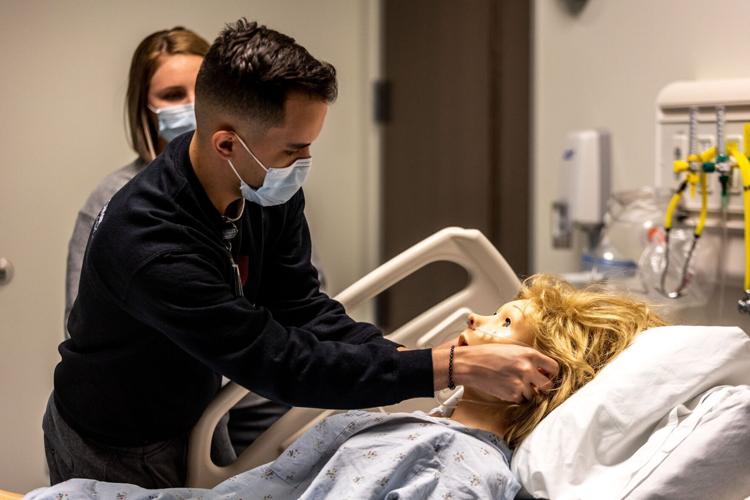
A UNMC student attaches a nasal cannula to a mannequin during a clinical simulation at the Davis Global Center in Omaha.

UNMC manager of educational technology and design Paul Dye demonstrates uses for an iWall at the Davis Global Center in Omaha.

UNMC computer programmer Jeremiah Wilt shows a visualization of a stent being inserted into an artery at the Davis Global Center in Omaha.

UNMC students monitor the heart rate of a high-tech mannequin during a clinical simulation.

One portion of the Davis Global Center, situated near the northeast corner of 42nd and Leavenworth dtreets, got a high-profile tryout in the early days of the pandemic when it housed evacuees from a cruise ship stricken by COVID-19.