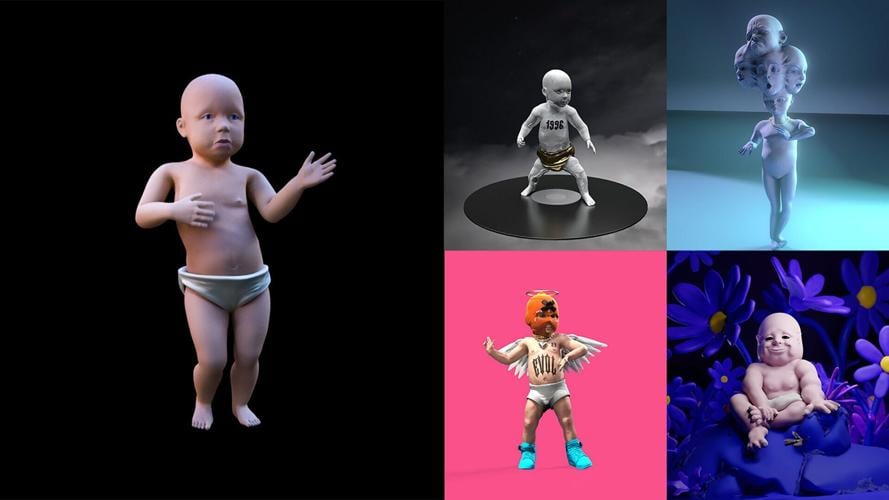

The internet's famous dancing baby from 1996 is getting a new look.
People are also reading…

(Clockwise from left) The newly rendered original Dancing Baby, plus "remixes" from Kreationsministern, Yuuki Morita, Yonk and Kid Eight.
Web3 is coming—here’s what you should know
Blockchains will be the foundation for Web3

The internet we know and use today is built on servers owned by individuals or corporations like Amazon Web Services. Proponents of Web3 envision breaking apart single-entity control by building programs using blockchain technology, which enables characteristics including decentralization, greater transparency and security, and immutability, meaning transactions cannot be changed. Web3 users could instead buy and sell information, goods, and services directly with each other without middlemen like banks or corporations. Using a dapp, or decentralized app, for payment, a user could pay another user directly, and the digital transaction would be verified and logged into a public record—or distributed ledger—on the blockchain without any banking institution.
NFTs open a market for digital art

Just as digital marketplaces took real-world services online, Web3 and NFTs will do the same. In October 2021, a digital artist named Beeple sold an NFT of a digital collage for $69 million dollars. What that buyer purchased was the digital proof—a unique file on the blockchain—that showed they own the original. People can still right-click on web images and “save as” all day long, but they only own a copy, not the original. Sales like this are happening all over the internet—people paying real money for NFTs that authenticate digital art. Artists can even ensure they receive royalties with each future sale of that specific NFT.
It may be censorship-resistant

Within the internet’s current structure, anyone, particularly bad actors, with access to a server can alter or remove the data it houses. This isn’t just hypothetical—there are plenty of examples of this happening already. But with a decentralized internet, no one entity can control where the data is housed, which makes it significantly less susceptible to censorship. Companies also won’t be able to silence or shut down individual accounts on their platforms. Users can access content that is stored in multiple places instead of one centralized server. And, because blockchain is immutable, data cannot be altered.
Web3 is "trustless"

Web2 relies on an intermediary between two internet users who do not know or necessarily trust each other. These peer-to-peer services control user data and set rules and protocols for interactions. Trust is placed in these third parties and not, necessarily, between individual users. But in this current environment, your data is not truly private or controlled by you. A “trustless” internet may sound even more dangerous and reckless, but according to experts, “equally credible” may be a better term. In Web3, blockchain will ensure all users will operate within the same set of rules, eliminating the need for trust and cutting down the risk of harmful or fraudulent transactions. Bitcoin’s early success is an example of a trustless internet.
It removes traditional hierarchy in a business or service

DAOs, or decentralized autonomous organizations, are the equivalent of a CEO-less company collectively owned and operated by its members. They are governed by the open and transparent codes written into smart contracts—essentially a computer program—and these contracts execute themselves. An enormous amount of bureaucracy and inefficiencies are eliminated when the bottleneck of a governing agency is removed. Every member has the right to propose and vote on changes. Some charitable organizations have started adopting DAOs as a more efficient way to raise funds and respond to urgent needs.
Major tech companies are already working on it

Recognizing both the potential of Web3 and the risk of losing top talent to startups pursuing the next iteration of the internet, current tech giants like Microsoft, Amazon and YouTube are investing in the future with job postings seeking experts in blockchain emerging technologies. Google announced in January 2022 that the company is forming a group to focus on blockchain and the next generation of “distributed computing and data storage technologies.” Even Facebook rebranding to Meta with a focus on the metaverse, which is the idea of an immersive online world where people use emerging technologies such as virtual reality, augmented reality, and holograms to interact with others online. Though different from Web3, both concepts hope to fundamentally change the future of the internet.
Tech employees are leaving established Silicon Valley companies to join Web3 startups

High-profile tech executives are leaving companies like Google and Amazon to help build and cash in on what they view to be the next big thing—crypto and Web3. While this does not necessarily guarantee either will reach the same levels of success or become as ubiquitous in our lives, it suggests that they are worthy of the attention of the brightest minds. YouTube, Meta, Uber, Airbnb, and Amazon, among others, have all lost top talent to new Web3 startups.
Its rise to prominence may not be inevitable, though

Skeptics and critics have called Web3 a scam, a multilevel marketing campaign, and a Ponzi scheme. While promoted under the guise of freedom, ownership, and an “of the people, by the people, for the people” narrative, critics say Web3 is simply going to make those already deeply embedded—and invested—in cryptocurrency and blockchain even richer. Critics also point to the hype and relatively limited scope and success of technology like augmented reality, or the fact that crypto is not a more widely adopted currency as evidence that Web3 may not come to prominence as proponents hope.
This story originally appeared on EWR Digital and was produced and distributed in partnership with Stacker Studio.