

The phrase “all’s fair in love and war” unfortunately also applies to politics. Especially when it comes to gerrymandering in Virginia. But it is fair to say that the Democrat push for redistricting prior to the 2030 census has shattered the concept of fairness.
People are also reading…
- 25-year-old Lexington man arrested for sexual assault
- Dan Osborn staffers infiltrated small Nebraska political party and tried to dissolve it
- First annual Lipedema Run and Walk held at Cozad Wellness Center
- Lady Swedes softball drops season opener to McCook
- Western Nebraska Football Top 5s
- Aristh Rodriguez-Linares found guilty of manslaughter Wednesday in Dawson County District Court
- Douglas County dismisses misdemeanor charges against Bellevue police officer
- ‘It’s hard work': Nebraska’s summertime rite of passage is quietly fading
- Volleyball top returners and key departures for Dawson County high school teams
- Livin’ Out Loud goes on despite storm damage
- LRHC’s Lehmann receives 2026 Caring Kind Award at surprise event
- Gothenburg softball finishes in seventh at Lexington tournament
- Wiley Canyon Ultra race hosts inaugural event Aug. 29 starting at Kirkpatrick Memorial Park
- 'Took my breath away' — Elm Creek, nearby communities unite at vigil for 3 injured teens
- Lake McConaughy could break its record low as summer wanes
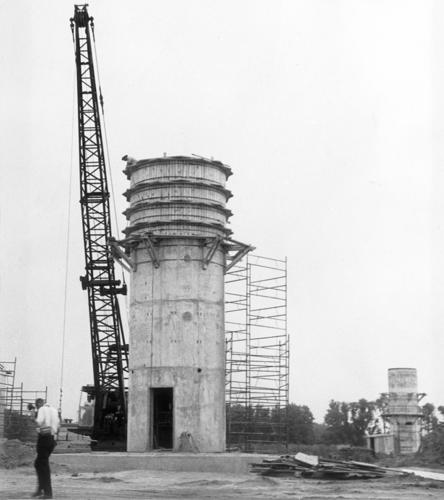
06-25-1959 (cutline): Space Age on a Sand Pit--John C. Palmer , scientists in charge of research missions at Wallops Island off Virginia's Eastern Shore, and Germain S. Brown, civil engineer in charge of construction, brief newsmen on building activity as the National Aernoautics and Space Administration expands its facilities. Work is reaching completion on three radar towers which will give Wallops its first long-range tracking and tie into the worldwide satallite tracking system. The new launch pads will permit firing of more powerful space vehicles. A tunnel is being dug to connect it to a blockhouse yet to be built. Wallops' job is to get the "bugs" out of new devices before full-scale space monsters are built.
- Staff photo
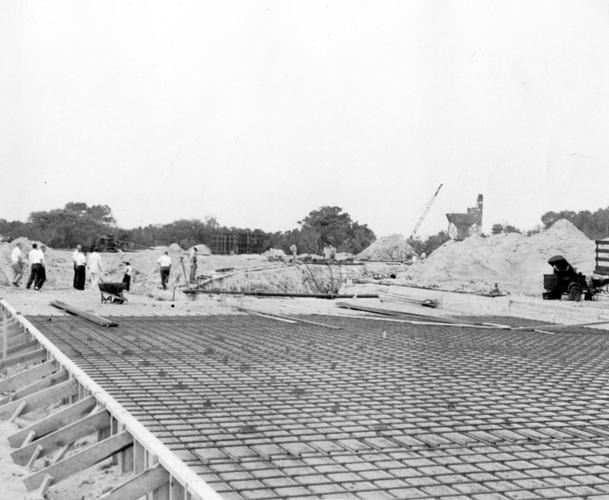
06-25-1959 (cutline): Space Age on a Sand Pit--John C. Palmer , scientists in charge of research missions at Wallops Island off Virginia's Eastern Shore, and Germain S. Brown, civil engineer in charge of construction, brief newsmen on building activity as the National Aernoautics and Space Administration expands its facilities. Work is reaching completion on three radar towers which will give Wallops its first long-range tracking and tie into the worldwide satallite tracking system. The new launch pads will permit firing of more powerful space vehicles. A tunnel is being dug to connect it to a blockhouse yet to be built. Wallops' job is to get the "bugs" out of new devices before full-scale space monsters are built.
- Staff photo
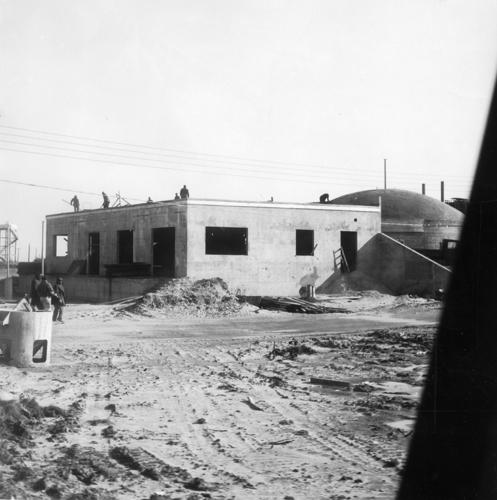
06-25-1959 (cutline): Space Age on a Sand Pit--John C. Palmer , scientists in charge of research missions at Wallops Island off Virginia's Eastern Shore, and Germain S. Brown, civil engineer in charge of construction, brief newsmen on building activity as the National Aernoautics and Space Administration expands its facilities. Work is reaching completion on three radar towers which will give Wallops its first long-range tracking and tie into the worldwide satallite tracking system. The new launch pads will permit firing of more powerful space vehicles. A tunnel is being dug to connect it to a blockhouse yet to be built. Wallops' job is to get the "bugs" out of new devices before full-scale space monsters are built.
- Staff photo
From the Archives: Wallop's Island
Wallop’s Island, a six-square mile island off of Virginia’s Eastern Shore, has a rich history dating back to the 1600s when it was granted to John Wallop by the Crown (of England) in 1692. The island passed hands several times and in the late 1940s, the U.S. Navy began using part of the island for aviation ordnance testing. Soon after, NASA leased a section of the island for their rocket launching facility.
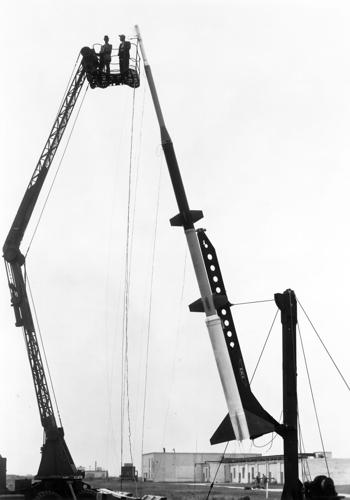
07-18-1957 (cutline): Five-stage rocket being tested at Wallops Island.
- File photo
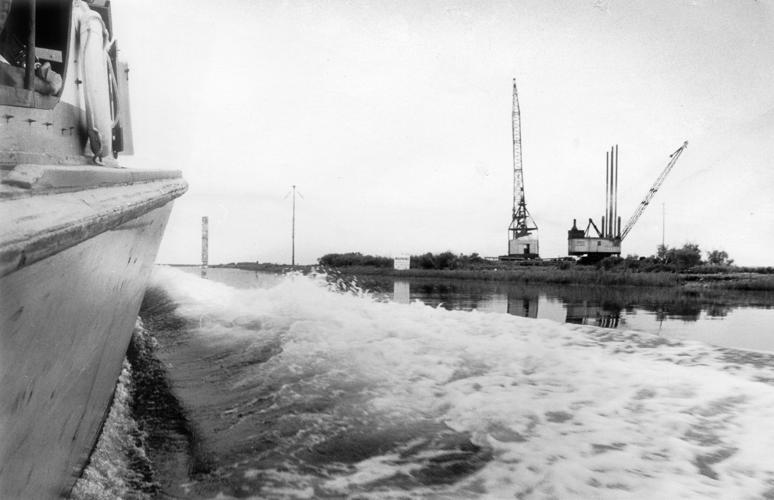
06-24-1959 (cutline): Cranes and steel towers etch sky over Wallops Island off eastern shore. New two-mile causeway will eliminate 30-minute boat ride to research station.
- Staff photo
- Times-Dispatch
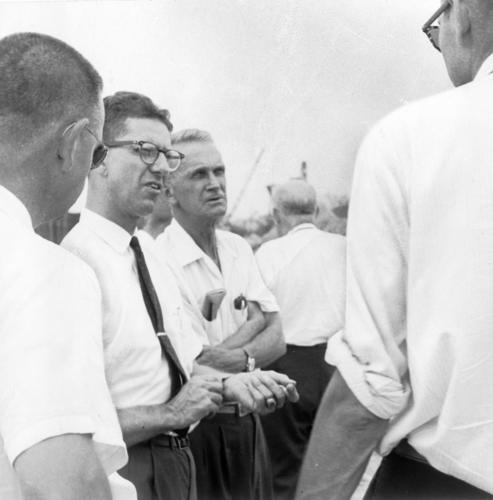
06-25-1959 (cutline): Space Age on a Sand Pit--John C. Palmer , scientists in charge of research missions at Wallops Island off Virginia's Eastern Shore, and Germain S. Brown, civil engineer in charge of construction, brief newsmen on building activity as the National Aernoautics and Space Administration expands its facilities. Work is reaching completion on three radar towers which will give Wallops its first long-range tracking and tie into the worldwide satallite tracking system. The new launch pads will permit firing of more powerful space vehicles. A tunnel is being dug to connect it to a blockhouse yet to be built. Wallops' job is to get the "bugs" out of new devices before full-scale space monsters are built.
- Staff photo
06-25-1959 (cutline): Space Age on a Sand Pit--John C. Palmer , scientists in charge of research missions at Wallops Island off Virginia's Eastern Shore, and Germain S. Brown, civil engineer in charge of construction, brief newsmen on building activity as the National Aernoautics and Space Administration expands its facilities. Work is reaching completion on three radar towers which will give Wallops its first long-range tracking and tie into the worldwide satallite tracking system. The new launch pads will permit firing of more powerful space vehicles. A tunnel is being dug to connect it to a blockhouse yet to be built. Wallops' job is to get the "bugs" out of new devices before full-scale space monsters are built.
- Staff photo
06-25-1959 (cutline): Space Age on a Sand Pit--John C. Palmer , scientists in charge of research missions at Wallops Island off Virginia's Eastern Shore, and Germain S. Brown, civil engineer in charge of construction, brief newsmen on building activity as the National Aernoautics and Space Administration expands its facilities. Work is reaching completion on three radar towers which will give Wallops its first long-range tracking and tie into the worldwide satallite tracking system. The new launch pads will permit firing of more powerful space vehicles. A tunnel is being dug to connect it to a blockhouse yet to be built. Wallops' job is to get the "bugs" out of new devices before full-scale space monsters are built.
- Staff photo
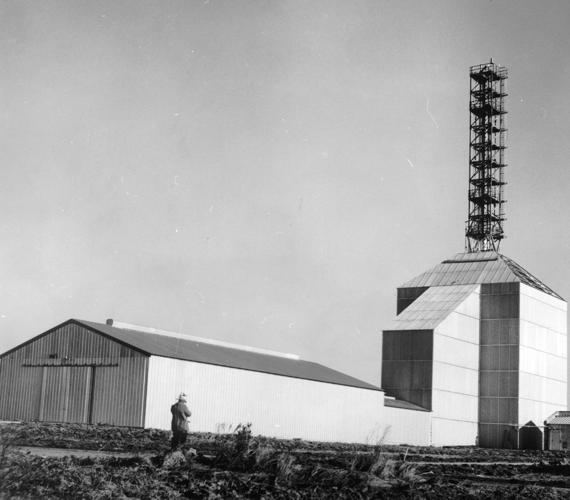
01-23-1960: Launch tower at Wallops Island.
- Staff photo
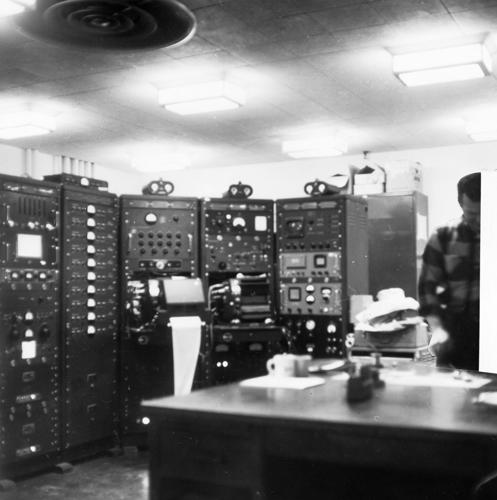
01-23-1960 (cutline): These are machines that record data on test rocket firings.
- Staff photo
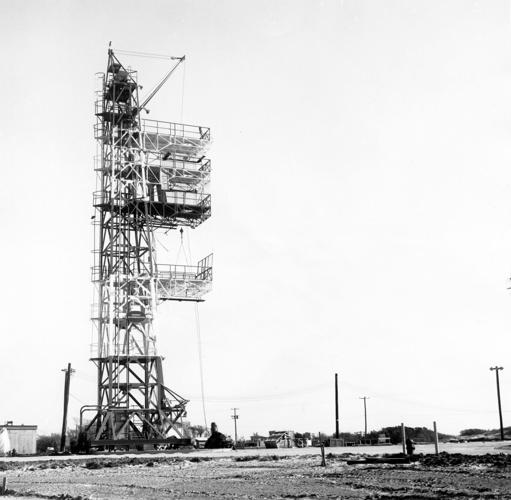
01-28-1960 (cutline): Tower for launching solid-fueld scouts at Wallops Island.
- Staff photo


