

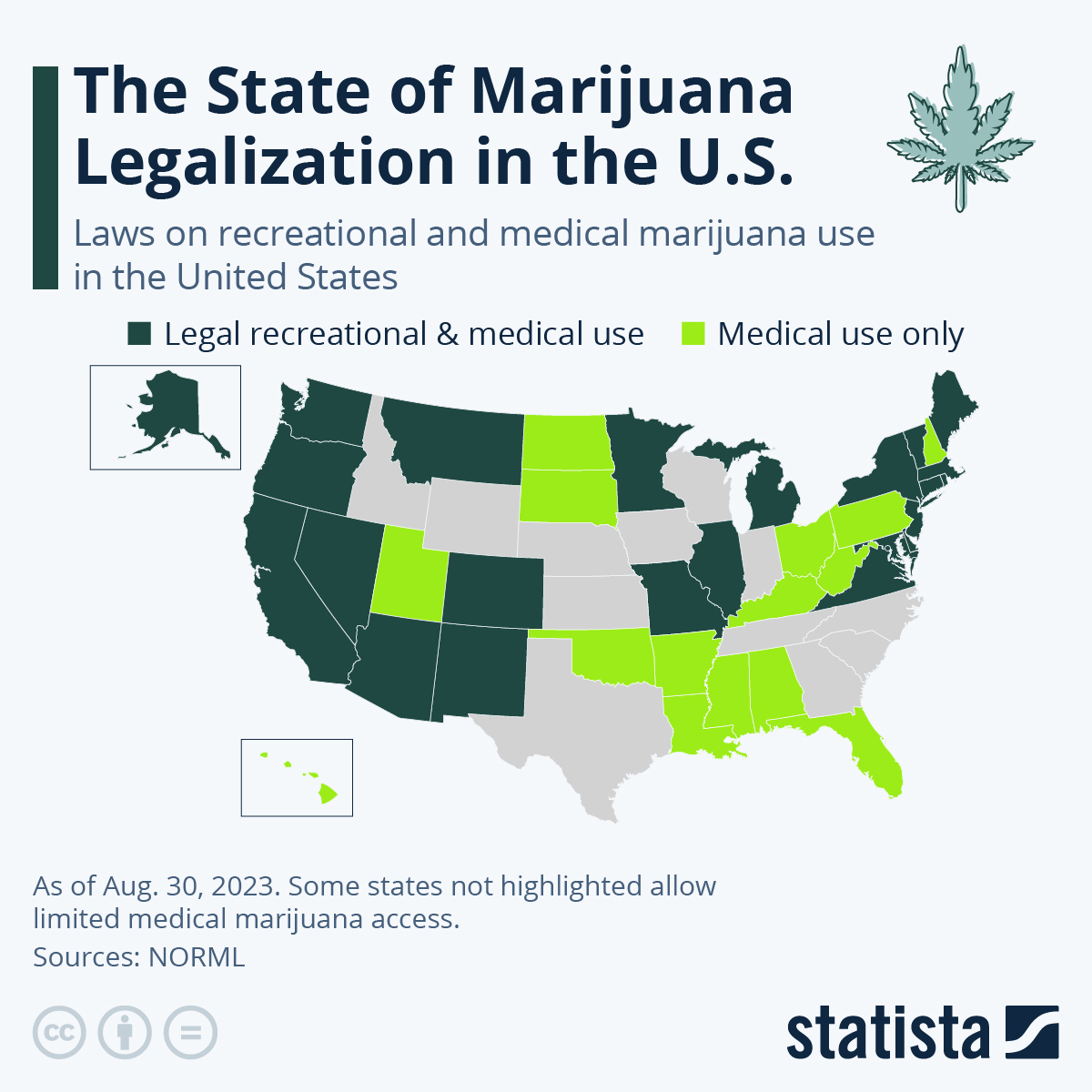
1 in 3 Americans Now Live in a State , Where Recreational Marijuana Is Legal. Voters in four states approved ballot measures to legalize marijuana on Election Day. 16 million residents of Arizona, Montana, New Jersey and South Dakota . now join the 93 million Americans who already lived in states where cannabis had been legalized. Several other states were expected to pass similar measures, but campaigns failed due to issues created by the pandemic. Advocates say that the move toward legalization in both red and blue states demands uniform action from the federal government. Regardless of who controls the White House, the House and the Senate, we should demand landmark federal marijuana reform in 2021, Steve Hawkins, Marijuana Policy Project, via Politico. Advocates also consider the passage of marijuana legalization ballots as victories for criminal justice reform
People are also reading…
25 most commonly used recreational drugs in America
America's vices: Alcohol, tobacco and more

From alcohol to cigarettes, most adults have tried some form of recreational drug. Fewer people have experimented with prescription medication for recreational reasons, but certain areas of the country are experiencing a serious problem with opoid addiction. Other drugs like cocaine and LSD, are used sporadically among adults in the U.S.
Using data from the Substance Abuse and Mental Health Data Archive, the experts at HealthGrove, a health data site, ranked the 25 most commonly used recreational drugs. The substances are ordered by the increasing percentage of people age 12 and over who used the drug recreationally in 2015. In the case of a tie, the drug with a higher classification by the Drug Enforcement Administration (DEA) is ranked higher.
To collect this data, SAMHDA conducts the annual National Survey on Drug Use and Health, in which they record use of illicit drugs, alcohol and tobacco in the U.S. population aged 12 or older. It is important to note that this data only includes recreational use of drugs, not proper medical use.
Drugs that are legal, alcohol and tobacco, have the highest recreational use. According to the survey, nearly one in five people over the age of 12 also used marijuana in 2015. As the drug becomes legal in more states, recreational use is likely to increase. Other Schedule I drugs (drugs determined to have no medical benefit by the DEA) including heroin and DMT had a recreational prevalence rate of less than 1 percent in 2015.
Note: Not all images in slideshow depict the exact drugs.
#25. Ketamine

Recreational use prevalence (2015): 0.17 percent
Drug category: Hallucinogen
DEA Schedule: III
Common forms: Liquid, powder
#24. Oxymorphone
_Oxymorphone_ER_20mg.jpg#/media/File:Actavis_(logo)_Oxymorphone_ER_20mg.jpg)
Recreational use prevalence (2015): 0.18 percent
Drug category: Opioid
DEA Schedule: II
Common forms: Tablet
#23. DMT

Recreational use prevalence (2015): 0.2 percent
Drug category: Hallucinogen
DEA Schedule: I
Common forms: Powder, crystal
#22. Carisoprodol (Soma)

Recreational use prevalence (2015): 0.21 percent
Drug category: Tranquilzer
DEA Schedule: IV
Common forms: Pill
#21. Methadone

Recreational use prevalence (2015): 0.23 percent
Drug category: Opioid
DEA Schedule: II
Common forms: Tablet, dispersible tablet, liquid
#20. Lorazepam (Ativan)
_tablets,_1_mg.jpg#/media/File:Lorafen_(lorazepamum)_tablets,_1_mg.jpg)
Recreational use prevalence (2015): 0.33 percent
Drug category: Sedative
DEA Schedule: IV
Common forms: Pill, capsule, liquid
#19. Morphine

Recreational use prevalence (2015): 0.37 percent
Drug category: Opioid
DEA Schedule: II
Common forms: Tablet, liquid, capsule, suppository
#18. Buprenorphine

Recreational use prevalence (2015): 0.38 percent
Drug category: Opioid
DEA Schedule: III
Common forms: Pill
#17. Heroin

Recreational use prevalence (2015): 0.39 percent
Drug category: Opioid
DEA Schedule: I
Common forms: Powder, tar
#16. Zolpidem (Ambien)

Recreational use prevalence (2015): 0.45 percent
Drug category: Sedative
DEA Schedule: IV
Common forms: Pill, capsule, liquid
#15. Diazepam (Valium)

Recreational use prevalence (2015): 0.54 percent
Drug category: Tranquilzer
DEA Schedule: IV
Common forms: Pill, capsule, liquid
#14. Clonazepam (Klonopin)

Recreational use prevalence (2015): 0.6 percent
Drug category: Tranquilzer
DEA Schedule: IV
Common forms: Pill
#13. Methylphenidate (Ritalin)

Recreational use prevalence (2015): 0.61 percent
Drug category: Stimulant
DEA Schedule: II
Common forms: Liquid, tablet, capsule
#12. Methamphetamine

Recreational use prevalence (2015): 0.68 percent
Drug category: Stimulant
DEA Schedule: II
Common forms: Powder, pill, crystal
#11. Tramadol

Recreational use prevalence (2015): 0.77 percent
Drug category: Opioid
DEA Schedule: IV
Common forms: Pill
#10. LSD

Recreational use prevalence (2015): 1.07 percent
Drug category: Hallucinogen
DEA Schedule: I
Common forms: Tablet, capsule, liquid, paper
#9. MDMA (Ecstasy/Molly)

Recreational use prevalence (2015): 1.5 percent
Drug category: Hallucinogen
DEA Schedule: I
Common forms: Tablet, capsule, liquid
#8. Alprazolam (Xanax)

Recreational use prevalence (2015): 2.05 percent
Drug category: Tranquilzer
DEA Schedule: IV
Common forms: Pill, capsule, liquid
#7. Oxycodone (OxyContin)

Recreational use prevalence (2015): 2.05 percent
Drug category: Opioid
DEA Schedule: II
Common forms: Capsule, liquid, tablet
#6. Cocaine

Recreational use prevalence (2015): 2.19 percent
Drug category: Stimulant
DEA Schedule: II
Common forms: Powder, crystal
#5. Amphetamine (Adderall)

Recreational use prevalence (2015): 2.8 percent
Drug category: Stimulant
DEA Schedule: II
Common forms: Tablet, capsule
#4. Hydrocodone (Vicodin)
.JPG#/media/File:Hydrocodone_7.5-325_(1).JPG)
Recreational use prevalence (2015): 3.17 percent
Drug category: Opioid
DEA Schedule: II
Common forms: Pill
#3. Marijuana

Recreational use prevalence (2015): 17.68 percent
Drug category: Depressant
DEA Schedule: I
Common forms: Plant, resin, oil
#2. Tobacco

Recreational use prevalence (2015): 31.1 percent
Drug category: Stimulant
DEA Schedule: N/A
Common forms: Cigarette, cigar, bidi, hookah, snuff, chew
#1. Alcohol

Recreational use prevalence (2015): 61.42 percent
Drug category: Depressant
DEA Schedule: N/A
Common forms: Liquid


