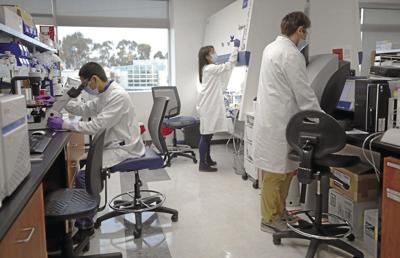

Sergio Vazquez, left, Dinah Amante and Alex Dolgoter work in a lab at Inovio Pharmaceuticals, a biotech company in San Diego that is developing a COVID-19 vaccine.

A look at the COVID-19 vaccine: How it’s progressing, and when it can be expected
Is there time for any vaccine to complete the clinical trials?
Partly it depends on whether the coronavirus is spreading rapidly in communities where vaccines are being tested against placebo.
The two vaccines that are farthest along are made by Pfizer and Moderna. Both require two doses, given three or four weeks apart.

Nurse Kathe Olmstead gives volunteer Melissa Harting an injection as a study of a possible COVID-19 vaccine in New York, developed by the National Institutes of Health and Moderna Inc.
What’s an Emergency Use Authorization?
The EUA program, established in 2004, gives the U.S. Food and Drug Administration the power to grant temporary, accelerated approval to a medical drug or device needed in a public health emergency. The EUA review process is less rigorous than a regular approval.
During the coronavirus pandemic, the FDA has granted EUAs to hundreds of tests and two treatments. But the only immunization ever approved for emergency use was against anthrax, in 2005.
How good would a vaccine have to be to get full approval?
A COVID-19 vaccine would need to prevent or decrease the severity of the disease by 50% or more, according to FDA guidelines. FDA Commissioner Stephen Hahn has repeatedly stressed that the agency won’t cut corners.
Is this political?
The United States has had an estimated 6.1 million cases of COVID-19 and 186,000 deaths. The Trump administration, which has invested heavily in vaccine development, could use a preelection win.
Paul Offit, director of the vaccine education center at Children’s Hospital of Philadelphia, who serves on the FDA’s vaccine advisory board, worries that the FDA will cave to pressure. He pointed to two controversial EUAs of COVID-19 treatments — for the drug hydroxychloroquine and convalescent plasma — that FDA officials initially opposed because studies had not shown them to work.
Why is hesitancy a concern?
In this country, vaccine “hesitancy” — skepticism about vaccines that have been huge public health successes — is a growing problem, so there is concern that rushing a COVID-19 vaccine will add to distrust, said Jose Romero, who chairs the CDC’s Advisory Committee on Immunization Practices (ACIP), a group that will help the government decide who gets priority access to new coronavirus vaccines.
In meetings between CDC staff and the Philadelphia Department of Public Health, public perceptions have come up. “If people don’t have faith in this vaccine, it is going to make our job impossible,” James Garrow, a department spokesman, told CDC employees.
Who gets the vaccine first?
Two groups, ACIP and a newly formed panel from the National Academies of Sciences, Engineering and Medicine, are working on how to prioritize vaccines, because doses are expected to be limited at first. The academies committee released its draft recommendations earlier this week and ACIP’s may come later this month. It is not clear who will make the final decision on who gets initial doses.
Both groups are suggesting prioritizing health-care workers because they are at high risk of exposure to the virus and of spreading it. The academies proposal includes nursing home employees, and first responders such as police and firefighters.
Can states start distributing vaccine in November?
Farley said it makes sense to prepare now even if a vaccine isn’t ready right away. “Sooner or later we’re going to have to distribute a vaccine,” he said.
Nate Wardle, a spokesman for the Pennsylvania Health Department, said the state has a team that is always preparing for big vaccination efforts. “Our current planning includes multiple pathways to provide vaccine to the public and high-risk groups, including working with doctors’ offices, pharmacies, and other locations where other vaccinations are readily available.