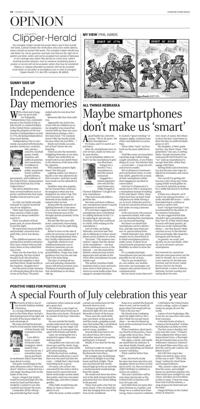

Paul Hammel: Maybe smartphones don't make us 'smart'
A good buddy has a favorite saying: “We’re all smart. We have smartphones.”
It’s funny, and I’ve used it several times.

Paul Hammel
After all, smartphones have, in a lot of ways, made our lives easier and smarter.
Got an unfamiliar address to find? Use the smartphone to give you directions.
Hungry for a burrito? Use a smartphone to find the nearest restaurant.
Engaged in a heated argument over who hit the most home runs, Willie Stargell or Harmon Killebrew? Google it on your smartphone.
They have basically killed a good bar bet.
But more and more evidence says smartphones haven’t exactly sharpened our intellect.
(It’s even been suggested that smartphones have contributed to a falling birthrate in the U.S. by replacing in-person relationships, those that could lead to a birth, with swiping on the smartphone.)
Lots of states, including Nebraska, now have laws that aim to eliminate or reduce smartphone use by students at school.
The book, “The Anxious Generation,” argues that the advent of the smartphone — one that allows continuous access to the internet — was the main driver behind a sharp increase in teen depression and suicides in the 2010s after smartphones became widely used.
The author, Jonathan Haidt, maintains that as more and more teens went to their phones to check on social media rather than engage in unsupervised play, it created a “great rewiring” of sleepless nights, isolation from others and addiction to screen time.
Those video “reels” on Facebook are the most addictive to me.
Stuff like scenes of ocean liners capsizing, huge walleye being caught somewhere, or my Pirates eking out a run. Ten minutes later — or even later — I snap out of it, and return to reality.
We’ve all been to restaurants and watched four teens, or even four adults, glued to the screens of their smartphones rather than engaging in any kind of conversation.
(And we’ve all glanced at a nearby driver who is staring into a smartphone instead of looking at the road ahead. Thirty-three states have bans on hand-held cell phone use while driving a car or truck. Nebraska restricts it only for school bus drivers and kids under 18 using a learners permit.)
In the classroom, the research is somewhat mixed, with some studies showing that smartphone use can increase learning.
But there’s no doubt that smartphones can be a distraction, and take away from person-to-person interactions.
I think Nebraska’s law, which requires local school districts to adopt smartphone policies, makes sense. It allows local school boards and parents some flexibility on where to draw the line.
It’s a complicated topic. Smartphones have become indispensable in a lot of ways.
They’re our football tickets, our wallets, our weather forecaster, our newspaper, our compass and a prime means of communication.
But too much screen time isn’t very smart, it seems. But where to draw the line? (And where to draw the line on artificial intelligence or AI?)
My daughter, a third-grade teacher, says there’s hope. “Her generation,” she says, is setting limits, though she knows that some parents find it hard to say “no” and use smartphones to occupy their kids, rather than engage with them.
Setting limits and restrictions has also become a key topic for debate by lawmakers and school officials.
You can tell I’m getting old because I miss those days when a gang of kids would gather on a vacant lot and pick up teams for a wiffle ball match or football game.
If there was a dispute, we’d work it out among ourselves — a really valuable life lesson — rather than deferring to a referee or coach in a sports club.
Such “unsupervised play” was recommended by the author of the Anxious Generation.
He also suggested that kids shouldn’t get a smartphone till they turn 16. If they need to keep in touch with their parents, let them use an old-fashioned flip phone — one that doesn’t allow constant access to the internet and social media, like Snapchat, Instagram and Facebook.
As parents, we could, and should, set our own limits. After all, we’re all smart; we have smartphones.
Paul Hammel has covered the Nebraska state government and the state for decades. He is a retired senior reporter for the Nebraska Examiner and the former Capitol Bureau Chief for the Omaha World-Herald. A native of Ralston, Nebraska, he loves traveling and writing about the state.