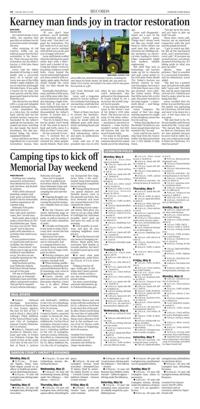


Antique tractor restoration keeps Kearney farmer connected to his father
For retired farmer Leroy Giffin, the emotion that goes into an antique tractor restoration easily outweighs the iron.
After restoring 10 old tractors, Giffin can say without pause that his first restoration is his favorite. That’s because his first restoration was his father’s tractor, a 1958 John Deere Model 620.
Leroy said his father dreamed of having a small family and a successful farm. As it turned out, Leroy was one of the Giffin family’s eight children. He was 15 when his dad bought the John Deere. It was quite a tractor for its time, but years passed, and the shiny green paint faded in the hot Nebraska sun.
The old tractor was fitted with a scoop and relegated to humble farmyard tasks.
Leroy remembers life as a farm boy. He worked hard, and his dad was his primary teacher. Leroy was fascinated by his father’s aptitude for mechanics. He soaked up hours watching his dad repair the farm’s machinery. His dad preferred fixing the farm’s equipment himself.
Leroy said there are three ingredients for a successful restoration: money, time and patience.
“If you don’t have patience, you’ll probably get frustrated and quit,” Leroy said. “You don’t set goals for restoration. You just work on it as you have time and you’re satisfied with all that you can do, and you’re happy with that.”
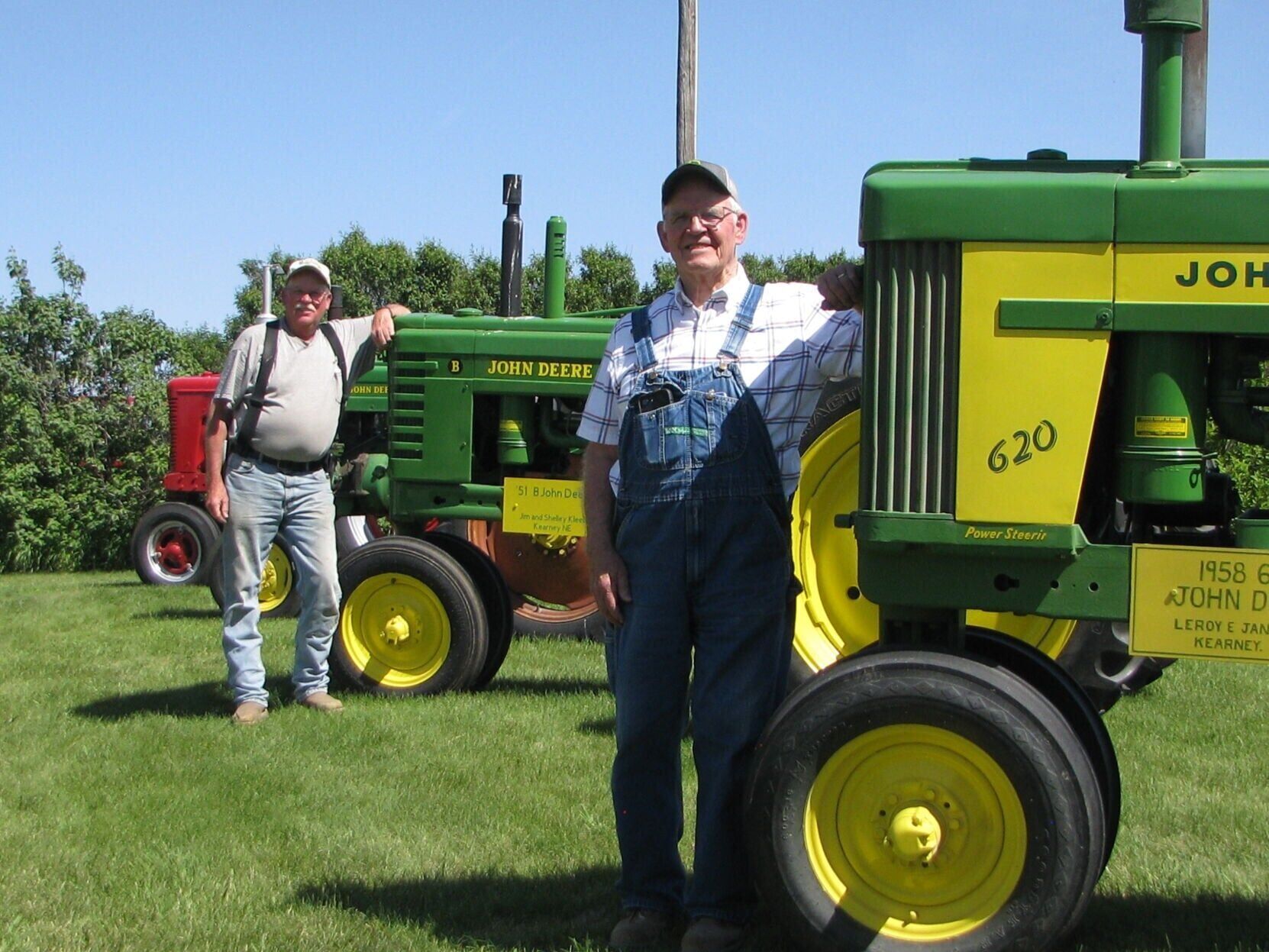
Leroy Giffin has restored 10 antique tractors, including the John Deere his father owned. Jim Kleeb, left, also owns his father's first tractor. He tracked it for years until he was given the machine as a gift.
Leroy said friends scoffed when he told them he spent entire days with a blowtorch and a bucket of ice. Using his father’s trick for loosening stubborn rusted bolts, Leroy heated the tractor metal until it glowed red, then cooled it with ice. Again, again, again, the heat would enlarge the stuck bolt. Ice then shrank the bolt.
Eventually, the bolt loosened, and then a little more, and a little more after that. Leroy would invest an entire day releasing a single stubborn bolt. It was one of many stubborn bolts he discovered as he methodically disassembled his father’s tractor. It turned into a 15-year undertaking.
“You try to break it free, but be careful. Don’t break it off. You want to move it back and forth, move it a little at a time,” Leroy said.
He has restored 10 tractors. “I restored five of my own, and the others I restored for other people, mostly friends. There were guys from Bertrand and Ord,” he said.
Leroy said a magazine geared to tractor enthusiasts estimates that fixing up one machine could take four to six months, or maybe a year.
“Most of them you have to restore the mechanical parts,” Leroy said. At times he would fabricate different parts with sheet metal, including hoods and fenders.
Tractor enthusiasts can find information, advice and parts in publications and online.
Leroy said one of his proudest days was in 2012 when he was among the 1,000 enthusiasts who gathered at the fairgrounds in Grand Island to set a record for the world’s largest tractor parade.
It was smooth sailing for Leroy in the driver's seat of his father’s 1958 John Deere. The luck ran out on some of the other enthusiasts. For whatever reason — mechanical, electrical or whatever — some tractors wouldn’t restart, but 800 old tractors did, and the record stands today.
For many in the parade, it was a day to recall when someone special was seated beside you at the wheel long ago.
Leroy said disappointments are a part of the antique tractor game. Things don’t always work out like you would want them to. Little critters can spoil your fun. Mice are notorious for nibbling rubber insulation on electrical wire, leading to shorts. Older components might lack modern, reliable engineering.
But what they lack in technology, old tractors make up for in character and soul. Leroy points to his 1958 John Deere Model 720. Today’s tractors use electric starters to turn over the engine, but Leroy’s 1958 John Deere uses a tiny gas-powered four-cylinder starter motor. When that little motor hits 6,000 rpm, the power transfers to the main engine — a mammoth diesel — and things get rocking.
Leroy compares the sound of that two-stage starting sequence to a night at the symphony, minus the bow tie and tux.
“When that big diesel on the Model 720 kicks in, you know you got done what you wanted to do,” he said.
Leroy said he has had to step back from his tractor hobby. His final restoration was a 1952 Model A John Deere.
“You get up in the years, and you have to give up stuff,” he said.
These days, Leroy said, tractors are an emotional connection with the past and the people he loved.
“I got to watch my dad. He did all the mechanical work, and I watched him,” Leroy said. “If you grew up around tractors, you always dreamed of having one. It’s taking pride in what you grew up with.”
Money, time and patience. They’re essential to a successful restoration, and for fatherhood, Leroy added.
“My dad was a patient man. He had to be with eight kids,” Leroy said. “He loved life, and he never expected a lot out of it. I think he just lived to enjoy what he was doing that day.”
Leroy recalled that his father was excited because the family was gathering for Christmas. He felt tired and went to lie down for a rest. A few days later, he was gone.
“My dad lived to be 99. He was healthy until the last week of his life,“ Leroy said. “We missed him because he died on Christmas, but we were grateful because he never had to suffer. In a way, you could say he made it home for Christmas. It’s what he earned.”
Related

Leroy Giffin prepares to start his 1958 John Deere two-stage starter system. He said the starter motor turns 6000 rpm before it starts the mai…