
Dawson County residents express frustration at joint public hearing, seek solution to rising property taxes
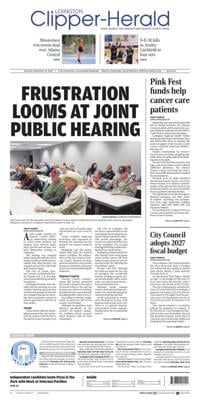
A joint public hearing for Dawson County political subdivisions seeking to collect more property tax revenue than allowed under their growth percentages was held Wednesday evening in Lexington.
The hearing was required under Legislative Bill 644, which requires political subdivisions to explain why their property tax requests exceed their allowable growth percentages.
The City of Cozad, Dawson County, Gothenburg Public Schools and S-E-M Public Schools presented their property tax requests.
Although attendees were initially told the meeting was not a protest hearing and questions would not be permitted, that rule was changed during the meeting when presenters agreed to answer questions to the best of their ability.
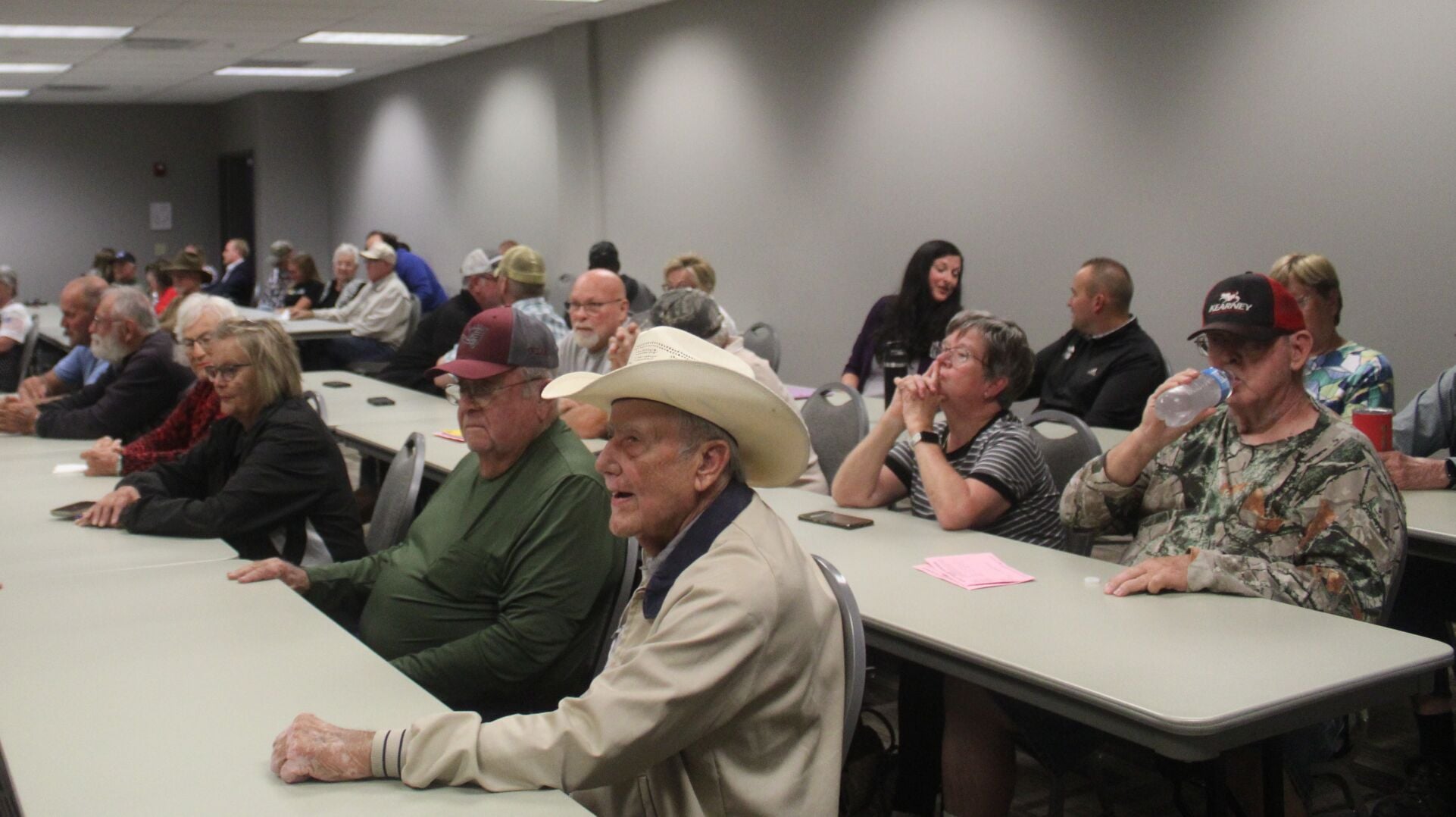
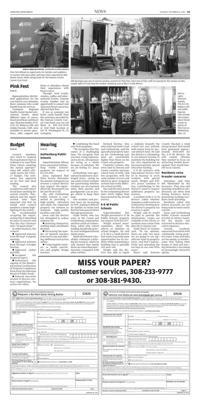
A full room waits for the joint public hearing of Dawson County political subdivision who are exceeding their property tax growth allowance to present at Lexington’s Opportunity Center on Sept. 23.
Cozad
Cozad Mayor Marcus Kloepping presented the city’s property tax request of $954,426.25. He said the request equates to 30 cents per $100 of taxable value and exceeds last year’s total by 4%.
Cozad residents expressed frustration and requested an itemized list showing how the property tax revenue would be spent.
Kloepping said the money would help fund the Paulsen Sports Complex, the replacement of the city attorney, Dawson County dispatch services, increased property and casualty insurance premiums and losses in sales tax revenue following the hailstorm.
Dawson County
Dawson County Commissioner Bill Stewart presented the county’s property tax request of $14,403,406.17. He said the increase was driven by inflation and the fuel costs associated with providing public safety services.
According to Stewart, public safety accounts for 38% of the county’s total budget.
Although no questions were directed specifically at the county’s tax request, Lexington residents raised concerns about property taxes in their community.
The City of Lexington did not have a representative at the meeting because its property tax request did not exceed its allowable growth percentage. The request was approved at the most recent Lexington City Council meeting following a public hearing held two weeks earlier.
Lexington residents asked how they benefit from rising home values if they cannot sell their homes because fewer people are moving to the city following the Tyson plant closure.
Stewart said that although he could not speak for the City of Lexington, the countywide benefits of higher property values include public safety, better roads, law enforcement protection and infrastructure.
Michaela Arndt, Dawson County clerk and meeting moderator, was asked when property valuation hearings are held.
Arndt said property owners must file protests in June, with hearings held in July each year. There is no general hearing; each property owner seeking a hearing must file an individual protest.
Gothenburg Public Schools
Superintendent Allison Jonas presented Gothenburg Public Schools’ property tax request of $11,652,884.
Jonas explained that three factors determine the amount of property tax revenue a school district may request: the expenditure lid, the property tax lid and the levy lid.
She said Gothenburg Public Schools is committed to providing a high-quality education and needs the requested property tax revenue to maintain high-quality facilities and staff.
Jonas said the district has attempted to reduce expenses by:
- Reducing elementary staffing when enrollment declines.
- Decreasing the number of Spanish teachers from two to one and offering additional instruction online.
- Using English teachers as media specialists and graphic design teachers.
- Combining the band and choir programs.
“We recognize that this comes at a challenging time. We recognize that you have rising expenses, and so do we. All expenses are rising as a whole because of inflation. We are all feeling it,” Jonas said.
Gothenburg-area agricultural landowners challenged Jonas, saying no one wants to hurt students but questioning whether students are also harmed when their parents and grandparents can no longer afford to keep their land.
One resident said pasture taxes are increasing by 50%, making it difficult for families to retain land that has been passed down through generations.
Glade Smith, who has roots in the Cozad and Gothenburg communities and lives north of Gothenburg, asked why school funding should take priority over multigenerational family farms.
Smith distributed a feasibility statement outlining his research, which he said showed that family farms are taxed disproportionately compared with other entities.
Richard Ristine, who owns land near both Cozad and Gothenburg, said the agricultural property taxes on his Gothenburg-area land are consistently higher than those on his Cozad-area property.
Charlotte Carlson, who owns land in Dawson and Custer counties and pays school taxes in both, said two properties with the same number of acres and identical pivot irrigation systems had vastly different school tax bills.
She said the taxes levied by the Gothenburg district were 300% higher than those levied by the Arnold district.
S-E-M Public Schools
Superintendent Ben Wright presented S-E-M Public Schools’ property tax request of $4,812,873.
Wright echoed Jonas’ comments about the effects of inflation on school budgets. He said S-E-M is a small district that wants to provide more opportunities for its students while maintaining a building that is partially 100 years old.
Wright said the district was able to repair a sinkhole beneath the school last year entirely with money from its special interest fund. He said the district is attempting to use interest revenue to maintain the building but has also experienced an increased need for special education funding.
S-E-M contracts with Educational Service Unit 10 in Kearney to serve students with special needs. Wright said ESU 10’s prices continue to rise, contributing to the district’s need to request additional property tax revenue.
A resident of the S-E-M district asked whether taxpayers could receive an itemized list showing how the district’s property tax revenue is spent.
Wright said he would be glad to provide the information. Copies are available at the school, or residents may contact him directly to request one.
Todd Ibach of Sumner said, “In my opinion, there are only two ways we are going to see significant relief in property taxes, and that’s legislatively and extending the tax base in our own little areas.”
Ibach said Dawson County blocked a wind energy project that would have generated approximately $500,000 for the S-E-M district. He told county officials they needed to focus on attracting taxable development that would benefit local schools.
Residents voice broader concerns
Attendees said they felt blindsided by the increases. They also said meetings of political subdivisions are often held during business hours, preventing working residents from attending.
Residents asked why lottery proceeds are not being used to fund county schools.
Jonas said Gothenburg Public Schools received $15,000 in lottery funds, but the money was restricted to distance education expenses.
Overall, residents expressed frustration with continually rising property taxes. Some said taxes are becoming so burdensome that selling their homes or land and leaving Nebraska is becoming an increasingly attractive option.