Donna Tryon needed little time 3½ years ago to target a key flaw in Lincoln County’s and Nebraska’s debut “pink postcard” joint property tax hearings for fellow frustrated taxpayers.
After some 100 people criticized local leaders, the then-North Platte city councilwoman noted the hearing was being held when the Legislature said it must — but after most new local budgets were set and just before the state’s Sept. 30 budget deadline.
![]()
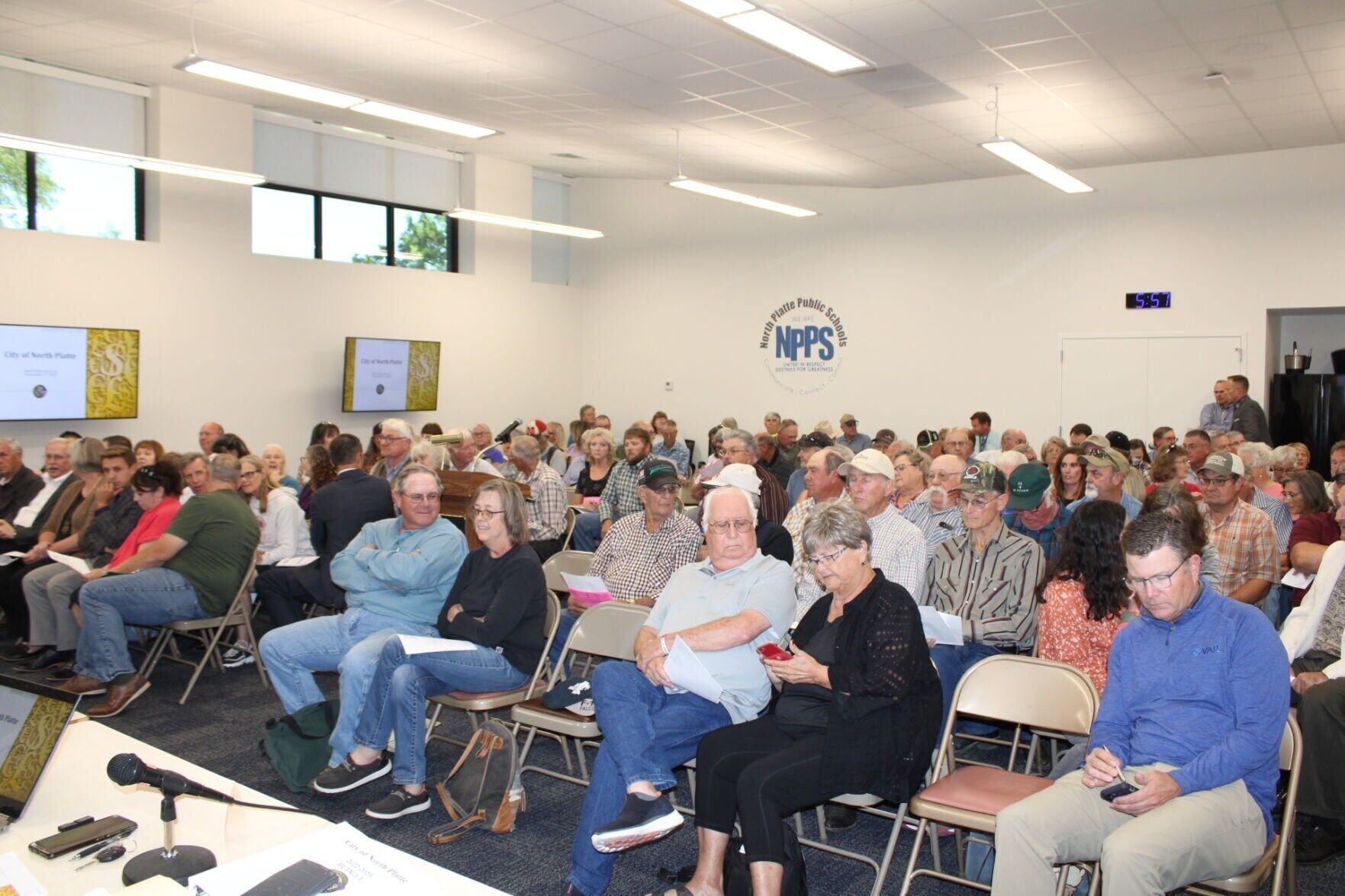
More than 100 people attended Lincoln County's first
state-mandated joint property tax hearing on Sept. 27, 2022, at
North Platte’s McKinley Education Center. Then-City Councilwoman
Donna Tryon pointed out that night that the "pink
postcard" hearings came too late to change local budgets. A
bill moving through the 2026 Legislature, LB 803, would move those
hearings to July.
TODD VON KAMPEN, THE NORTH PLATTE TELEGRAPH
“I am tickled to death to see all these people here. However, it’s too late,” Tryon told the McKinley Education Center crowd on Sept. 27, 2022. “You need to go to these board meetings when they’re setting their agendas and they’re setting their budgets.”
After hearing similar comments statewide ever since, the Legislature Monday overwhelmingly advanced a bill to move up the joint hearings to early summer and make them more of a primer on the coming “budget season.”
2/3 tax-boost threshold
Legislative Bill 803, which won 42-0 first-round approval, would raise the bar starting in 2027 for raising property tax requests. In most cases, city councils, county boards and school boards — the “Big Three” property tax collectors — would need a two-thirds vote to do so.
The bill’s other major tax-setting feature would move up each county’s joint tax hearing window from its current Sept. 14-24 to any time between July 1 and July 15. Its “pink postcard” nickname comes from the color of notification postcards counties have been required to send to taxpayers.
That 2½-month calendar shift would move the joint hearings not only well ahead of when local budgets and taxes are set but also before most of the figures needed to set them are finalized.
LB 803 says the relocated joint hearing would cover two subjects: an outline of each government’s four-month budget-setting process and preliminary information on relevant data” that will affect their budgets.
Public comments still would be taken, and cities, counties and schools would have to take part every year. At present, they only must if they raise their tax request by more than an “allowable growth percentage” of 2% plus higher taxable values from property improvements, annexations or changes in a property’s use. Villages and other local governments are excused.
At least one elected member of each board and the county assessor would have to attend in person, a legal change already made when Gov. Jim Pillen Feb. 9 signed LB 384 by state Sen. Tanya Storer of Whitman. County clerks are in charge of running the hearings.
Senators Monday added four unrelated tax bills to LB 803, including a state first-time homebuyer savings account and Sumner Sen. Teresa Ibach’s bill (LB 1116) adjusting how smaller cities and villages can use state “turnback taxes” for sports arena projects.
The bill originated in the tax-setting Revenue Committee, which made it a committee priority bill and voted 7-0 to send it to the floor. Ibach and North Platte Sen. Mike Jacobson, the panel’s vice chairman, are members.
‘Engaged,’ not ‘enraged’
Its chairman, Sen. Brad von Gillern of Omaha, told lawmakers resulted from “lengthy good-faith conversation” with the League of Nebraska Municipalities, the Nebraska Association of School Boards, the Nebraska Association of County Officials and the Omaha-based Platte Institute think-tank.
Former Omaha Sen. Jim Vokal, CEO of the last group, hailed the bill’s advancement in a Wednesday email that reminded readers it had pushed for the joint hearings in 2021 under the banner of “Truth in Taxation.”
Vokal called LB 803’s supermajority to raise tax requests an “automatic rate rollback,” meaning a city, county or school board’s failure to achieve the needed two-thirds vote would lower its tax rate if its total taxable value rises.
“That’s a meaningful step toward aligning spending decisions with taxpayer accountability,” he wrote in the email. Otherwise, “the rate may stay the same but the bill keeps climbing.”
But Sen. Bob Hallstrom of Syracuse, whose LB 575 to move up the pink-postcard hearings was rolled into LB 803, focused on the sessions’ inability to impact local budget decisions due to its place on the calendar.
“Basically, the process (under LB 803) is going to allow for the public to be engaged, rather than enraged, at an earlier time period when they can have a more meaningful impact,” he told senators. “Their voices can be heard, and the public can listen to what they have to say about the impact of valuation increases” on their tax bills.
Lifting budget-making veil
Lobbyists representing the three local government umbrella groups told The Telegraph in a joint phone interview that earlier joint hearings could help Nebraskans better understand how local budgets and taxes are put together.
They joined in crafting LB 803 “because to have any meaningful dialogue between the governing body and constituents, it needs to be before the budget is adopted,” said NACO Executive Director Jon Cannon.
He, League of Municipalities Executive Director Lynn Rex and NASB Associate Executive Director Colby Coash called attention to the light to nonexistent public attendance at local governments’ individual budget hearings in late August or September.
“It’s very frustrating that almost no one shows up,” Rex said. The annual budget is “the most important document the city will issue that year.”
“Budget hearings are when the most impact (by constituents) can be made,” added Coash, a former state senator.
Cannon said holding the pink-postcard hearings early in July isn’t popular with some NACO members.
“I’m catching some flak from counties that ‘you’re pouring gasoline on the fire when we’re already hearing protests’” of valuations in early summer, he said. “But from the calendar, this is the only good time.”
The July 1-15 window would put the joint hearings roughly halfway between June 1, when counties finalize individual properties’ taxable values, and the Aug. 20 deadline for calculating local governments’ total “tax base” valuations. County boards must rule on valuation protests by July 25.
LB 803 would require taxpayers to be notified of the dates of their pink-postcard hearing and each local government’s fall budget hearing when counties send out notices of valuation changes June 1.
Under the bill, the joint hearings would take place just after counties finish their fiscal year and well before cities and K-12 schools finish theirs. Fiscal years end June 30 for counties and the state, Aug. 31 for schools and the overall state budget deadline day of Sept. 30 for cities.
But that’s also where LB 803’s changes could help taxpayers focus their concerns on how each piece of their property tax value — their individual taxable value, each government’s total tax base, tax request and tax rate and state tax-relief discounts — impacts their final tax bill, Cannon said.
Specific local spending decisions are best addressed at their August or September budget hearings, he said. Earlier pink-postcard hearings if LB 803 passes won’t be for local leaders “to go through (budgets) and say ‘We’re going to buy four squad cars.’”
Local reactions
Cannon, Rex and Coash said they agreed to a two-thirds threshold for approving higher tax requests because their members rarely have trouble finding budget majorities of that size.
They said LB 803’s supermajorities could yet be tweaked to reflect the differing sizes of their members’ boards. The bill needs to gain second-round approval by Wednesday to get a final vote before the Unicameral adjourns either April 10 or 17.
Any four of North Platte’s six school board members would form exactly a two-thirds majority under LB 803. But higher tax requests would need approval from six of the eight City Council members (75%) and four of the five Lincoln County commissioners (80%).
Senators voted 39-1 Monday for a von Gillern amendment that would set the threshold for seven-member boards at four members (57.1%). Requiring five “yes” votes from such a board would equal a 71.4% majority.
But the three local government lobbyists said all existing legal exceptions to their members’ tax-request lids — including asking voters to exceed them — would be available to a board that gets enough votes to collect more in property taxes than the previous year.
North Platte City Administrator Layne Groseth said LB 803 “will not fundamentally change our process” if it becomes law. “We have fairly significantly lowered the city (tax-rate) levy over the past few years.”
County Board Chairman Kent Weems doesn’t think the bill will affect commissioners’ budget process year over year, either.
“I believe most counties always anticipate a certain percentage of cost increases due to inflation in a given year and encourage the departments and row officials to roll over any possible surplus each and every year,” he said.
Failing to find LB 803’s two-thirds board majority to raise tax requests could make schools more vulnerable to state-aid drops and unexpected valuation changes, said Damon McDonald, North Platte Public Schools’ executive director of finance and acting superintendent.
On the other hand, “the opportunity (under the bill) is a broadened tax base, more stabilized funding and maybe reduced levy pressure,” he said.
“I believe providing the (school) board with a clear (spending) justification and program alignment can assist with decision-making, and that will be even more relevant” under LB 803, he added.