

Former Amherst farmer Ken Bramer bid on a life as an auctioneer. He won.
AMHERST — The secret to a good auction is telling a good story and keeping people entertained, veteran auctioneer Ken Bramer believes.
“Everything needs a story. If you have stories behind some of these things and tell jokes, people like that. You gotta keep ‘em interested,” he said.
Bramer’s talent as a raconteur has kept Ken Bramer Auction and Realty going strong for 40 years. “I thought the older we got, it would slow down, but it hasn’t,” his wife Sherry, the co-owner, said.
The Bramers hold auctions throughout Nebraska, into Kansas and beyond. Bramer travels hundreds of miles for good finds. Last month, he and a few friends drove a 32-foot trailer to Oklahoma and bought crocks, saddles, guns and furniture from a going-out-of-business antique store.
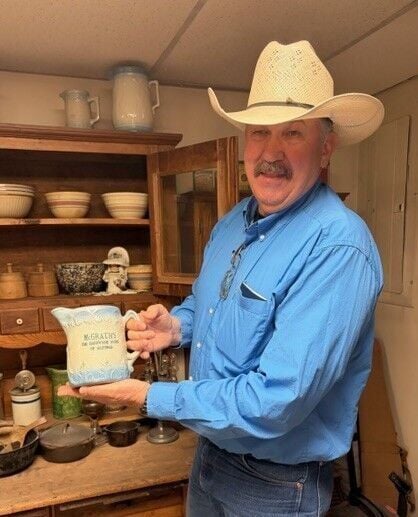
Ken Bramer poses with an old pitcher in his basement, which, not surprisingly, is full of antiques.
He has picked up items from a Kansas family that kept its money in an old coffee pot. He picked up church bells at an auction in Oklahoma.
Then there’s that 144-year-old old crock belonging to Lois Jurgens that Bramer sold for $32,000 in Holdrege on Jurgens’ 91st birthday.
“I was sitting at the kitchen table when Lois called on a Monday and said she had a Red Wing crock for me to look at. I said, ‘Lois, we’re kinda full, but I guess one more item ain’t gonna hurt,’” he said.
When he stopped by her house to take a look, he knew instantly that the crock was valuable. She’d hoped to get $100 for it, but he knew she’d get far more. As soon as he posted a picture of the crock on his website, www.braemerauction.com, collectors called from Kansas, New Mexico and Arizona.
“You get a feel for things,” he said. “You learn what people are looking for.”
Setting a price
Bramer’s auctions are major social events, with coffee and lunch on site. On April 18 at the Phelps County Fairgrounds, he’ll auction off 200 items ranging from antique furniture, collectibles, coins, currency, firearms, tools, Zane Grey books, a Southwestern blanket and a two-burner camp stove.
He’ll offer 60 Red Wing stoneware pieces, too. “Red Wing crocks are making a comeback right now. I don’t know why. People are looking for the bigger ones,” he said.
He does research before setting prices, then sees what the crowd is willing to spend. "You can ask for the blue sky, but if no hands are raised, I drop down. I might ask $5,000, and if hands go up in the air, I know that’s too cheap," he said. He takes it as high as he can.
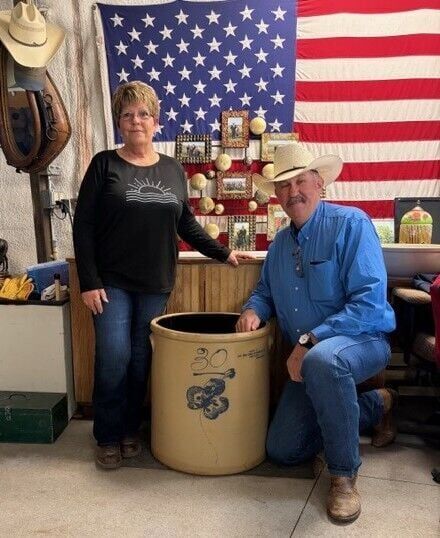
Sherry and Ken Bramer started Ken Bramer Auction & Realty 40 years ago. Crocks like the one in the picture are among their most popular offerings.
He makes roughly 2-3% on real estate and 5-6% on a house sale. Sales of household items might earn him 30-35%. “It just depends,” he said.
He tape-records the proceedings as a woman sits beside him keeping careful track of each sale. “If we make a mistake, and sometimes we do, we go back and listen to the tape recorder,” he said.
Sales are finalized then and there. Everything is sold as is.
Tongue twisters
The bidding started low on Bramer’s career as an auctioneer.
In 1986, he and Sherry were living on a farm northwest of Amherst raising cattle, hogs, corn, and — at that time — two children.
“The bank called. We’d made monthly payments, and I’d never missed a payment, but we were one of 90 some families that got pushed out,” he said.
As he pondered what to do, he took his father’s advice and enrolled in a rigorous eight-day auctioneer school in Lincoln led by auctioneers from across the state.
“You’d go to school until six at night, have a 30-minute break, then resume until 10 p.m.,” he said. “They gave us a tongue twister that we had to say 25 times without taking a breath.”
Back home, he’d practice the auctioneer lingo while he was driving. “In class, we’d have to count by 2.5 up to 100, and back. When you’re up there running an auction for four, five or six hours, you get tired, but you have to know numbers,” he said.
Starting slow
Bramer thought the eight-day class would quickly launch his new career, but he was wrong.
“Little did I know that when I went to every sale barn, every auctioneer would put you out in the yards and never let you inside the barn,” he said.
“Most auction companies are family owned and operated. At that time 40 years ago, the people who were in it were part of families who had grown up in it and passed it from one generation to the next, and they weren’t going to let any new people in,” he said.
By chance, an auctioneer in Broken Bow (“an old cowboy out of the Sandhills”) invited Bramer to come up and sell. “You can’t imagine how nervous I was. I didn’t know anything, but when I finished the sale, he said, ‘Our next sale is Thursday night. I want you to come back if you can,’” Bramer said.
He went back. Slowly, he began to learn the trade, but he still couldn’t land a job and bills mounted. Finally, at Sherry’s suggestion, they opened their own auction company.
A rough beginning
The Bramers rented a building in Amherst and had consignors drop off items. They held auctions every Saturday from midafternoon to midnight.
“People would be there, then go eat at Stockman’s and then come back,” Sherry said. “Meanwhile, I milked cows at 2 a.m. and helped Ken at the auction while trying to raise (by now) three kids.”
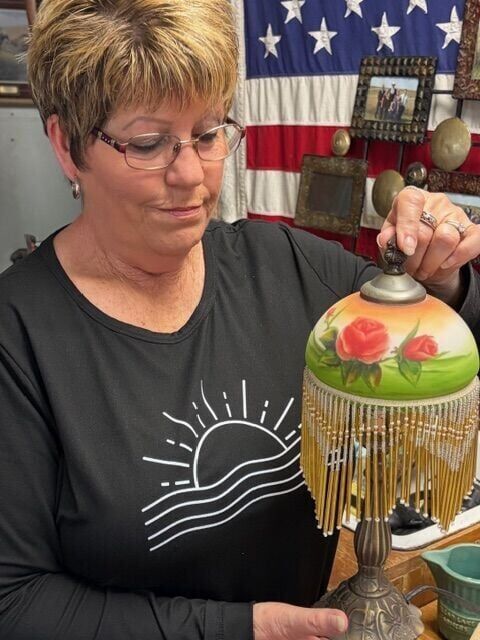
Sherry Bramer shows an antique lamp, one of many antiques they own. Their large collection includes old jars, Southwestern Indian dolls and pottery.
Five nights a week, from 11 p.m. to 8 a.m., Bramer worked at the Gibbon packing plant.
“I sorted and weighed cattle and cleaned the pens. Some days I’d go in at 3 p.m., work a double shift, and come home at 8 a.m. I made $6 an hour, but this was 1988, so I was making some big money. That helped pay the electric bill,” he said.
Bramer also farmed and helped neighbors as he and Sherry nurtured their fledgling auction business.
“Every Saturday, we’d haul stuff in. If people called, we’d go get it. I loaded an old upright piano into a trailer by myself,” Bramer said.
“A man called and said he had an old upright freezer that still runs, so my dad came to help me load it into the trailer. Dad was in his late 80s. He was on one end, and he let loose of the cart and that freezer chased me all the way to the basement,” he said.
Slowly, the business grew. Eventually, the Bramers were doing 56 auctions a year, sometimes two a week. One Saturday, they started an auction outside of town at 9 a.m., got done at 4, jumped in the pickup and came to Amherst for the auction there.
Still going strong
The Bramers run their business in the sunroom at the back of their house in Amherst, where they've lived for the past decade. They had an office in Kearney, but they closed it during the COVID-19 pandemic six years ago.
Bramer isn’t surprised at the popularity of his auctions. People are always waiting when doors open at 8 a.m.
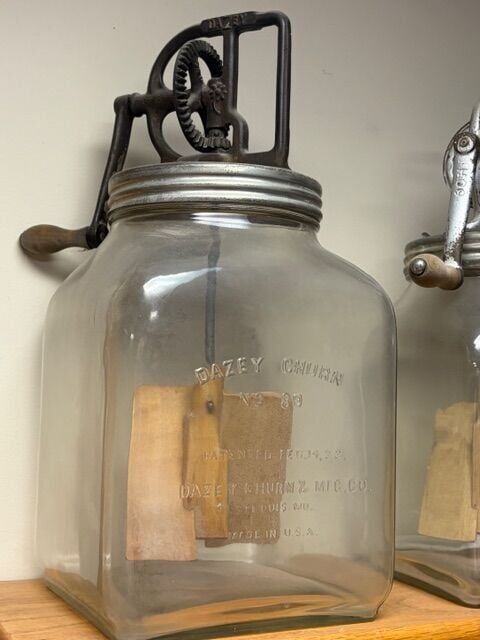
Old jars like this appeal to many people who come to the Bramer auctions.
Small items sell pretty well, “but bigger stuff is hard to sell, like a nice china hutch. It used to be that people wanted oak tables with six matching chairs, but not now,” Sherry said.
She added that people under 40 don’t want antiques. “They just buy new stuff,” she said.
Auctions will taper off a bit as summer approaches. “In the winter, people get cabin fever, and an auction is a sociable event, especially if you have good food,” Bramer said. “But in June, July and August, people want to be outside.”
The Bramers freely say they’ve had heavenly help with their business, especially with the Lois Jurgens crock. “The good Lord had lots to do with that,” he said. “We’ll give Him all the praise and all the glory. If God used us as the tool to help Lois, I’m glad.”