

Nebraska artist's bronze bison stop in Lincoln before permanent post in Washington, D.C.
Awestruck eyes gazed upon a flatbed truck mounted with 5,000 pounds of bronze bison Saturday at Morrill Hall.
The three larger-than-life animals, coming from a Colorado foundry, stopped in Lincoln on the drive toward their permanent home, where they will flank the entrance to the Smithsonian's National Museum of Natural History in Washington, D.C.
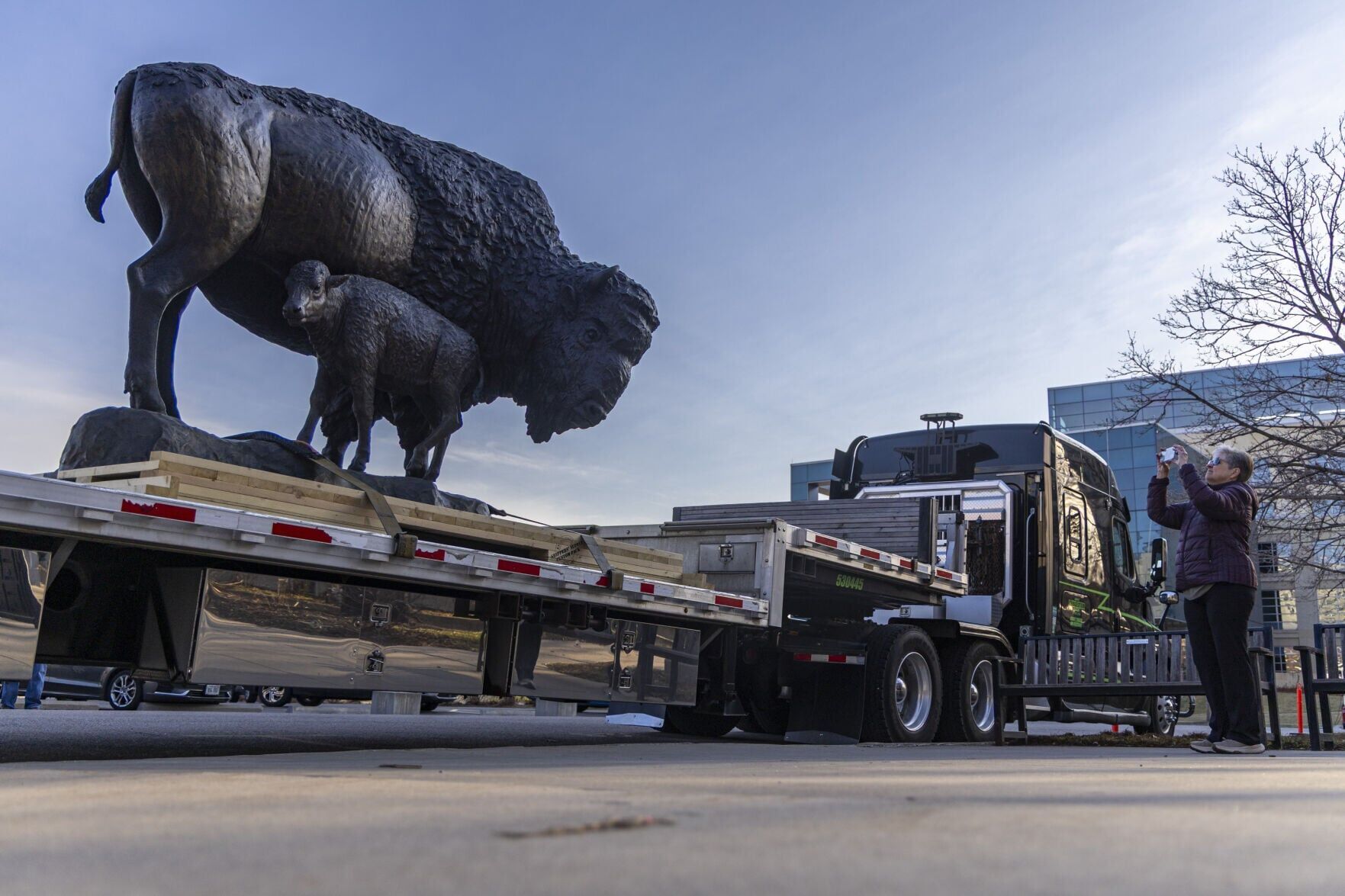
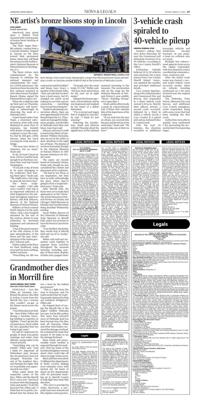
Doris Rempe, from Grand Island, photographs a larger-than-life bronze bison statue perched atop a trailer on Saturday outside of Morrill Hall at the University of Nebraska-Lincoln. The bronze statues are part of the Smithsonian National Museum of Natural History’s new “Bison: Standing Strong,” exhibit. The bison are making stops across the U.S. on the way to their new home out the Smithsonian's National Museum of Natural History in Washington, D.C. Rempe, an English teacher at Grand Island Central Catholic, taught the artist, Gary Staab, when he was in high school. “It is truly amazing — I’m looking forward to seeing this when I go out to Washington, D.C.,” she said.
The bison statues were commissioned by the museum to celebrate the national mammal and commemorate the country’s 250th anniversary. The American bison became the first national mammal in 2016 when former President Barack Obama signed the National Bison Legacy Act.
When the sculptures take up their post on Thursday, museumgoers will knowingly or unknowingly be observing the work of a Nebraska artist.
Grand Island native Gary Staab, a renowned natural history artist with work displayed in more than 50 museums, has traveled with dozens of large animal sculptures across the country, but he still gets a little nervous when the truck carrying his work reaches a bridge.
“We have four inches of clearance, but no more,” Staab said.
So far, he hasn't faced an issue. Drivers could be lucky enough to see the bison continue their road trip toward Washington.
“If you put a tarp, it tends to be more damaging to the sculptures than leaving them open,” Staab said. “We might have a few bugs to clean off, but that's fine.”
The bison sculptures' roughly 1,780-mile cross-country road trip is an important reflection of what happened to the animals throughout America's history, said Kirk Johnson, director of the National Museum of Natural History.
Millions of bison roamed North America in the early 1800s. Only a few hundred remained by the end of the century, driven to near extinction by westward expansion and commercial hunting.
“One of the great traumas of the 19th century is the near extermination of the bison and the near extermination of the Native peoples,” Johnson said.
Natives relied on the bison for their livelihood, using every part for food, clothing, shelter and more.
“Everything we did was centered around the buffalo,” said Renee Sans Souci, a member of the Omaha Tribe. “Now, not only that we don't have a food source, but it's changed our entire social makeup in our tribe and our connection — everything that we had been living by.”
Thanks to pioneering conservation efforts, there are now approximately 500,000 bison living in the U.S. Thousands are managed by Indigenous peoples, and all tribes in Nebraska have their own bison, Sans Souci said.
Johnson said much credit is owed to the efforts of taxidermist William Hornaday, who set out in the 1880s to draw attention to the rapid loss of bison. The display of six bison Hornaday brought to the National Museum of Natural History in 1887 became references for Staab's work.
The poses are loosely based on Hornaday's bison, Staab said, though he also considered the context and placement of his sculptures.
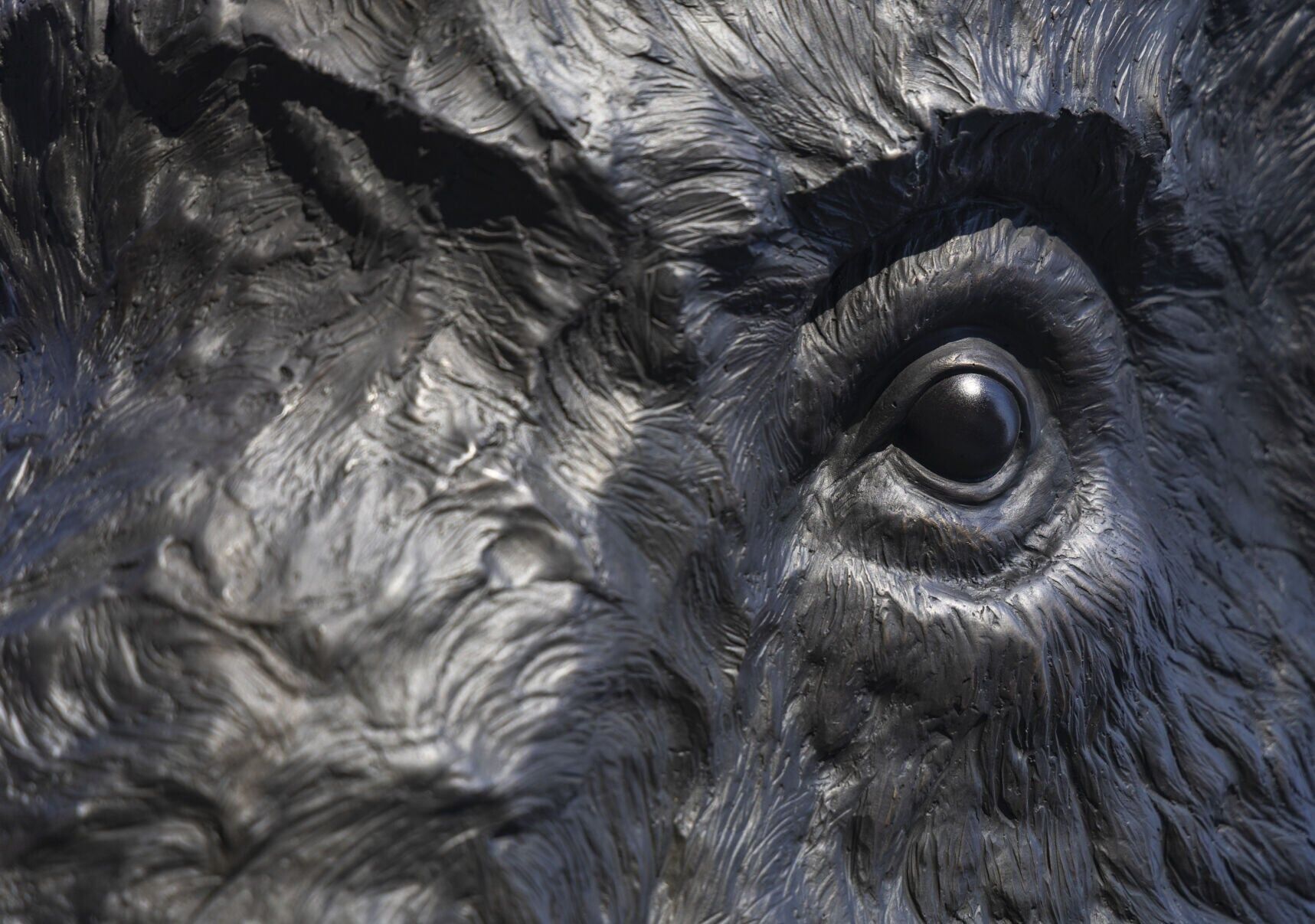
The bison statues brought to Morrill Hall at the University of Nebraska-Lincoln on Saturday had lifelike details.
“We had to use those as our inspiration, but then have to really acknowledge the place where they're going to sit for a couple hundred years,” Staab said.
After Morrill Hall, the bison were set to make final appearances at the University of Iowa Museum of Natural History on Sunday and Chicago's Field Museum on Monday and Tuesday before being installed Wednesday evening.
Susan Welter, director of the University of Nebraska State Museum at Morrill Hall, said it was an honor to have the bison in Lincoln for a day.
“I was thrilled, absolutely, they would stop at Morrill Hall and say hi to Archie,” she said.
Welter said staff and volunteers came together to organize bison activities throughout the museum Saturday, including samples of bison meat, displays of hides and a puppet show.
“If people miss the event today, it's OK,” Welter said. “We have more about bison for the next six to eight weeks.”
Taking in the bronze spectacle, Steven Bohnet said he was impressed and inspired by the talent of a fellow Nebraskan.
“I'm so proud and happy that it stopped in Lincoln,” he said. “I think it's just amazing.”
Following the installation, Staab and Johnson will talk Thursday about the significance of the national mammal returning to the museum. The conversation will set the stage for the National Museum of Natural History's new exhibit, “Bison: Standing Strong”, set to open May 7.
Staab said he often recalls a quote by conservationist Dan O'Brien that reminds him of the importance of his sculptures.
“If you look into the eyes of a bison, you can look into the past and the future at the same time,” Staab said. “We need to take care of what we have.”

Reach the writer at 402-473-7326 or lziskey@journalstar.com.