![]()
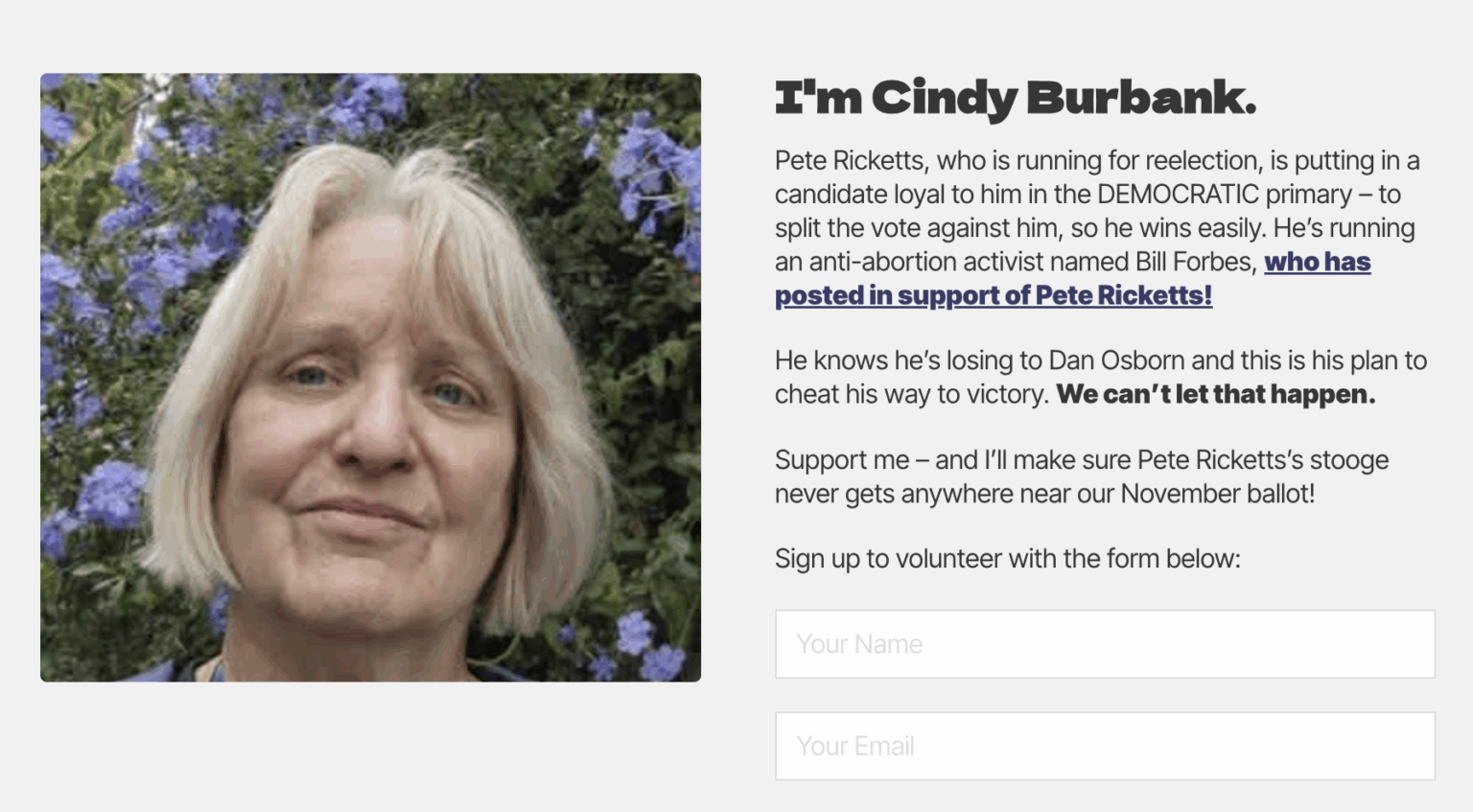
A screenshot of Cindy Burbank’s campaign website on March 3.
The Nebraska Supreme Court on Monday said a Nebraska woman removed from the primary ballot as a candidate for the U.S. Senate should be placed back on the ballot.
The decision reversed a district judge's decision last week Tuesday in Cindy Burbank's case. She sued Secretary of State Bob Evnen after he deemed her a "plant candidate" and said he wouldn't certify her.
Burbank, a Democrat, has said she entered the race in an effort to prevent William Forbes, who she considers to be a sham candidate, from siphoning opposition votes from Dan Osborn, an independent candidate whom she supports and whom the Nebraska Democratic Party has endorsed.
Osborn's name will not appear on the primary ballot since he's an independent candidate. He has to petition to appear on the general election ballot in November.
Burbank said she believes Forbes entered the race as a Democrat, as a plant by the incumbent, Sen. Pete Ricketts, to split the vote against him.
![]()
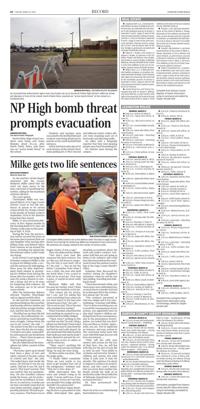
Cindy Burbank
Courtesy photo
The Nebraska Republican Party objected to Burbank appearing on the ballot, saying she was expected to bow out of the race to support Osborn if she won the primary.
But the party missed the deadline for challenges.
Evnen denied the objection a week ago based on timing, but he removed Burbank on his own authority, finding that she has no intention of holding the office but instead entered the race to "divert votes and confuse voters."
The move prompted Burbank's lawsuit and an emergency hearing last week, where her attorney, Jacob Shelly, argued Evnen had no authority to unilaterally pick and choose which candidates can run.
By statute, candidate forms shall be deemed valid unless objections are made in writing within seven days of the filing deadline.
He said Burbank satisfies the qualifications set by the U.S. Constitution to hold the office and should be on the ballot. She is over 30, has been a U.S. citizen for more than nine years and is a Nebraska resident.
Nebraska Solicitor General Cody Barnett, who represents Evnen, called it a case about election integrity.
"In short, Nebraska law requires candidates to be legitimate, and Cindy Burbank is not a legitimate candidate," he said.
District Judge John Colborn ultimately dismissed the case, saying Burbank hadn't carried her burden of proof for a peremptory writ of mandamus.
Burbank appealed.
On Monday, the Nebraska Supreme Court reversed the judgment and sent the case back to district court, directing the judge to order the Secretary of State to certify Burbank as a Democratic Party candidate for the U.S. Senate for the primary election on May 12.
In response, Democratic Party chair Jane Kleeb said: "Republicans are so afraid of voters that they’d rather fight in courtrooms than compete at the ballot box. They went after two Democrats: a law enforcement veteran (Mark Martinez) and a Senate candidate. Both are back on the ballot."
She said Nebraska Republicans should focus on earning votes, not erasing them.
The Nebraska Attorney General's Office, which represented Evnen in the case, argued that the appeal was moot because Evnen already certified the ballot last Thursday.
Evnen contended it resulted in a change of circumstances that effectively prevented the Supreme Court from putting Burbank on the ballot.
In a per curiam decision, the Supreme Court disagreed, saying they knew of "no legal or practical barrier that would prevent the Secretary from recertifying the primary ballot to list Burbank as a candidate."
"Furthermore, at this stage, no statutory deadline has passed that would arguably preclude the Secretary from recertifying the primary election ballot," the opinion said.
The statutory deadline is 5 p.m. Monday, March 23.
The court said Evnen didn't contend that Burbank’s candidate filing form was incomplete or untimely.
Instead, his letter shows that the reason he refused to certify Burbank as a candidate was his conclusion, based on public statements by Burbank and others about her intentions in running for U.S. Senate, that the oath Burbank swore to "serve if elected" lacked veracity.
Even if Evnen can make such a decision on his own authority, which the court didn't address, the court concluded that all objections are subject to a strict seven-day deadline, including the secretary's.
By statute, once the deadline has passed without a written objection, the candidate filing form is conclusively "deemed to be valid," and the secretary has a ministerial duty to certify it, the court said.
"On this record, we conclude the Secretary had a ministerial, nondiscretionary duty to include Burbank’s name as a Democratic Party candidate for U.S. Senate when certifying the 2026 primary election ballot," the opinion said.