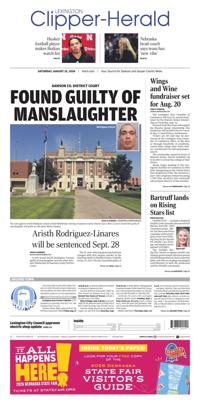

Aristh Rodriguez-Linares found guilty of manslaughter Wednesday in Dawson County District Court (copy)

The case against Aristh Rodriguez-Linares closed Wednesday evening in Dawson County District Court after 12 jurors found him guilty of manslaughter and guilty on two other felony charges.
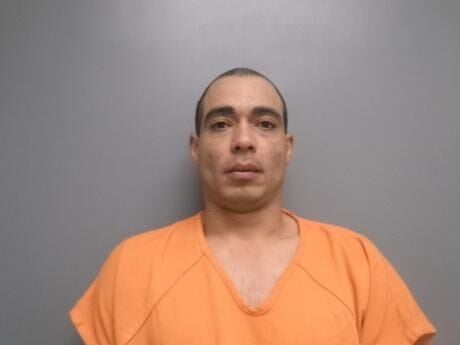
Rodriguez-Linares
A jury found Aristh Rodriguez-Linares guilty of manslaughter and two other felonies Wednesday in Dawson County District Court.
The 35-year-old Lexington man had been charged with first-degree murder in the shooting death of Maykel Farinas Carballo on Jan. 21, 2025. The jury found him guilty of a lesser charge, as allowable under Nebraska statute.
Rodriguez-Linares was also found guilty of use of a firearm to commit a felony, a Class 1C felony; and unlawful/intentional discharge of a firearm, a Class 1D felony.
Sentencing by District Judge Chawnta M. Durham is set for 10:30 a.m. Monday, Sept. 28.
CLOSING ARGUMENTS
The jurors heard closing arguments Wednesday morning before deliberation began.
State Assistant Attorney General Sandra Allen took the floor, providing statements that the state proved beyond a reasonable doubt that Rodriguez-Linares killed Carballo with malice and pre-mediation.
“Rodriguez-Linares left the safety of his home with a gun,” Allen said. “He could of called the police if he felt threatened.”
“This never needed to happen,” she added.
Allen raised a question to the jury, “Is it self-defense to fire 11 rounds into a vehicle?”
Allen walked the jury through key points witnesses made that contradicted Rodriguez-Linares account of Jan. 21, 2025, stating he did not tell officers he was injured after being struck by the Monte Carlo and he did not tell officers that it was Carballo that showed up to his house the night of Jan. 2, 2025, after calling 911.
She further told the jury that the analysis provided by Sgt. Dion Neumiller proved that it was unlikely Rodriguez-Linares fired his gun from a seated position.
“He’s making up a story to claim self-defense,” Allen said.
Allen told the jurors to think about Rodriguez-Linares testifying that he said it was a short amount of time between the last call he received from Carballo and the knock on the door Jan. 21.
She said there was 39 seconds between the last call and the first shot heard on the surveillance video camera audio from the office of Willow Ridge Trailer Court.
“There was no time for a discussion with Carballo, bang his fist on the his car, get in the car, put his seatbelt on and drive forward before Rodriguez-Linares fired the first shot.
“Mr. Rodriguez-Linares walked out of his residence and started firing,” Allen said. “That proves beyond a reasonable doubt that Rodriguez-Linares committed first-degree murder.”
Allen finished, saying, “It didn’t have to happen. He didn’t even have to be outside, and he needs to be held accountable.”
David Tarrell, defense attorney, then provided his closing argument, highlighting that Rodriguez-Linares did not want Carballo at his house the night of shooting, and all the threats Carballo sent to Rodriguez-Linares.
Tarrell told the jury to remember that the Monte Carlo was in drive and doors locked. “Why would he put the car in drive? … to drive forward and hit Aristh.”
He said there were problems in the investigation, that Carballo was angry, high and wanted to harm Rodriguez-Linares, that Carballo’s wife testified that she didn’t know her husband did drugs, and that Rodriguez-Linares sent only one text response to Carballo on that night.
“This is not a game. This is not a contest to win. The stakes are high for my client,” Tarrell said.
Tarrell said that when humans are in danger “we worry only about our survival. We don’t always have a clear memory.”
He said that Rodriguez-Linares was only trying to go back into his home.
Tarrell asked the jury to find his client not guilty on all the charges. “Let him go. Let him go where he was trying to go that night. To his home,” Tarrell finished.
Allen provided a brief rebuttal, stating that Carballo was leaving after Rodriguez-Linares wasn’t responding, but pulled back into the driveway after Rodriguez-Linares went outside, and that’s why the car was in drive.
She reminded the jury that Rodriguez-Linares put in a request nearly two months after the shooting, where he told doctors he was hit by a car before being in jail.
Allen said that there was only one minute between the last gun and the time the police were called before playing the video of the gunshots being recorded from the camera of the trailer court office.
“Are those the gunshots?” Allen finished.
RODRIGUEZ-LINARES TESTIMONY
In lengthy testimony Monday, Rodriguez-Linares took the stand.
With the state resting its case Friday, Aug. 7 and Dawson County District Judge Chawnta M. Durham denying a motion to dismiss, Tarrell immediately called Rodriguez-Linares to the stand.
In his questioning of Rodriguez-Linares, Tarrell often asked about what he characterized as Carballo’s violent past and their contentious relationship.
Fearing that the Cuban government was following him, Rodriguez-Linares fled to New Jersey then Florida, he said in testimony. There he bought a gun “for protection.”
Tarrell asked, “Did you buy the gun to harm someone?” Rodriguez-Linares answered, “No. Never.” Tarrell further asked if Rodriguez-Linares had a criminal record, to which Rodriguez-Linares said, “No.”
Rodriguez-Linares soon brought his family to Lexington to work for Tyson, where he told jurors he met Carballo, later becoming friends. Rodriguez-Linares later began distancing himself from Carballo after Carballo continued to threaten him.
It was revealed on three separate occasions that Rodriguez-Linares recalled where Carballo had threatened him, one time at a farm where Carballo pointed a rifle at him while they were there slaughtering pigs for New Years, a second time where Carballo claimed that he kidnapped Rodriguez-Linares’ mom and stepdad while Rodriguez-Linares was traveling back to Lexington with his wife and son, and a third time when Carballo came to his home at 75 Cypress Lane with another man.
Rodriguez-Linares said that after the third incident, he tried to keep his distance from Carballo. “Did Mykal respect that distance?” Tarrell asked. “No, he did not listen to me,” Rodriguez-Linares answered.
On the night of the shooting, Rodriguez-Linares said that Carballo started texting him that he was coming over to his house to sell him something, but he didn’t know what. Rodriguez-Linares stated that Carballo showed up irritated that he hadn’t responded to him.
Rodriguez-Linares testified that he told his wife to stay in their bedroom before he picked up his gun and went outside to see what Carballo wanted. Outside, Carballo asked Rodriguez-Linares why he wasn’t answering him and asked him to help him out, saying, “Man, throw me a life line. I have tennis shoes and a watch to sell.” Rodriguez-Linares told him he didn’t have money.
Rodriguez-Linares said that upset Carballo then Carballo hit the hood of his car twice with his hands. After that, Rodriguez-Linares said he stepped back and took out his gun. “I had it down in my hand. I told him again to leave my house.” Rodriguez-Linares added that Carballo was acting like he was going to come at him.
Upon further questioning, Rodriguez-Linares testified that Carballo got in his Monte Carlo and as Rodriguez-Linares was walking away, Carballo appeared to put the car in gear. Rodriguez-Linares testified that Carballo then drove forward and hit him with the passenger side of the car.
Tarrell asked Rodriguez-Linares what the Monte Carlo was doing after he was on the ground. “Slowly coming at my legs,” he said. Tarrell questioned was Rodriguez-Linares mind clear or in a panic. “Panicked,” Rodriguez-Linares said.
Rodriguez-Linares said that’s when he began shooting. Upon the last shot, Rodriguez-Linares said that the car stopped moving. He testified that he got up and went inside where he yelled out to his wife to call the cops.
Tarrell questioned Rodriguez-Linares about not telling the police about his injuries, of which he stated that he didn’t speak English. It was revealed that over a month later, he was seen for his injuries while in jail. Tarrell asked him why it look so long. “It took me a long time to relay to the officers and doctor that I was hurt,” he said.
Tarrell asked Rodriguez-Linares if he went outside wanting to kill Carballo. “No. I went out there to get him to leave my house.”
“Why did you shoot Mykal?” Tarrell’s final question to Rodriguez-Linares.
“I was scared for my life,” Rodriguez-Linares said.
In the state’s cross of Rodriguez-Linares, Allen questioned Rodriguez-Linares on why he continued to communicate with Carballo if he was continually threatening him. “I was scared of him,” Rodriguez said.
Allen also brought into question why Rodriguez-Linares called the police the night Carballo showed up to his house with another man on Jan. 2, 2025, but didn’t call the police the night of the shooting. “I didn’t have time,” Rodriguez-Linares said. Allen revealed that a message from Carballo read, “I’ve been here for half an hour,” asking why that wasn’t enough time to call the police.
Rodriguez-Linares was questioned by Allen on the events that occurred once Rodriguez-Linares went outside to confront Carballo. Rodriguez-Linares testified that Carballo got into his vehicle, put his seatbelt on and plugged his phone in.
Allen then questioned what happened once Rodriguez-Linares started to walk back across the front of the vehicle. “How do you describe his acceleration?” she asked. “He just sped up and hit me with the car,” Rodriguez-Linares answered.
Allen brought into question that Rodriguez-Linares testified to saying that he did not tell the officers he was hurt because he didn’t speak English. “But officer Perdomo was there. And he speaks Spanish,” Allen said. “Yes,” Rodriguez-Linares said.
Rodriguez-Linares was questioned about his actions during the shooting after Allen asked, “He hits you then you turn and point your gun?” Rodriguez-Linares said, “No, I just shot.”
Allen questioned him if he got up from the ground once he started shooting, of which Rodriguez-Linares said he shot from sitting on the ground.
TUESDAY TESTIMONIES
As the case against Aristh Rodriguez-Linares resumed Tuesday, the defendant was back on the stand questioned by Tarrell in a re-direct.
In the re-direct, Tarrell asked several clarifying questions from Rodriguez-Linares’ Monday testimony about the Jan. 21 incident. Rodriguez-Linares testified that he did not believe that Carballo was at his house until he heard a loud bang on his front door.
Allen asked Rodriguez-Linares questions about a medical request he submitted March 1, 2025, where he asked to see a skin doctor, in her re-cross examination before the witness was excused from the stand.
The state called Nemesys Solemzal-Veloz, Carballo’s wife, to the stand. Allen questioned Solemzal-Veloz on how she knew Rodriguez-Linares and what happened the night they were all at a pig farm.
Solemzal-Veloz testified that she never left the pig farm that night, though Rodriguez-Linares testified that she left with his truck and returned after a couple hours. Allen raised questions about her observations of the behavior between Carballo and Rodriguez-Linares and if there were any tensions between the two. “No, everything was fine,” Solemzal-Veloz said.
Solemzal-Veloz later testified that she never saw Carballo point a rifle at Rodriguez-Linares at the pig farm. She also testified that after they left the pig farm, they returned to Rodriguez-Linares’ home at 75 Cypress, where they stayed to eat until approximately 3-4 a.m.
Tarrell delivered cross-examination questions of Solemzal-Veloz, questioning the rocky relationship between her and Carballo. Solemzal-Veloz testified that Carballo would occasionally sleep at other people’s homes when they were in a disagreement.
Tarrell questioned Solemzal-Veloz about the night her, Carballo and Rodriguez-Linares were at a pig farm on Dec. 30, 2024, asking if she ever left to do laundry, of which she said, “No.”
Solemzal-Veloz was questioned on her knowledge of Carballo using drugs, including marijuana, meth and cocaine. She answered all the questions the same, “No, I did not know,” adding that drugs were not allowed in her home with her three sons.
She testified that she did not see or speak to Carballo at all on the day of Jan. 21, 2025. Solemzal-Veloz said that Carballo was at their home, but she was at work from 1:30 to 11 p.m. “But you did not see him that day at all?” Tarrell questioned. “Correct,” Solemzal-Veloz said.
Allen proceeded with a re-direct of Solemzal-Veloz, questioning when and how old she was when she first met Carballo in Cuba, and if Carballo ever acted violent or aggressive toward her during their disagreements.
Tarrell brought into question if Solemzal-Veloz knew that Carballo was in prison while in Cuba. “I have no idea about that,” Solemzal-Veloz said. She testified that she had moved to the U.S. in 2003, and lost contact with Carballo before reconnecting when he later moved to the U.S.
After a short recess, the state then re-called Sgt. Edwin Perdomo to the stand. Perdomo, upon questioning, testified that on the night of Jan. 21, 2025, Rodriguez-Linares did not appear injured at his home or while being processed at the Lexington Police Department.
Perdomo testified that he also responded to an incident on Jan. 2, 2025, to 75 Cypress Lane, when Rodriguez-Linares had called. He recalled that Rodriguez-Linares did not tell him specifically who came to the house or that one of the men had a knife on him. “There was not a lot to go off of,” Perdomo said.
Tarrell questioned Perdomo during cross examination about the Jan. 2 call to Rodriguez-Linares’ home, asking if he received a request from the state to preserve the body cam footage from that night, of which Perdomo said he did not.
The state also re-called Sgt. Dion Neumiller to the stand to testify on additional analysis from Monday and Tuesday morning. Neumiller was called to complete scale diagrams at 75 Cypress Lane.
Neumiller told the jurors that he used a 5-foot-9-inch avatar, a representation of the height of Rodriguez-Linares, to recreate the scene where Rodriguez-Linares testified he was hit by the car and projected forward to the porch of his home.
Neumiller told the jurors that with the avatar in a seated position on the ground, the travel patterns of the bullets were “inconsistent with a downward trajectory.” Neumiller added that the shooter would have had to clear the hood of the Monte Carlo. “I can’t say its impossible, but its improbable,” he said.
Allen called into question where the bullet casings were found scattered around, and if Neumiller believed that the shooter could be seated, “No, ma’am,” he answered.
Tarrell questioned Neumiller during cross-exam, asking if on his new analysis, if he could tell if the shooter was changing directions, of which he answered “no.”
Neumiller was also questioned on the angle the gun was held, if he could tell the stance of the shooter and if the bullet trajectory could have been from the shooter swinging his arm.
Allen questioned Neumiller in re-direct about the grouping of bullets on the windshield of the Monte Carlo, and how those were possible. “It was obvious aim,” Neumiller said. He added that the shots were towards the driver of the vehicle.
Tarrell asked Neumiller in re-cross, if the shell casing location could be pretty much anywhere. “Correct,” Neumiller said.